ADAGuard
ADAGuard scans behind logins and tells you what it can't automate—real WCAG coverage, no overlay tricks.
NewName Editorial
Editorial Team

The accessibility compliance market has a dirty secret: most automated scanners quietly overstate their coverage, and overlay widgets promise fixes they never deliver. ADAGuard enters this landscape with a contrarian bet—that honesty about automation limits, plus the ability to scan pages behind login walls, is a stronger selling point than claiming near-total compliance. The company's public materials show a tool that doesn't just scan more criteria than competitors; it openly publishes which 12 WCAG success criteria it cannot automate and why. That transparency, combined with a Playwright-powered engine that renders JavaScript and authenticates into dashboards, positions ADAGuard less as a quick-fix widget and more as a litigation-risk management tool for teams that need evidence of good-faith remediation.
The 22% Gap No Other Scanner Admits
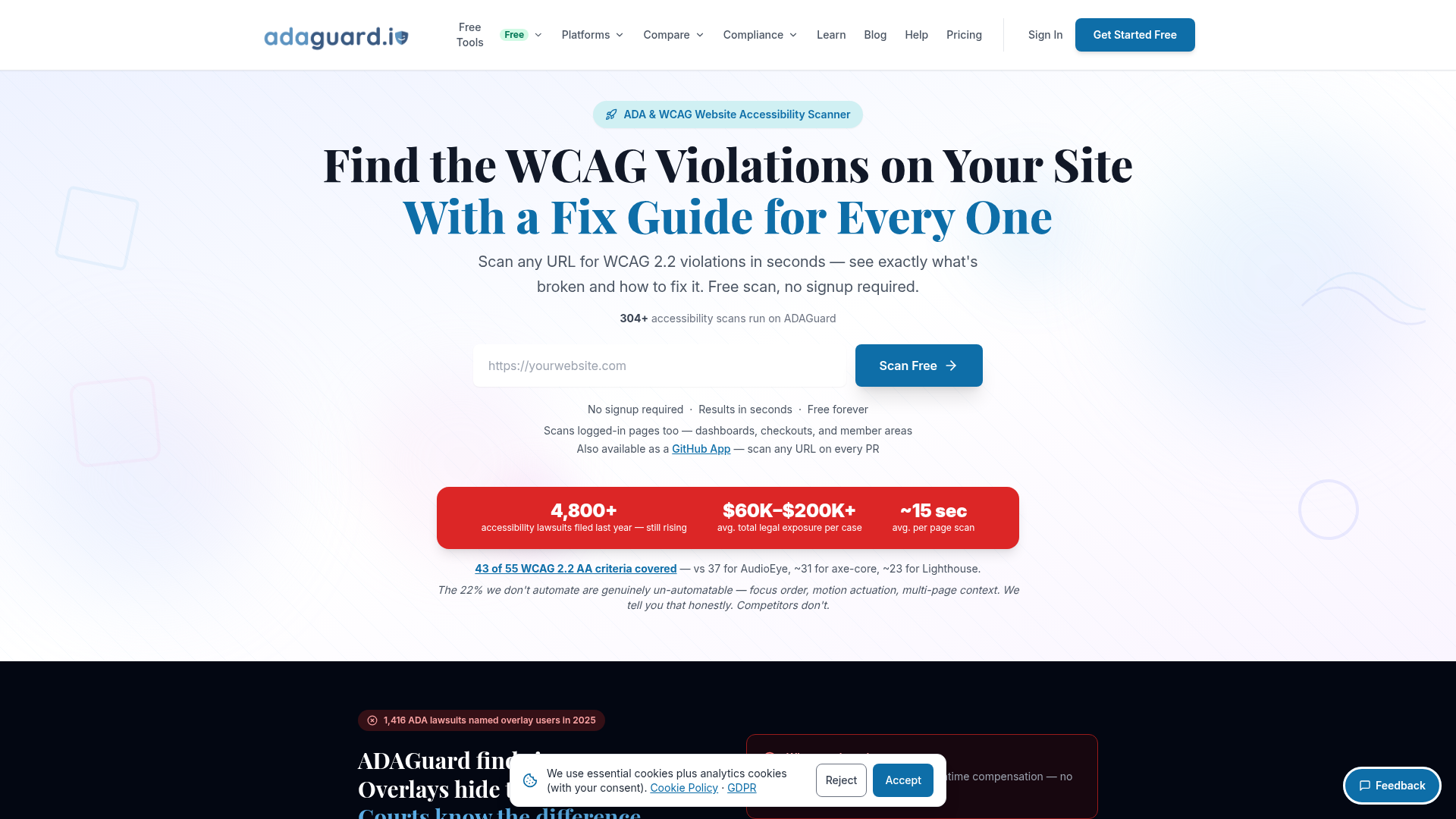
ADAGuard's homepage leads with a number most competitors would bury: it covers 43 of 55 WCAG 2.2 Level A and AA success criteria, which it claims is more than AudioEye (37), axe-core (~31), and Lighthouse (~23). But the more striking admission is the flip side—the 12 criteria it does not automate. Focus order, motion actuation, and multi-page context are, as the site puts it, "genuinely un-automatable" by any tool. Where competitors pretend this gap doesn't exist, ADAGuard publishes a criterion-by-criterion breakdown and explains why those checks need human review.
This is a strategic risk. Admitting limits could undermine confidence in the product, but ADAGuard frames it as a feature: honesty is what makes its reports credible in court. For a buyer facing a demand letter, a report that claims 100% automation is a liability; one that says "we automated everything possible and here's what needs a human" is evidence of good faith. The company's willingness to name the gap—and to name competitors' numbers—signals a confidence that its technical coverage is genuinely best-in-class.
Why Authenticated Crawling Is the Real Moat
Most accessibility scanners only see public pages. ADAGuard's standout feature is its authenticated crawl engine: users can log in once, and the scanner will crawl dashboards, member portals, and checkout flows—the pages where critical user journeys live and where many accessibility failures hide. The site claims this is "unique to ADAGuard," and while that's a strong word, the capability is rare in a category that typically relies on unauthenticated spiders.
The technical implication is significant. Authenticated crawling requires handling session state, cookies, and JavaScript-heavy single-page apps. ADAGuard's use of Playwright, a browser automation framework, suggests it renders pages in a real browser environment, executing JavaScript and CSS rather than parsing raw HTML. The homepage even notes it calls focus() on every interactive element to catch issues static scanners miss. For SaaS companies and e-commerce sites where the most important flows are behind login, this is the difference between a compliance theater and a real audit.
The Overlay Backlash and the Case for Evidence
The accessibility widget industry has been under fire. The site cites FTC action against an overlay vendor for false claims, and notes that 1,416 ADA lawsuits in 2025 targeted sites already running an overlay. ADAGuard's positioning is explicitly anti-overlay: "Overlay widgets inject JavaScript that attempts to compensate for accessibility failures at runtime—without ever fixing your code." Instead, it argues, courts want "evidence of genuine remediation: fixed code, documented testing, ongoing monitoring."
ADAGuard is a scanner, not a fixer. It doesn't claim to make your site compliant; it shows you what's broken and how to fix it. That's a deliberate contrast to the overlay model, which promises compliance with a line of code. The company's pitch is that its reports—with specific elements, code examples, and fix guidance—provide the paper trail that holds up in litigation. In a market where fear is the primary driver, ADAGuard is selling not just detection but defensibility.
One Scan, Six Legal Regimes
ADAGuard's compliance coverage is a key part of its value proposition. The site lists six standards checked in a single scan: WCAG 2.2, ADA Title III, European Accessibility Act (EAA), Section 508, EN 301 549, and AODA. For a US-based company with European customers, the EAA is a growing concern—enforced since June 2025, with fines up to €900,000 in the Netherlands or 10% of turnover. ADAGuard's ability to check all these in one pass, without extra configuration, simplifies a complex legal landscape.
The company also publishes specific, citable numbers: 4,800+ ADA lawsuits last year, $60K–$200K+ average legal exposure per case, and $100K/day maximum fines under AODA. These figures are sourced from public data and give the tool a sense of urgency. For agencies managing multiple client sites, the ability to generate compliance certificates and VPAT documents—required for federal procurement—turns ADAGuard from a dev tool into a business asset.
The Playwright Engine and the 15-Second Page
Under the hood, ADAGuard uses a custom Python/Playwright engine with axe-core 4.7.2. It runs 100+ automated rules across 19 checker categories, and claims 74% WCAG 2.1 & 2.2 AA coverage. The parallel scan engine processes 100 pages in about 3 minutes, or roughly 15 seconds per page. That speed is a practical advantage: a full site audit that might take hours of manual testing finishes in minutes.
The choice of Playwright is notable. Unlike lightweight HTTP-based scanners, Playwright runs a real browser, so it sees what users see—including dynamic content and client-side rendering. This is essential for modern web apps built with React or similar frameworks, which is why ADAGuard offers platform-specific checkers for Shopify, WordPress, React, and SaaS. The engine's ability to call focus() on elements is a clever trick to catch focus-order issues, though the site admits some of those still need human review.
What ADAGuard's Honesty Costs and Buys
ADAGuard's transparency about its limits is a double-edged sword. On one hand, it builds trust and differentiates the product from competitors that overclaim. On the other, it invites scrutiny: if you admit you can't automate 12 criteria, why should a buyer trust your automated results on the other 43? The company's answer is that it publishes its methodology and offers a free scan, letting users judge for themselves.
The free tier is a smart entry point: no signup required for a first scan, with paid plans starting at $49/month. That's low enough for a single developer to try, while the white-label reports and API access (with OpenAPI spec and RapidAPI listing) appeal to agencies and enterprises. The GitHub App integration, which scans every pull request, positions ADAGuard as a developer tool that catches accessibility regressions early.
In a market where fear of lawsuits drives purchasing, ADAGuard's bet is that buyers are tired of snake oil and want a tool that tells the truth—even when the truth is inconvenient. Whether that bet pays off depends on whether its coverage claims hold up under independent audit, but the company's willingness to publish its numbers and admit its gaps is a refreshing change in a category known for vague promises.