Adoptly
Lightweight in-app announcements that turn updates into adoption, without the enterprise bloat.
NewName Editorial
Editorial Team


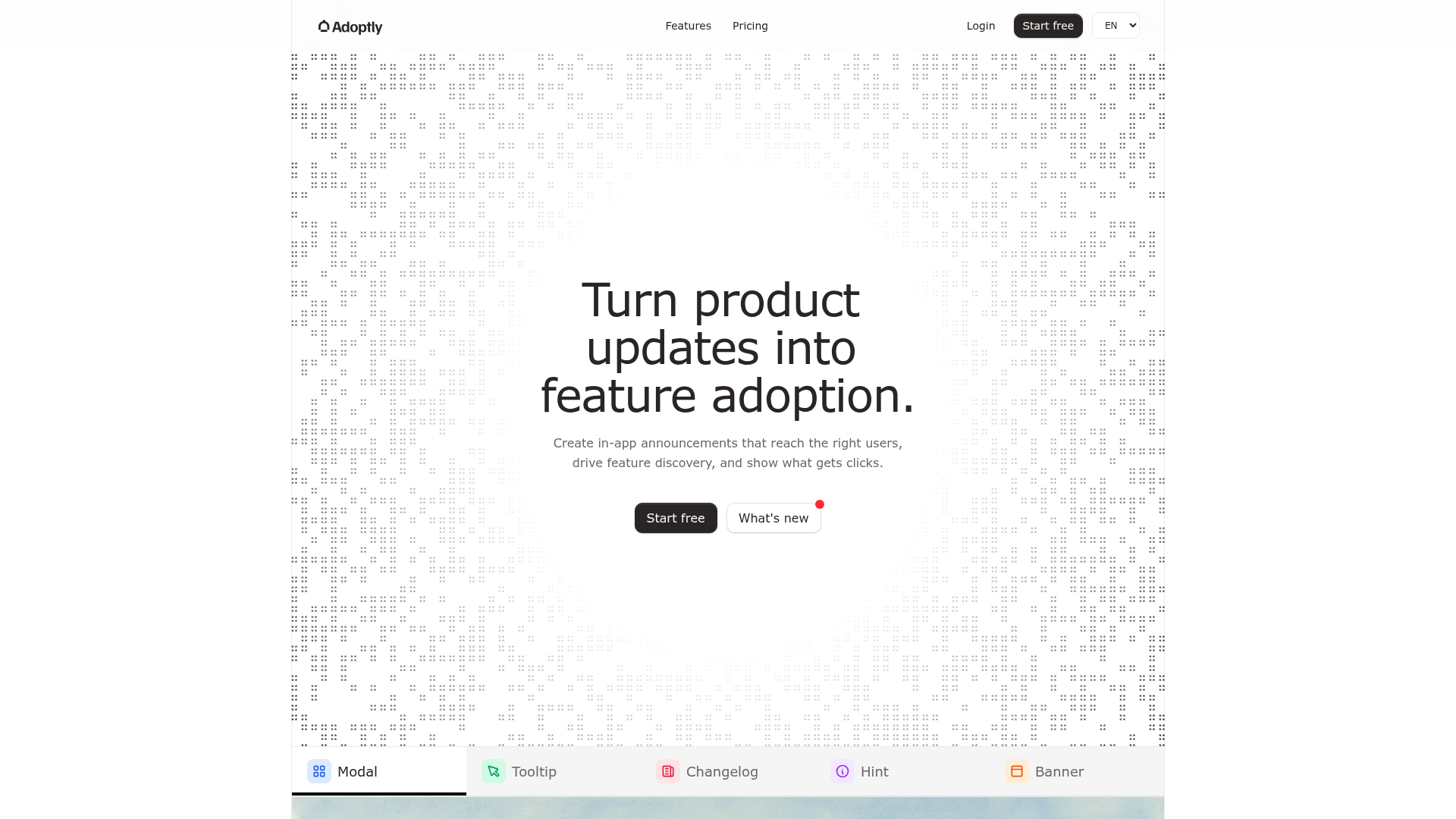
Most SaaS teams don't have an announcement problem. They have an announcement-platform problem. The tools that promise to drive feature adoption often arrive with a month of integration work, a six-figure contract, and a widget that feels like it was bolted onto the product by a different company. Adoptly, a newer entrant in the in-app messaging space, is making the opposite bet: that the future of product communication is lightweight, affordable, and native-feeling. Its tagline—"Turn product updates into feature adoption"—signals a focus not on flashy campaigns but on the quiet, everyday job of telling users what changed and why it matters.
The cost trap of heavyweight announcement platforms
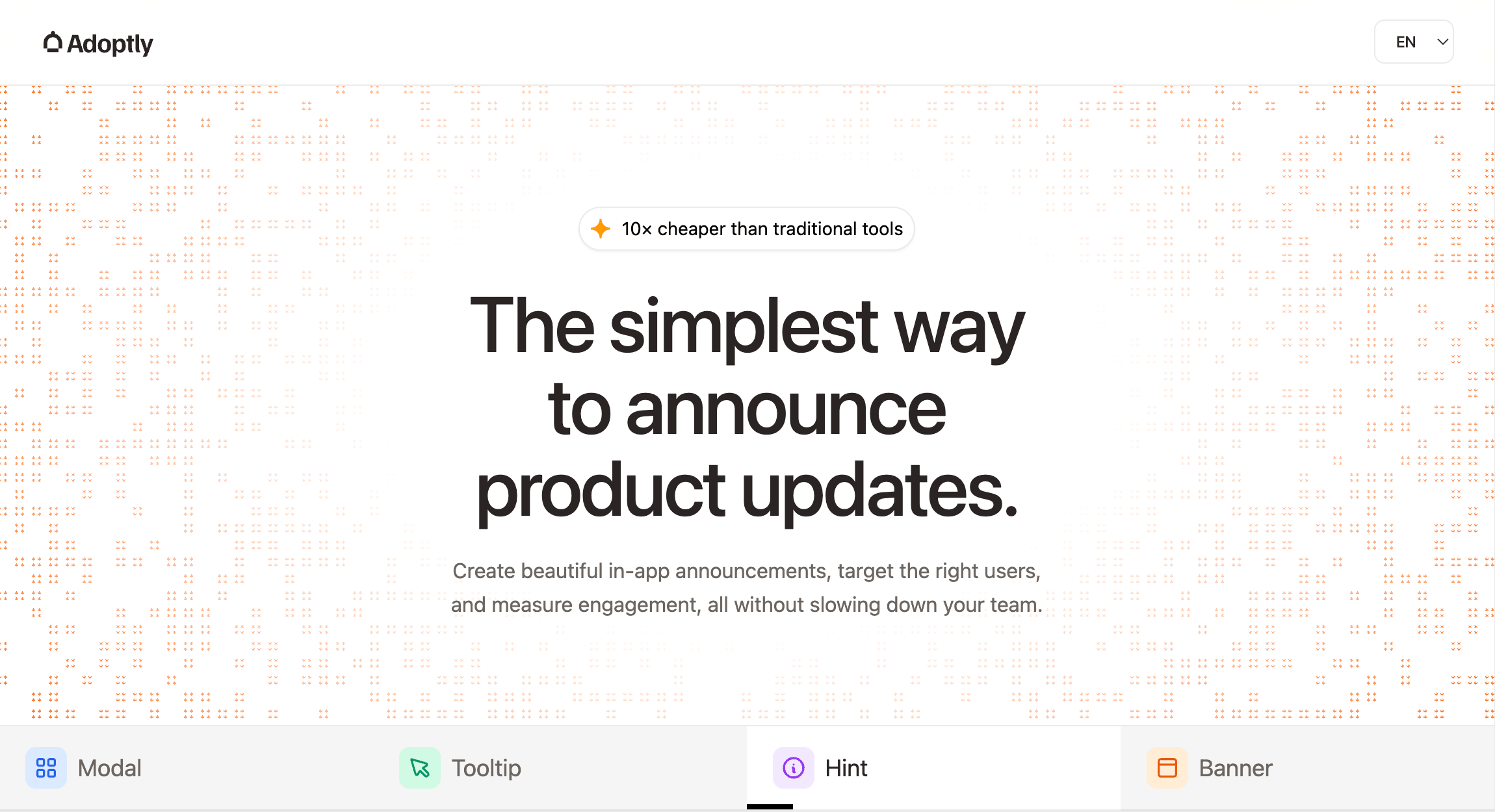
The in-app messaging category has a well-documented pattern: tools start simple, then accumulate features—journey builders, A/B testing, multi-channel orchestration—until they require a dedicated team to operate. For a SaaS startup, the overhead is often disproportionate to the need. Adoptly's positioning directly targets this pain. The product description emphasizes "affordable and lightweight," and the website copy reinforces the message: "Product and marketing teams design, update, and publish messages themselves. Engineering stays focused on the product." This is a clear jab at the enterprise platforms that demand engineering resources for every campaign. Adoptly's promise is that a product manager can create a modal or a banner in minutes, without writing code or opening a ticket. The pricing page is not detailed in the provided materials, but the tagline's emphasis on affordability suggests a deliberate contrast with the per-month costs of tools like Appcues or Pendo, which often scale with monthly active users and can quickly become prohibitive for early-stage companies.
What 'native-feeling' actually means in practice
A common complaint about in-app widgets is that they look like third-party add-ons—clashing with the host product's design language and breaking the user's immersion. Adoptly's answer is granular control over visual details. The website shows a style editor with fields for background color, border radius, border width, and layout properties like width, height, and padding. This is not just cosmetic; it's a functional requirement. An announcement that matches the product's existing UI is more likely to be perceived as a natural part of the experience, not an interruption. Adoptly's examples—a modal announcing "Enable team notifications," a banner about a "Platform slowdown," and a hint for an AI Agent—all appear in the product's own interface, reinforcing the idea that announcements should feel like they belong. The copy on the site puts it bluntly: "Create announcements that match your product, not widgets bolted on top." This is a strong differentiator in a market where many tools offer only basic theming.
Targeting logic: the difference between noise and signal
The most dangerous failure mode for in-app announcements is irrelevance. A user who sees a message about a feature they don't care about will quickly learn to ignore all messages. Adoptly's targeting capabilities are designed to prevent that. The website shows conditions such as audience (e.g., "Paid plan"), page (e.g., contains "/pricing/**"), trigger (e.g., "onPageView"), device, date, tag, and language. This allows teams to show a modal only to users on a paid plan who visit the pricing page, or to display a hint only to desktop users after a certain date. The logic is straightforward, but it's the kind of precision that separates a thoughtful announcement from a blast. Adoptly also includes an "Audience is not" condition, enabling exclusions like "Trial ended"—so you don't nag users who have already churned. This level of control, combined with the no-code interface, means that even non-technical team members can segment their audience without relying on engineering.
The changelog as a bridge between marketing and product
Beyond one-off announcements, Adoptly offers a changelog feature. A changelog is a persistent, often public-facing list of updates, and it serves a dual purpose: it keeps existing users informed and acts as a subtle marketing asset for prospects evaluating the product. The website lists "What's new" as one of the announcement types, alongside modal, tooltip, hint, and banner. This suggests that Adoptly views the changelog not as an afterthought but as a core component of the product communication toolkit. For SaaS teams, a well-maintained changelog can reduce support tickets and increase user trust. Adoptly's approach—making it as easy to publish a changelog entry as it is to create a modal—could be a key advantage for teams that want to maintain a consistent communication cadence without dedicating a resource to it.
Why the name 'Adoptly' carries the whole thesis
The name "Adoptly" is a portmanteau of "adopt" and the suffix "-ly," which is a common pattern for SaaS brands (e.g., Shortly, Bufferly). It directly references the core metric the product aims to improve: feature adoption. This is a smart naming choice because it aligns the brand with the outcome, not the mechanism. The domain, useadoptly.com, is clean and memorable, though it's a longer URL than some competitors might have. The name also avoids the generic "announce" or "notify" terms that would position the product as just another messaging tool. Instead, it signals a focus on user behavior change—a more ambitious and valuable promise. The brand's visual identity, as seen in the website's clean, modern design, reinforces this focus on simplicity and clarity.
Open questions: where lightweight meets its limits
Adoptly's lightweight approach is a clear strength, but it also raises questions. The website does not disclose details about pricing tiers, which is a common gap for early-stage products. More importantly, the targeting and analytics features, while solid for basic needs, may not scale to the complexity required by larger enterprises. For example, the targeting conditions shown are all rule-based; there's no mention of user cohorts, behavioral events, or integration with a customer data platform. As a company grows, it may need more sophisticated segmentation, which could push it toward a heavier platform. Adoptly's challenge will be to maintain its simplicity while adding enough depth to retain customers as they scale. The public materials do not mention any integrations with other tools, which could be a limitation for teams that want to sync announcement data with their analytics or CRM. However, for early-stage SaaS teams that want to ship in-app messages quickly and affordably, Adoptly's value proposition is compelling. It's a tool that respects the user's attention and the team's budget, and that's a rare combination in a category often defined by over-engineering.