Impact-Site-Verification: 41b53a0c-6d04-458b-a457-fe9e29acde1a

Other··6 min read

AgentLens

A review platform for AI agents, aiming to be the trust layer in a hype-driven market.

NN

NewName Editorial

Editorial Team

AgentLens product image 1
AgentLens product image 2
AgentLens product image 3

The AI agent market has a credibility problem. Every week, a new autonomous tool launches with bold claims of handling customer support, writing code, or closing sales. Marketing pages promise the world; real-world performance often delivers less. In this environment, buyers face a dangerous information gap: how do you know which agent actually works before you invest weeks of integration time?

AgentLens, a review platform that launched in early access, is betting that the answer is structured, verified feedback from real users. The site's tagline — "Find AI Agents You Can Trust" — is a direct challenge to the affiliate-marketing listicles and vendor hype that dominate the category. But building trust in a market defined by rapid iteration and inflated expectations is a different beast than reviewing, say, a CRM. This article examines how AgentLens is approaching that challenge, where its model shows promise, and where the cracks are most likely to appear.

The Trust Gap in the Agent Economy

The core problem AgentLens addresses is not a lack of information about AI agents — it's a lack of trustworthy information. The site's about page puts it bluntly: "Most 'best AI agent' lists are written by affiliate marketers chasing commissions, not practitioners who've shipped with the tools." That's a real pain point. When a new agent like OpenClaw — an open-source autonomous agent that surpassed 100k GitHub stars within weeks — appears, early adopters have little to go on beyond GitHub metrics and hype. AgentLens wants to fill that void with reviews from "engineers, marketers, support leads, founders, and analysts" who actually use these tools day to day.

The stakes are high. Choosing the wrong agent can cost weeks of integration work, blow budgets, and erode team trust. AgentLens's mission is to bring "transparency and accountability" to a market where marketing claims are bold and verification is scarce. That's a compelling value proposition — if the platform can deliver on it.

What a 'Lens' Actually Sees: Verification Mechanics

AgentLens's approach to trust rests on two pillars: verified user reviews and AI-assisted assessments. The verification part is straightforward — every reviewer must confirm their email before posting, and the site claims to reject paid placements and sponsored rankings. This is standard practice for review platforms, but it's a necessary baseline.

The more interesting piece is the "AI Score" that appears alongside user ratings. For example, Intercom's Fin, a customer support agent, shows a 9.7/10 AI Score, while Clay's Claygent scores 9.3/10. The about page explains that these scores are based on "documentation, ease of setup, feature maturity, integrations, pricing transparency, and vendor accountability." This is a structured, multi-dimensional assessment — a more systematic approach than a simple star rating.

However, the methodology behind these scores is not publicly detailed. How exactly does the AI arrive at a 9.7 versus a 9.3? What data does it use? Without transparency, the AI Score risks becoming another opaque metric in a market already full of them. The site's editorial independence policy is a good start, but for a platform whose entire value proposition is trust, clarity on scoring criteria will be essential.

Categories as a Promise: Marketing, Support, Coding, and Beyond

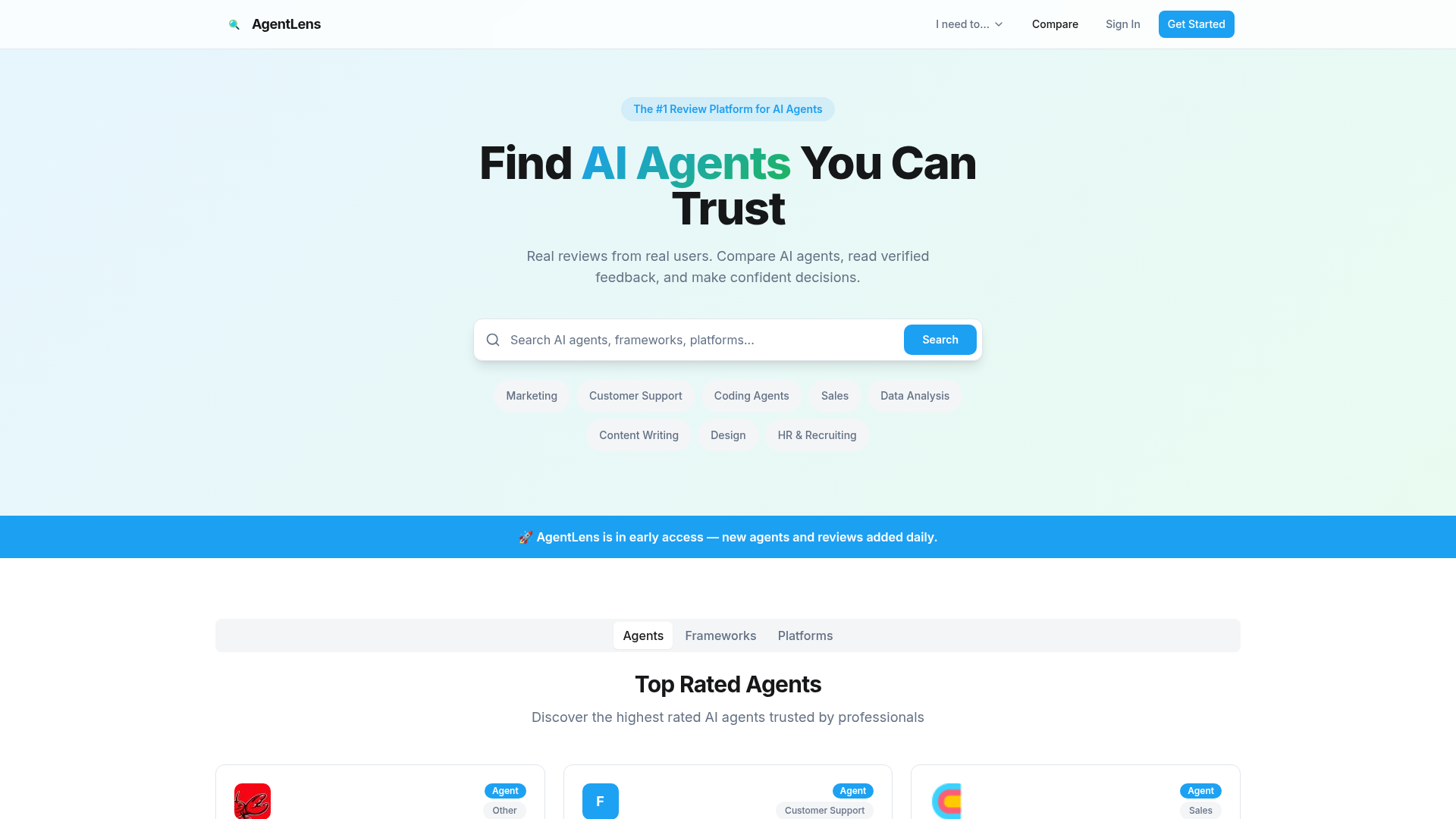
AgentLens organizes its listings into categories: Marketing, Customer Support, Coding Agents, Sales, Data Analysis, Content Writing, Design, and HR & Recruiting. This is a smart move — it mirrors how buyers actually think about agents, by the job they need done. The homepage even starts with an "I need to..." prompt, letting users select their goal before seeing agents.

This category structure is more than a navigation aid; it's a promise of relevance. A marketing lead doesn't care about a coding agent's features; they want to know which tool will write better copy or generate leads. By segmenting the market, AgentLens positions itself as a practical decision-making tool, not just a directory.

But the categories also reveal the platform's early-stage nature. The top-rated agents list includes a mix of well-known names like Intercom's Fin and HubSpot's Customer Agent, alongside newer entries like OpenClaw and Gumloop's Meeting Prep Agent. The review counts are sparse — OpenClaw has a single 5-star review, while others show only AI Scores without visible user reviews. This is a chicken-and-egg problem: buyers want reviews, but reviewers need an audience. The site is clearly in its early days, and the depth of coverage will determine whether it becomes a go-to resource or a ghost town.

The Cold-Start Problem No Review Site Escapes

Every review platform faces the cold-start problem, but AgentLens's challenge is uniquely acute. The AI agent market moves at breakneck speed — new tools launch weekly, and existing ones update constantly. A review written three months ago may be outdated. This creates a maintenance burden that traditional software review sites don't face. A CRM's core features change slowly; an AI agent's behavior can shift with a single model update.

AgentLens's answer is to combine user reviews with AI assessments, which can be updated more frequently. But the site is still dependent on a critical mass of active reviewers. The "early access" banner and the promise that "new agents and reviews are added daily" suggest the team is actively seeding content, but the long-term health of the platform depends on organic participation.

There's also the question of incentive. Why would a user take time to write a review? AgentLens offers a community and the satisfaction of helping others, but that may not be enough. The site encourages builders to "collect authentic reviews" and "build trust," which gives vendors a reason to push their users toward the platform. That could drive volume, but it also risks attracting promotional reviews rather than honest ones. The editorial independence policy is a safeguard, but enforcement will be key.

Naming as Positioning: Why 'Lens' Beats 'Review'

The name "AgentLens" is a deliberate choice. It doesn't say "AgentReviews" or "AgentCompare" — it says "Lens," implying a tool for seeing clearly. This is smart positioning. A lens focuses, clarifies, and reveals what's otherwise invisible. In a market clouded by hype, AgentLens wants to be the instrument that cuts through the fog.

The name also suggests a broader ambition than just reviews. A lens is something you look through, not just a list you read. It hints at analysis, insight, and a deeper understanding of the agent landscape. The site's blog reinforces this, with articles on enterprise evaluation frameworks and agent observability — content that positions AgentLens as a thought leader, not just a rating site.

The domain, theagentlens.com, is clean and memorable, though the "the" prefix is a minor stumble. Still, the name is distinctive and category-relevant, which is more than many AI tools can claim. It signals clarity and trust — exactly what the platform needs to build.

What AgentLens Still Needs to Prove

AgentLens has a clear thesis and a solid foundation, but it faces significant hurdles. First, it needs to achieve critical mass — enough reviews and active users to make the platform genuinely useful. Second, it must maintain editorial independence as it grows, resisting the temptation to accept paid placements or favor vendors. Third, it needs to keep its AI assessments transparent and accurate, or risk becoming another black box.

The market is young, and AgentLens has a first-mover advantage. If it can establish itself as the trusted source for AI agent reviews, it could become an essential part of the procurement process for businesses of all sizes. But the window is narrow. Big players like G2 and Capterra are already expanding into AI tools, and specialized competitors may emerge. AgentLens's success will depend on its ability to move fast, build community, and — above all — earn the trust it promises to provide.

For now, AgentLens is worth watching. It's asking the right questions and building the right infrastructure. Whether it can turn that into a sustainable platform is an open question — but in a market that desperately needs clarity, it's a bet worth taking.