Agently
The company brain that doesn't just know — it acts, ships, and runs your stack.
NewName Editorial
Editorial Team
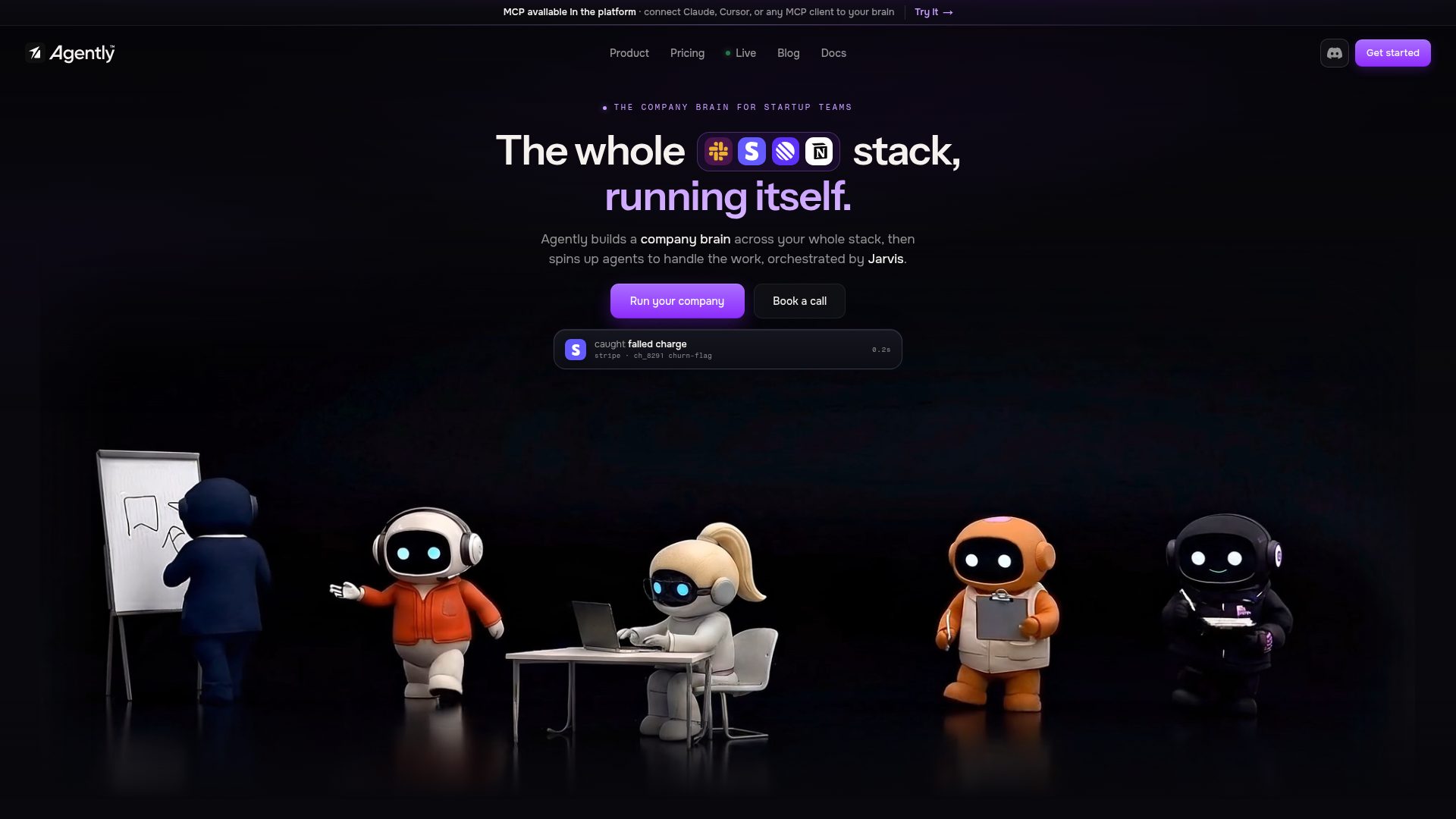
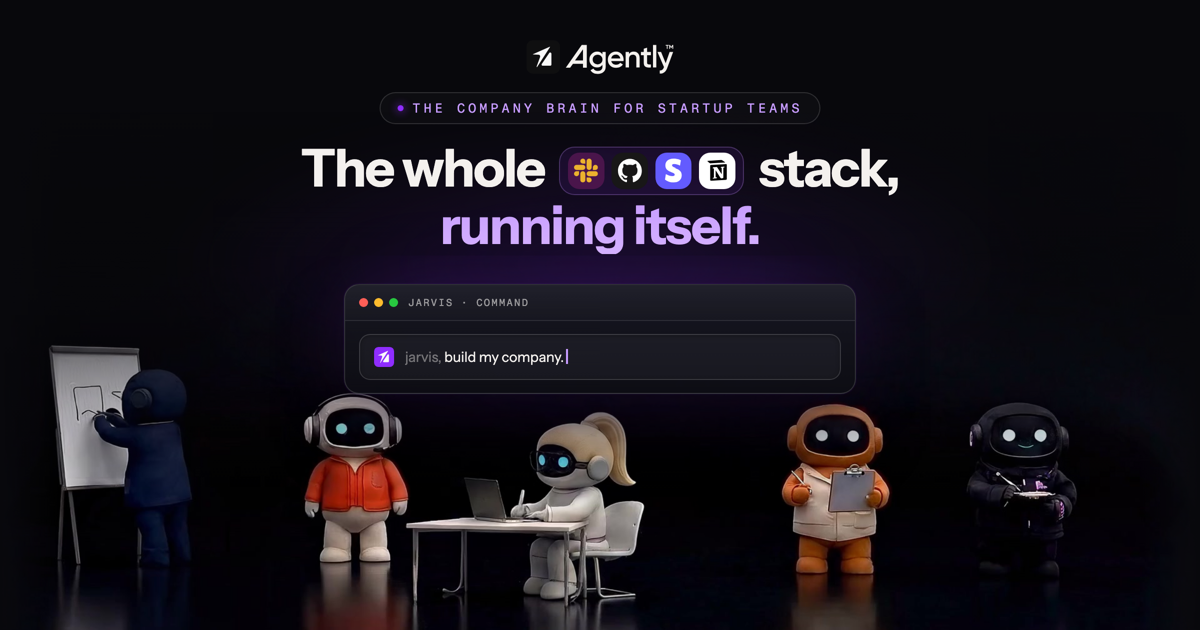
Agently is not another AI chatbot that answers questions. It's a bet that the next layer of company software is a brain that doesn't just know — it acts. The tagline, "Your whole stack, running itself," is a promise that borders on science fiction, but the product is built on a very concrete idea: connect every tool your company uses, let an AI hold that context, and when something needs doing, have an agent do it — end to end.
The name itself is a signal. "Agently" sounds like "agent" and "gently," but the product is anything but gentle. It's a company brain that spins up agents to handle work, orchestrated by a central AI called Jarvis. The name suggests a layer that's always on, always watching, and ready to act — not a tool you ask, but a system that runs.
The company brain is a new category — and a naming bet
Agently is positioning itself in a category it calls the "company brain." The website defines this as a system that "holds your whole company in context" — a temporal knowledge graph that connects events across your stack. A Stripe charge failure, a Slack thread about a worried customer, a Linear ticket that's been escalated: Agently links these on its own, so it understands the story behind your operations, not just isolated data points.
This is a deliberate contrast to tools like Glean, Notion AI, or Guru, which the site calls out as "knowledge bases" that answer questions but don't act. Agently's thesis is that the next step after AI that knows is AI that does. The name "Agently" reinforces this: it's not a place you go to look things up; it's a force that acts on your behalf. The domain, agently.dev, is clean and memorable, though the .dev TLD signals a developer-first audience, which aligns with the MCP-centric approach.
Jarvis: the orchestrator that turns context into action
At the heart of Agently is Jarvis, an orchestrator that "spins up specialized agents, routes the work, and runs the board with you." The website shows a command center where Jarvis manages tasks across different agents: Researcher, Revenue, Growth, Support, Ops, Briefer. Each agent has a role, and Jarvis decides which one handles what.
The demo is vivid: a user types "jarvis, acme's renewal looks at risk. handle it." Jarvis reads the #cx-team Slack channel, confirms the risk, and then triggers a sequence: it drafts a save email, posts a weekly brief to #leadership, updates the Linear ticket, and prepares a distribution audit. All of this happens in the background, with receipts shown in a live activity feed.
This is a significant step beyond the typical AI assistant. It's not just generating a response; it's executing a workflow across multiple tools. The orchestrator is the key differentiator — it's the "brain" that decides what needs to happen and which agent should do it. This is where Agently's ambition lies: not in building a better chatbot, but in building a system that can run operations.
MCP is the connective tissue, not another integration platform
Agently connects to over 100 tools through MCP (Model Context Protocol) connectors. This is a strategic choice. Instead of building and maintaining hundreds of native integrations, Agently leverages an emerging standard that allows AI models to access external data and tools. The site notes that MCP is available in the platform, so you can connect Claude, Cursor, or any MCP client to your company brain.
This is a smart move for a startup. It positions Agently as a layer that sits on top of your existing AI stack, not a replacement for it. The company brain becomes a shared memory that any MCP-compatible tool can read from. This is a different approach from building a walled garden — it's an attempt to become the infrastructure for AI agents across your company.
The risk is that MCP is still evolving. But by betting on it early, Agently is positioning itself as a leader in the agentic AI space, where the ability to connect and act across tools is the core value proposition.
From chat logs to shipped artifacts: the Pages philosophy
One of Agently's most interesting features is Pages. The site says: "Outputs land as real artifacts your team can ship, share, and gate. Not chat logs. Not 'ask me anything.' Real files. Real decisions." This is a crucial distinction.
Instead of just generating text in a chat window, Agently produces documents, presentations, spreadsheets, and HTML pages. The examples include a Q2 board update deck, a weekly brief, a distribution audit PDF, and a ranked lead list. These are not just AI outputs; they are work products that can be used directly.
This philosophy addresses a common pain point with AI assistants: they give you answers, but you still have to do the work of turning them into something useful. Agently aims to skip that step by generating the final artifact. This is a bold claim, but it's backed by the product's design: the agents are built to produce these outputs, and the receipts show the work happening.
The name "Pages" is a nod to the idea of a document, but it also suggests a web page — something that can be shared and accessed. It's a fitting name for a feature that turns AI output into something tangible.
The trust gap: guardrails, receipts, and the autonomy question
Agently's agents can act autonomously, but the company is careful to address the trust issue. The FAQ states: "You set the guardrails. Agents can run fully autonomously, or hold for your approval on anything that sends, pays, or posts. Every action shows up as a receipt you can audit."
This is a critical feature. The idea of an AI sending emails, updating tickets, and posting to Slack without human review is scary. Agently's answer is to give users control over the level of autonomy and to provide a transparent log of every action. The "receipts" are a clever way to build trust — you can see exactly what the agent did, when, and via which tool.
The site also emphasizes security: data is encrypted in transit and at rest, never used to train models, and kept private to your workspace. This is table stakes for enterprise adoption, but it's good to see it addressed.
The open question is whether the guardrails are enough. The demo shows a fully autonomous sequence, but in practice, will users trust it? The early adopters quoted on the site are founders and PM leads who are already running on it, which suggests a certain willingness to embrace the risk. But for broader adoption, Agently will need to prove that its agents are reliable and safe.
Who should run on Agently — and who should wait
Agently is clearly aimed at startup teams. The site says: "The autonomous company isn't a prediction, it's a deadline. Run a 500-person company with five, while your competitors still call it impossible." This is a strong pitch for founders who want to do more with less.
The pricing is designed for this audience: Plus at $29/mo, Pro at $69/mo, and Team at $199/mo, with a founding rate of $69/mo that includes all connectors and Jarvis. This is accessible for a small team, and the promise of replacing recurring meetings and manual work could justify the cost.
But who should wait? Teams that are not ready to delegate critical actions to AI, or that have highly complex, regulated workflows, may want to see more evidence of reliability. Also, teams that don't use a wide range of tools may not benefit as much from the 100+ connectors.
Agently is a bold bet on the future of work. It's not just a tool; it's a vision of how companies will operate with AI at the center. The name, the Jarvis orchestrator, and the Pages philosophy all reinforce that vision. Whether it delivers on its promise remains to be seen, but it's certainly a product to watch.