Agreena
Verra-verified soil carbon credits from Europe's largest regenerative agriculture programme.
NewName Editorial
Editorial Team
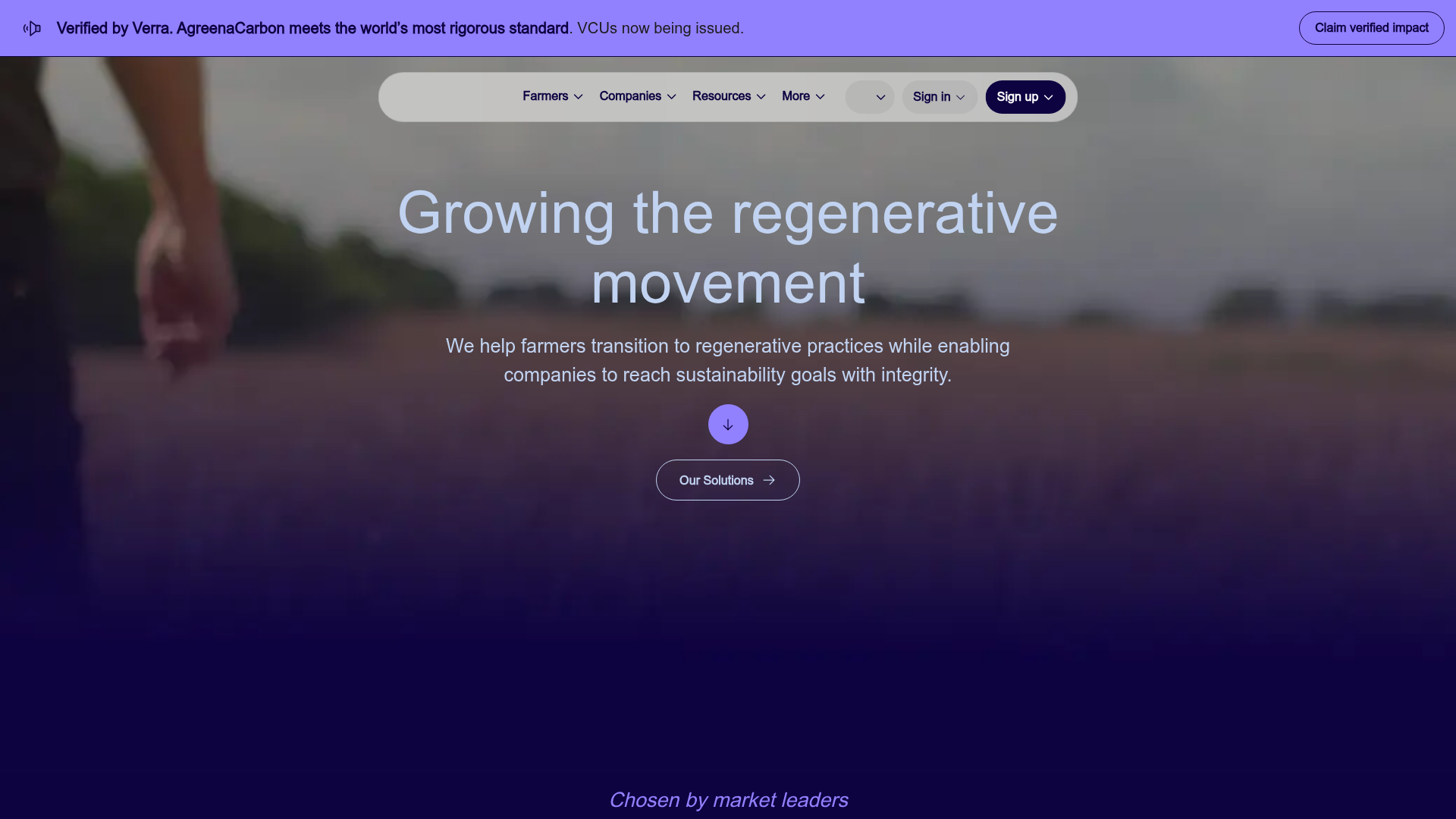

Soil carbon has long been the most talked-about and least trusted asset in the voluntary carbon market. Farmers are told their fields can sequester CO2, corporates are told they can offset Scope 3 emissions, but the market has struggled to convert that promise into verifiable, tradeable credits. Agreena, a Copenhagen-based startup, has spent years attacking this credibility gap head-on. In 2025, it achieved a landmark: the AgreenaCarbon Project became the first large-scale arable agriculture project to receive verification under Verra's Verified Carbon Standard (VCS), with VCUs now being issued. That single milestone transforms Agreena from a carbon-farming promoter into a bankable asset originator, and it reshapes the economics of regenerative agriculture across Europe.
Soil Carbon’s Credibility Gap and Agreena’s Verification Wedge
The voluntary carbon market has been plagued by scandals—from rainforest offsets that didn't actually protect trees to cookstove projects with inflated baselines. Soil carbon, in particular, has been dismissed by skeptics as too difficult to measure, too prone to reversal, and too expensive to verify at scale. Agreena's answer is to submit its entire programme to the world's most rigorous standard: Verra's VCS. The company now claims to be the first large-scale arable agriculture project to pass Verra's scrutiny, a process that took years and required rigorous scientific evidence. This is not a marketing badge; it's a structural differentiator. Verra verification means Agreena's credits are eligible for use in compliance markets and by corporates with strict sustainability reporting requirements. For buyers, this eliminates the 'trust me' problem that has plagued soil carbon. For Agreena, it creates a moat: competitors must replicate the same expensive, time-consuming verification process.
The Farmer Economics: Turning Regenerative Practices into a Paycheck
Agreena's core value proposition to farmers is simple: adopt regenerative practices—reduced tillage, cover cropping, crop rotation—and get paid for the carbon you sequester. The company's platform, AgreenaCarbon, enrolls farmers across 20 European countries, covering over 5 million hectares and 2,500+ farmers. The financial incentive is critical because the transition to regenerative agriculture often involves short-term yield risks and upfront costs. By providing a new revenue stream from carbon credits, Agreena lowers the barrier to adoption. The company also offers AgreenaGro, a platform for farm resilience that provides insights, community, and additional revenue opportunities. This dual approach—carbon payments plus agronomic support—positions Agreena as a partner in farm profitability, not just a carbon buyer. The economics are still early-stage: credit prices for soil carbon vary widely, and public materials do not disclose exact farmer payout rates. But the model is clear: farmers get paid for ecosystem services, and Agreena takes a cut for measurement, verification, and market access.
dMRV as the Scalability Engine: Satellites, AI, and Ground Truth
To make soil carbon work at scale, Agreena has built a proprietary digital Measurement, Reporting, and Verification (dMRV) stack. The company combines satellite imagery, ground truth data, and AI models aligned with IPCC methodologies to estimate soil organic carbon changes across millions of hectares. This is the technological wedge that allows Agreena to move beyond small pilot projects and aggregate carbon at a continental scale. Traditional soil sampling is expensive and slow; Agreena's approach uses remote sensing to identify management practices and model carbon sequestration, with ground-truthing to calibrate and validate. The result is a scalable, cost-efficient MRV process that can be deployed across diverse geographies and farming systems. This dMRV capability is not just an internal tool—it's a potential product in itself. Agreena could license its technology to other project developers or use it to expand into new regions, making it a foundational layer for the entire soil carbon market.
Competitive Landscape: Registries, Aggregators, and Agtech Giants
Agreena operates at the intersection of carbon markets, agtech, and sustainability consulting. Its direct competitors include other soil carbon project developers like Indigo Ag (in the US), Nori (which has pivoted), and Bayer's Carbon Programme. However, Agreena's European focus and Verra verification give it a distinct advantage in the EU market, where corporate demand for high-integrity credits is surging due to regulatory pressure like the EU's Corporate Sustainability Reporting Directive (CSRD). Agreena also competes with traditional carbon registries like Gold Standard, but it positions itself as a full-stack solution: it originates credits, verifies them, and sells them to corporates. This vertical integration is both a strength and a challenge. On one hand, it allows Agreena to control quality and capture more value. On the other hand, it creates conflicts of interest—Agreena is both the project developer and the verifier's client, which could raise questions about impartiality. To mitigate this, Agreena emphasizes third-party audits and its Verra certification, but the tension remains.
Two-Sided Market Mechanics: Farmers as Suppliers, Corporates as Buyers
Agreena's business model is a classic two-sided marketplace. On the supply side, it recruits farmers and provides them with the tools and knowledge to adopt regenerative practices. On the demand side, it sells carbon credits and supply chain solutions to corporations. The company's client list includes Radisson Hotel Group, Louis Dreyfus Company, Aalborg Airport, and ZeroMission—names that signal credibility and a focus on high-quality, European-origin credits. For corporates, Agreena offers two products: carbon credits for voluntary offsetting and supply chain solutions to reduce Scope 3 emissions. The latter is particularly compelling for food and beverage companies that need to decarbonize their agricultural supply chains. By connecting farmers directly to these corporate buyers, Agreena creates a transparent, traceable value chain. This is a significant advantage over generic carbon credit brokers, as it allows Agreena to tell a compelling story: 'Your money goes directly to European farmers transitioning to regenerative practices.' The company's go-to-market motion is still evolving, but its partnerships with travel and hospitality companies suggest a focus on sectors with high carbon footprints and strong sustainability commitments.
The Road to Global Scale: From 5 Million Hectares to 5 Billion
Agreena's stated ambition is to scale globally, and the math is compelling: there are 5 billion hectares of farmland worldwide, and if even a fraction of that land adopts regenerative practices, the carbon sequestration potential is enormous. However, scaling soil carbon faces significant hurdles. First, Verra verification is expensive and time-consuming; replicating it in new geographies will require local partnerships and regulatory alignment. Second, carbon prices for soil carbon are still volatile and often below the cost of production, making it difficult to incentivize farmers at scale. Third, the market is increasingly crowded, with major agtech players and oil companies entering the space. Agreena's path forward likely involves expanding its dMRV technology licensing, deepening its supply chain solutions for food companies, and potentially entering new markets like North America or Latin America. The company's leadership, led by CEO Simon Haldrup, is focused on 'scalable impact,' but the next 3-5 years will test whether soil carbon can truly become a mainstream asset class. Agreena's Verra verification is a critical first step, but the real challenge lies in making the economics work for farmers and buyers alike, at scale, across the globe.