Albato
Embed AI agents and 1,000+ integrations into your SaaS with Albato's white-label iPaaS.
NewName Editorial
Editorial Team
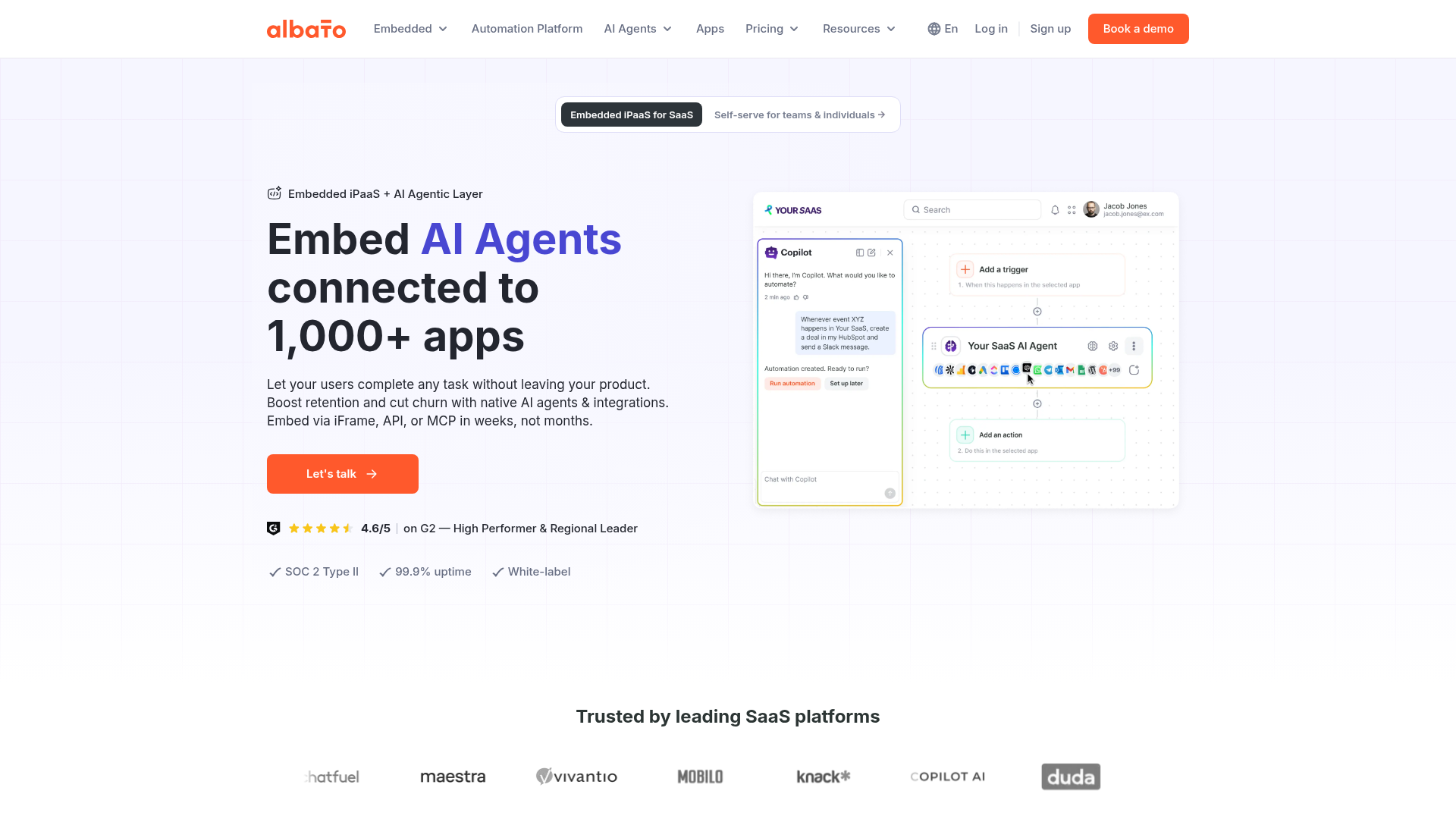
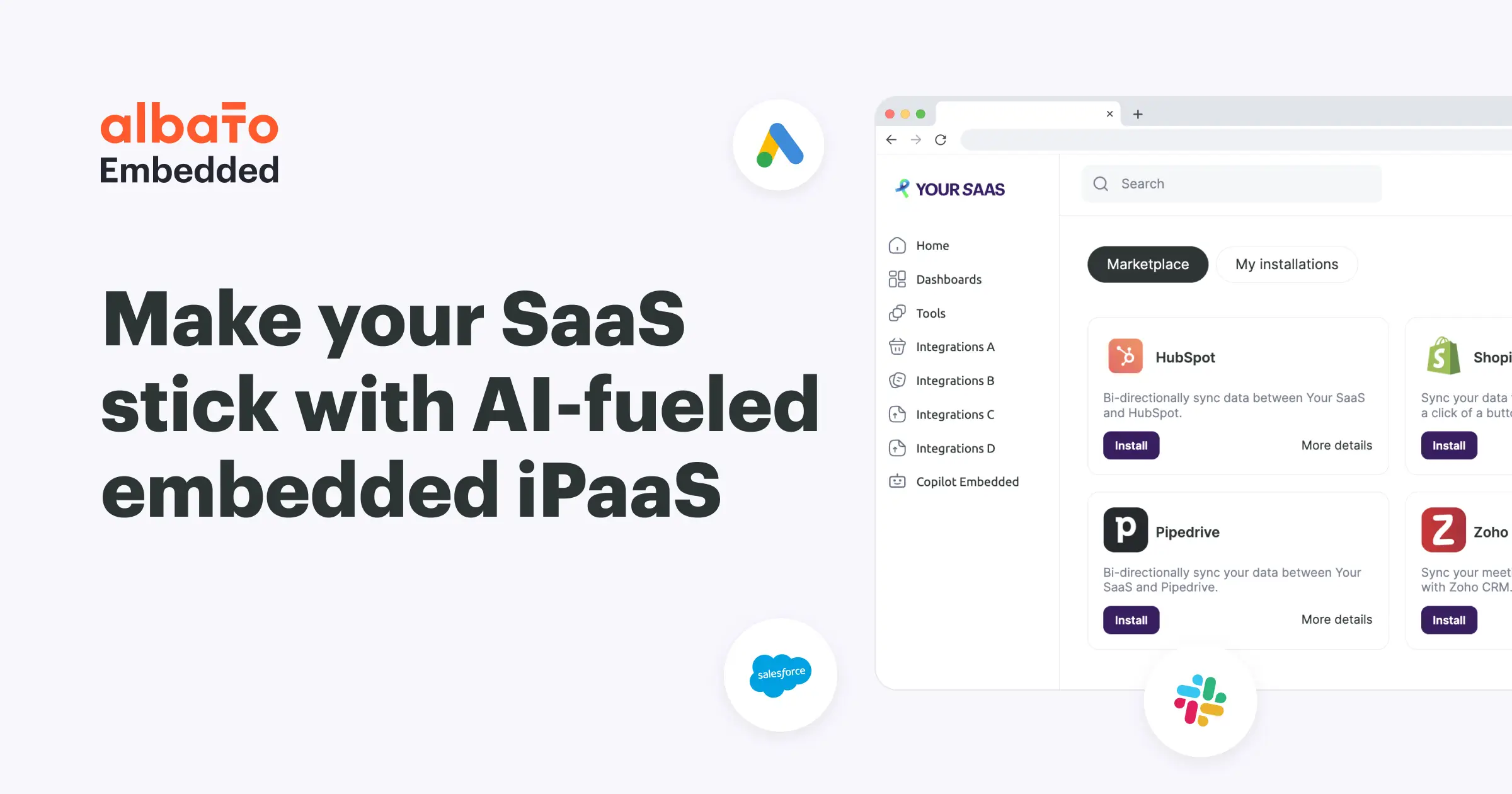
Albato started as a no-code automation platform, the kind of tool that lets a marketing ops person connect a CRM to a spreadsheet without writing a line of code. But the current homepage tells a different story. The hero section doesn't talk about workflows or triggers. It says, "Embed AI Agents connected to 1,000+ apps." The primary call-to-action is not "Sign up" but "Book a demo." This is not a subtle shift. Albato is repositioning itself as an embedded integration platform for SaaS companies, with an AI agentic layer on top. The question is whether this pivot is a genuine strategic evolution or just a rebranding of the same integration middleware that has existed for years.
The Quiet Pivot from Automation Tool to Embedded AI Layer
Albato's public materials reveal a deliberate move upmarket. The self-serve automation product still exists, but the homepage now leads with the embedded iPaaS offering. The navigation splits into two distinct tracks: one for "Individuals & Businesses" and another for "Embedded Integrations for SaaS." The embedded track is where the company is placing its bets, with dedicated pages for API methods, headless API, and an app marketplace.
The language is telling. Albato talks about "embedding AI agents" and "native integrations" inside a SaaS product, not about building automations for end users. The value proposition is no longer "automate your workflows" but "make your product AI-native." This is a classic platform shift: instead of being the tool that users log into, Albato wants to be the infrastructure that other products run on.
Two Products, One Platform: Self-Serve vs. Embedded
The dual-market strategy is explicit. Albato offers a self-serve automation platform for individuals and businesses, and a separate embedded iPaaS for SaaS companies. The pricing pages are separate, the feature sets are tailored, and the messaging is distinct. The self-serve product leans on the familiar no-code automation builder, Copilot chat, and AI Agents for complex branching logic. The embedded product, on the other hand, emphasizes white-label iFrame, Universal API, and MCP (Model Context Protocol) support.
This is a smart way to serve two very different customer profiles. A marketing manager at a small agency has different needs than a CTO at a Series B SaaS company. But it also creates a risk: maintaining two product lines with different feature sets and pricing models can dilute focus. Albato seems to be managing this by positioning the self-serve product as a lead generator for the embedded offering. A user who starts with the free tier might eventually become a champion for Albato inside their company.
The Universal MCP Pitch: One Protocol for 1,000+ Apps
Albato's most distinctive technical claim is the "Universal MCP." The idea is that instead of building separate integrations for each AI agent, you can connect all your agents to 1,000+ apps through a single protocol. The pitch to Head of AI roles is compelling: "Stop wasting tokens on brittle MCPs and bloated APIs." Albato exposes pre-built tools as functions for your model, with zero OAuth code on your side.
This is a significant departure from the traditional iPaaS model, which focuses on API connections and data mapping. MCP is an emerging standard for AI agents to interact with tools, and Albato is positioning itself as the bridge between AI models and the long tail of SaaS applications. If the promise holds, it could reduce the engineering effort required to make AI agents actually useful in production.
Why the 'AI Copilot' Is a Retention Play, Not a Feature
Albato's embedded AI copilot is not just a chatbot. It's a natural-language automation builder that lets end users describe what they want to automate, and the copilot handles the app selection, trigger setup, and field mapping. The marketing materials emphasize that this is a "self-serve" feature that reduces setup calls and support tickets. But the deeper value is retention: if your users can build integrations without leaving your product, they are less likely to churn.
The copilot is also a sales demo magnet. Albato calls it a "vibe coding" look and feel that wows prospects. In a crowded SaaS market, having an AI copilot that can actually build integrations is a differentiator. It turns a boring integration page into an interactive experience.
Security as a Sales Argument, Not Just a Requirement
Albato is not shy about its security credentials. The homepage lists SOC 2 Type II, 99.9% uptime, and AES-256 encryption at rest. For an embedded platform, this is table stakes. But Albato goes further by positioning security as a sales tool: "Meet enterprise demands for AI agents and integrations that would otherwise block larger deals." In other words, security is not just a compliance checkbox; it's a way to close enterprise deals.
The company also emphasizes governance features, such as tool-level observability and per-tenant guardrails. This is aimed at the Head of AI role, who needs to audit every AI action. In an era of AI governance concerns, this is a smart move.
The Competitive Field: Albato vs. the Incumbents
Albato's website includes comparison pages against Workato, Zapier, Prismatic, Paragon, and Tray.ai. This is a direct acknowledgment that it is competing in a crowded field. Workato and Tray.ai are established enterprise iPaaS players, while Zapier dominates the self-serve market. Prismatic and Paragon are focused on embedded integrations.
Albato's differentiation is the AI layer. While other platforms are adding AI features, Albato is making AI the core of its embedded offering. The Universal MCP is a bet that AI agents will become the primary way users interact with integrations. If that bet pays off, Albato could leapfrog the incumbents. If not, it will be just another iPaaS with a chatbot.
The evidence suggests that Albato is executing well. The Product Hunt page shows a 4.8 rating with 144 reviews, and the website claims 20,000+ active embedded users and 1B+ API calls per month. These numbers are not independently verified, but they indicate traction. The company also lists notable customers like RD Station and Chatfuel, which adds credibility.
Albato's pivot is a calculated risk. The self-serve automation market is commoditized, but the embedded AI agent market is still nascent. By positioning itself as the infrastructure for AI-native products, Albato is aiming for a future where every SaaS product has an AI agent built in. Whether that future arrives is uncertain, but Albato is positioning itself to be the plumbing underneath it.