Appaca
Describe the tool, get the tool: Appaca builds bespoke apps and agents for operators.
NewName Editorial
Editorial Team
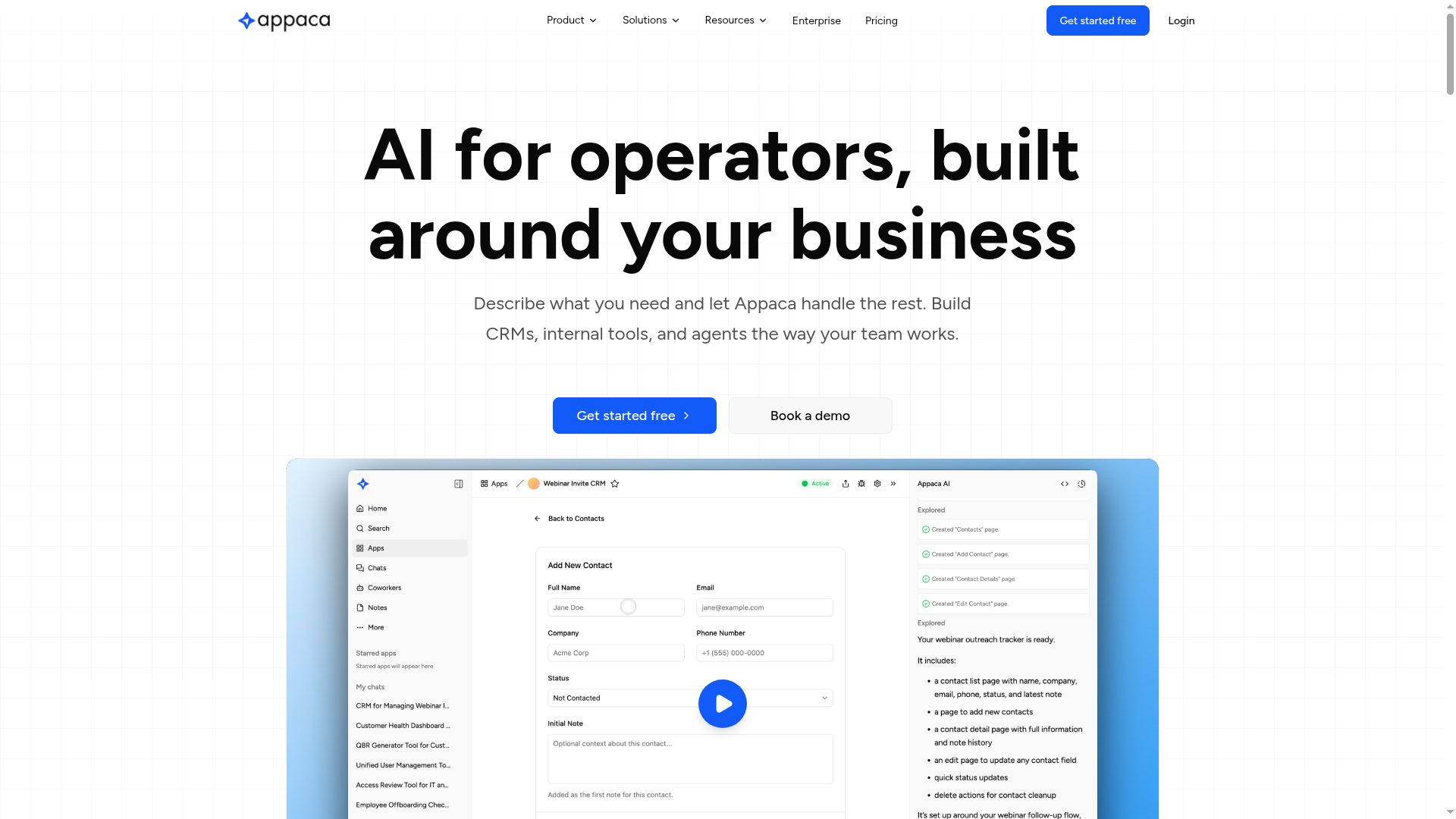
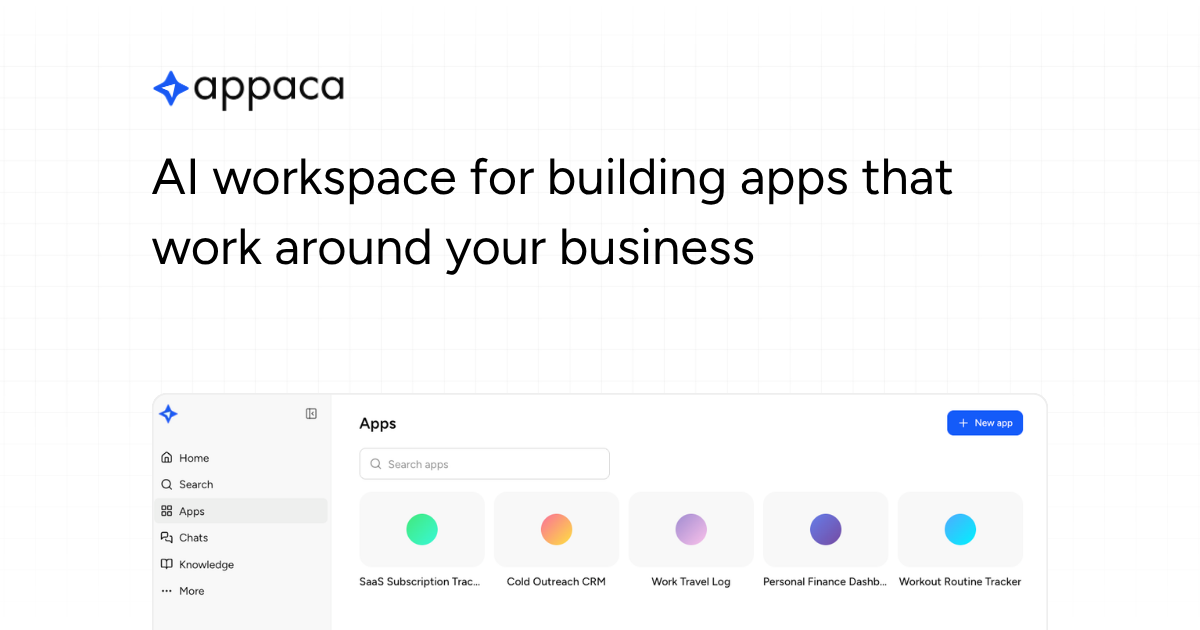

Every SaaS tool is built for a hypothetical business. That's the quiet frustration behind the average operations team's app stack: a CRM that doesn't track the right fields, an internal tool that requires a ticket to IT, a dashboard that shows the wrong metrics. Appaca's pitch is to collapse that gap entirely. Instead of buying another subscription and contorting your workflow to fit it, you describe the tool you need and the platform generates it — apps, agents, and a shared workspace all at once.
The company calls itself an "AI workspace for operators," and the phrase matters. Operators are the people who run the business day-to-day: sales ops, finance ops, marketing ops, HR ops. They are not developers. They are not looking for a low-code platform that still requires logic diagrams and API keys. They are looking for a way to get a tool that works the way their team actually works, without waiting for engineering.
The operator's tool gap: why off-the-shelf SaaS doesn't fit
The standard solution to an operational need is to buy a SaaS product. But SaaS products are designed for a broad market, which means they are designed for a hypothetical business. The sales team at one company might need to track follow-up cadence by lead source; at another, they might need to route inbound leads by territory and product line. A generic CRM can do both, but only with configuration, custom fields, and often a consultant to set it up.
Appaca's positioning targets this mismatch directly. The homepage copy is blunt: "Every SaaS tool was built for a hypothetical business. Appaca builds for yours." That's a strong claim, and it's backed by a workflow that starts with a description. You type what you need — a lead follow-up assistant, an invoice processor, a travel log — and the platform's agent builds a functional app around your workflow. No coding, no technical setup. The tool is generated, not configured.
This is a different mental model from the traditional internal tools builder. Low-code platforms like Retool or Airtable still require you to design the interface, define the data model, and wire up the logic. Appaca's premise is that you can skip most of that by describing the outcome. The platform's AI agent handles the assembly, and you get a working app that fits your process.
Describe it, get it: the app builder as a conversation
The core mechanic is the app builder. It's not a drag-and-drop canvas; it's a chat. You describe what you need, and the agent builds it. The website shows a demo thumbnail with a chat window that turns a request into an app. This is a fundamental shift in how internal tools are created. Instead of learning a tool's interface, you articulate the need in plain language.
The examples on the site are concrete: a SaaS subscription tracker, a cold outreach CRM, a work travel log. These are not exotic, complex systems. They are the mundane tools that operators use daily, but they are also the ones that generic SaaS often gets wrong. A travel log in a generic expense tool might not capture the right approval flow. A cold outreach CRM might not integrate with the team's existing lead source. Appaca's promise is that you can build the version that fits.
This approach has a clear appeal for operators who are tired of adapting to software. But it also raises a question: how deep can the customization go? The site shows the builder can create apps with forms, lists, and workflows, and it connects to a built-in database. For many operational needs, that's enough. For more complex logic, the platform offers a scheduler and integrations, but the depth is still being proven.
The AI brain and the built-in database: context without the plumbing
A tool is only as useful as the data it can access. Appaca addresses this with two features: the AI brain and the built-in database. The AI brain is a knowledge base where you upload documents to provide context for the workspace's AI system. The agent, your apps, and your AI coworkers can all access this context. This is what makes the generated tools feel intelligent — they're not just forms; they can reason about your specific business data.
The built-in database is a practical necessity. Instead of setting up a third-party database, every app built on Appaca can store and retrieve data from a secured built-in storage. This removes a major barrier for non-technical users. You don't need to know SQL or manage a Postgres instance. The platform handles the plumbing.
This combination of context and storage is what differentiates Appaca from a simple app generator. It's not just about creating a UI; it's about creating a system that understands your business. The AI brain feeds the apps, and the apps feed the database. Over time, this becomes a repository of operational knowledge that the entire workspace can use.
Coworkers: agents that live in the same workspace, not in a separate tab
One of the most distinctive features is the "coworker" — an AI agent that works alongside your team. The website describes it as "your own specialised AI agents that can do work 24/7 in your workspace." This is more than a chatbot; it's an agent that can access the same apps, data, and context as your human team.
For example, a sales team might create a coworker that monitors leads and drafts follow-up messages. A finance team might create one that processes invoices and flags discrepancies. These agents are not separate products; they are part of the same workspace, sharing the same brain and database. This integration is what makes them useful. They can act on the data your apps collect, and they can trigger actions through the scheduler.
The coworker concept is a bet on the future of work: that AI agents will become team members, not just tools. Appaca is positioning itself to be the environment where those agents live. It's an ambitious vision, and the execution is still early, but the direction is clear.
From lead follow-up to invoice processing: where the use cases actually land
The website's use cases are organized by team: sales, finance, marketing, HR, operations, product engineering, IT support. Each section includes specific examples that are grounded in real operational pain. For sales, there's a Lead Follow-Up Assistant that drafts personalized follow-ups based on CRM activity. For finance, there's an Invoice Processor that extracts data, matches it against purchase orders, and flags discrepancies.
These are not generic AI features; they are targeted at specific workflows. The sales example addresses the problem of slow follow-up, which the site claims costs reps nearly half their week. The finance example addresses the manual work of invoice processing, which the site says can take days. By focusing on these concrete pain points, Appaca demonstrates that it understands the operator's world.
The use cases also show the platform's versatility. It can build a proposal generator, a payment reminder assistant, a monthly finance report, an employee onboarding assistant, and a customer health dashboard. This breadth is impressive, but it also raises the question of quality. Can a platform that generates apps from a description really deliver a tool that is as good as a purpose-built SaaS product? The answer is likely "it depends." For simple workflows, yes. For complex, mission-critical systems, the depth may not be there yet.
The tradeoff: speed of assembly vs. depth of customization
The fundamental tradeoff Appaca makes is between speed and depth. By letting users describe what they need, the platform sacrifices the fine-grained control that a developer would have. You can't tweak every line of code or design every pixel. But for many operators, that's not the point. They need a tool that works, and they need it now.
This tradeoff is similar to the one that low-code platforms made a decade ago, but Appaca goes further by removing the visual builder entirely. The conversation is the interface. This is a bold bet, and it will only work if the AI can reliably translate descriptions into functional apps. The site's demos suggest it can, but real-world use will test the limits.
For operators, the value proposition is clear: stop adapting to software, and start having software adapt to you. Appaca is not trying to replace the entire SaaS stack; it's trying to fill the gaps that generic tools leave behind. It's a workspace for the tools you can't buy off the shelf, built on demand. That's a compelling idea, and if the execution holds up, it could change how operations teams think about software.