Atlia
Flat-fee, AI-native property management for short-term rental owners who want more revenue and less work.
NewName Editorial
Editorial Team
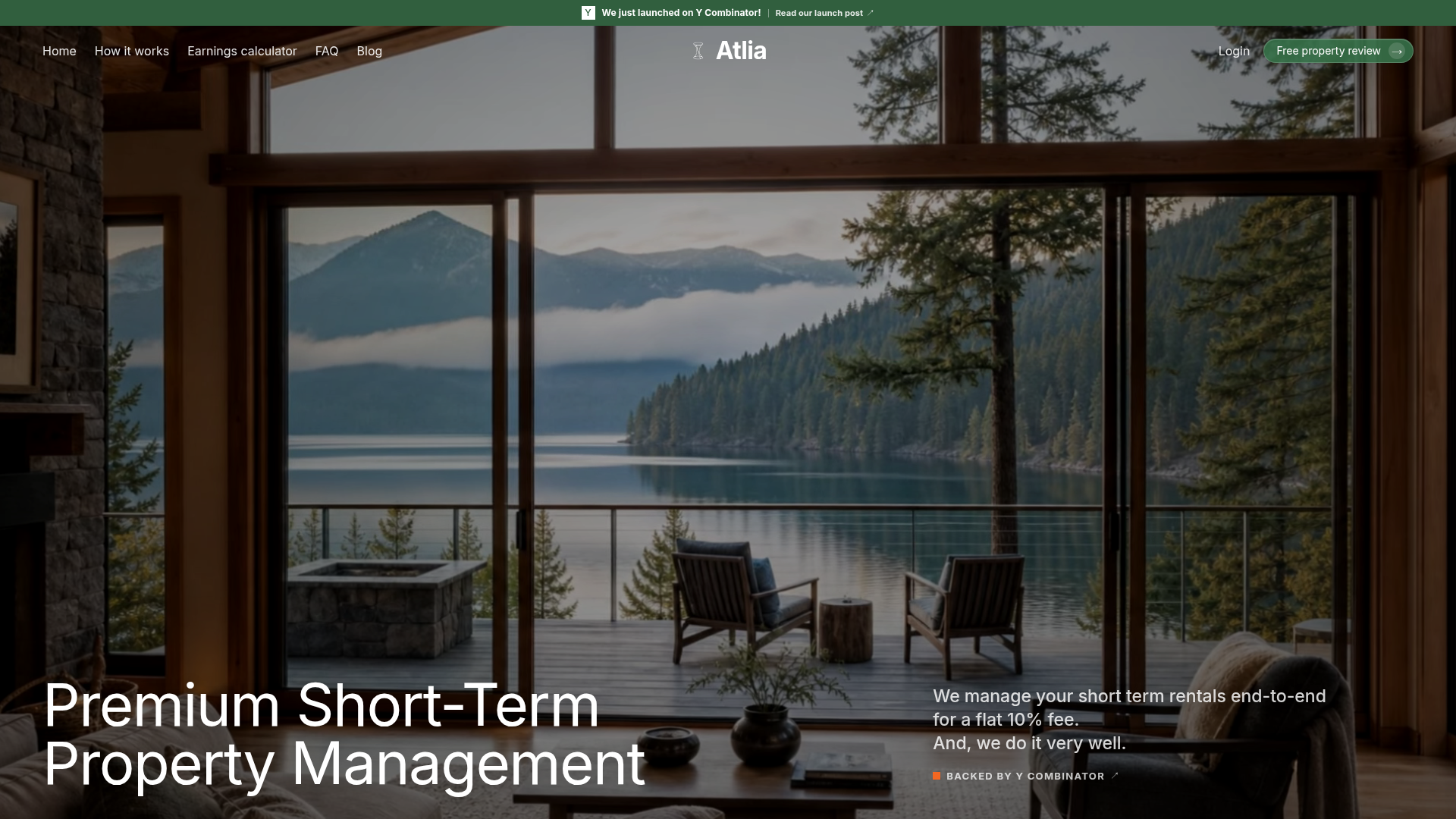


Short-term rental management has long been a business of percentages. Traditional property managers take 20% to 35% of booking revenue, a toll that owners accept because the alternative—self-managing—means becoming a de facto hotelier. Atlia, a Y Combinator-backed startup, is trying to break that trade-off with a flat 10% fee and an AI-native operating system. The pitch is simple: you keep more of every booking, and the software remembers your property better than any human could. But the real question is whether Atlia can scale its local, high-touch model without becoming just another manager with a dashboard.
The 10% fee is the product
Atlia's pricing is its most aggressive move. The website leads with a flat 10% management fee, compared to the industry-standard 20-35% charged by traditional managers. The company's earnings calculator makes the math concrete: on an annual Airbnb revenue of $82,000, a traditional manager at 30% would take $24,600, while Atlia's fee is $8,200—a monthly savings of $1,367. For self-managers, the pitch shifts to revenue growth: Atlia claims it can drive booking revenue up through upsells, marketing, and dynamic pricing, while handling the work.
The fee is not just a price; it's a positioning statement. By charging a flat percentage, Atlia signals that it earns more when the owner earns more, aligning incentives. It also simplifies the owner's mental model: no tiered fees, no hidden charges for 'premium' services. The site is careful to note that guest-paid cleaning charges and pass-through costs for repairs and supplies are separate, but the headline number is unambiguous.
A property with a memory
Atlia's core software concept is 'property memory.' The system retains context on house rules, vendors, calendars, pricing, guests, and property-specific operating details. This is more than a CRM; it's an institutional memory that persists across turnovers and staff changes. The website visualizes this as a 'brain' that improves guest experiences with every booking.
The practical implication is that Atlia can offer consistency that a rotating team of cleaners and contractors cannot. When a guest asks about the Wi-Fi password or the check-out procedure, the system knows. When a maintenance issue arises, the system knows which vendor to call and what the owner prefers. This is the kind of operational intelligence that typically lives in a property manager's head—and walks out the door when they quit.
Local operators, not just software
Despite the AI emphasis, Atlia is careful to position itself as a full-service property management company, not a software tool. The website states: 'Atlia is the property management company—not a dashboard owners are expected to operate themselves.' It maintains staffed operating bases in Fort Lauderdale and San Diego, with local operators who coordinate guests, vendors, and urgent issues.
This hybrid model—software plus human operators—is a deliberate response to the failure of pure-tech platforms in real estate. Owners want a human to call when a pipe bursts, not a chatbot. Atlia's 'experienced operators supervise the system,' meaning AI handles the routine, but humans handle the exceptions. The balance is critical: too much automation and owners feel abandoned; too little and the 10% fee becomes unsustainable.
The fee calculator as a trust signal
Atlia's website features a prominent earnings calculator that lets owners input their annual revenue and see potential savings. This is a clever trust-building tool. It turns the fee comparison from an abstract claim into a personalized number. The calculator also serves as a lead magnet, capturing owner data and initiating a 'free property review.'
The transparency extends to the blog, which publishes detailed guides on local regulations like San Diego's Transient Occupancy Tax and Fort Lauderdale's vacation rental registration. This content positions Atlia as an expert in the two markets it serves, building credibility with owners who are navigating complex compliance landscapes.
What Atlia's name says about its ambition
The name 'Atlia' is short, abstract, and tech-forward. It doesn't contain 'rent' or 'property,' which is a deliberate choice. The name suggests a platform, not a traditional agency. This aligns with the company's AI-native identity, but it also creates a challenge: owners searching for 'property management near me' won't find 'Atlia' unless they already know the brand. The company compensates with SEO-optimized landing pages for 'Airbnb property management Fort Lauderdale' and similar terms, but the brand itself remains a blank slate.