Atomic One
Autonomous AI agents that run your Amazon P&L, margin-first, 24/7.
NewName Editorial
Editorial Team
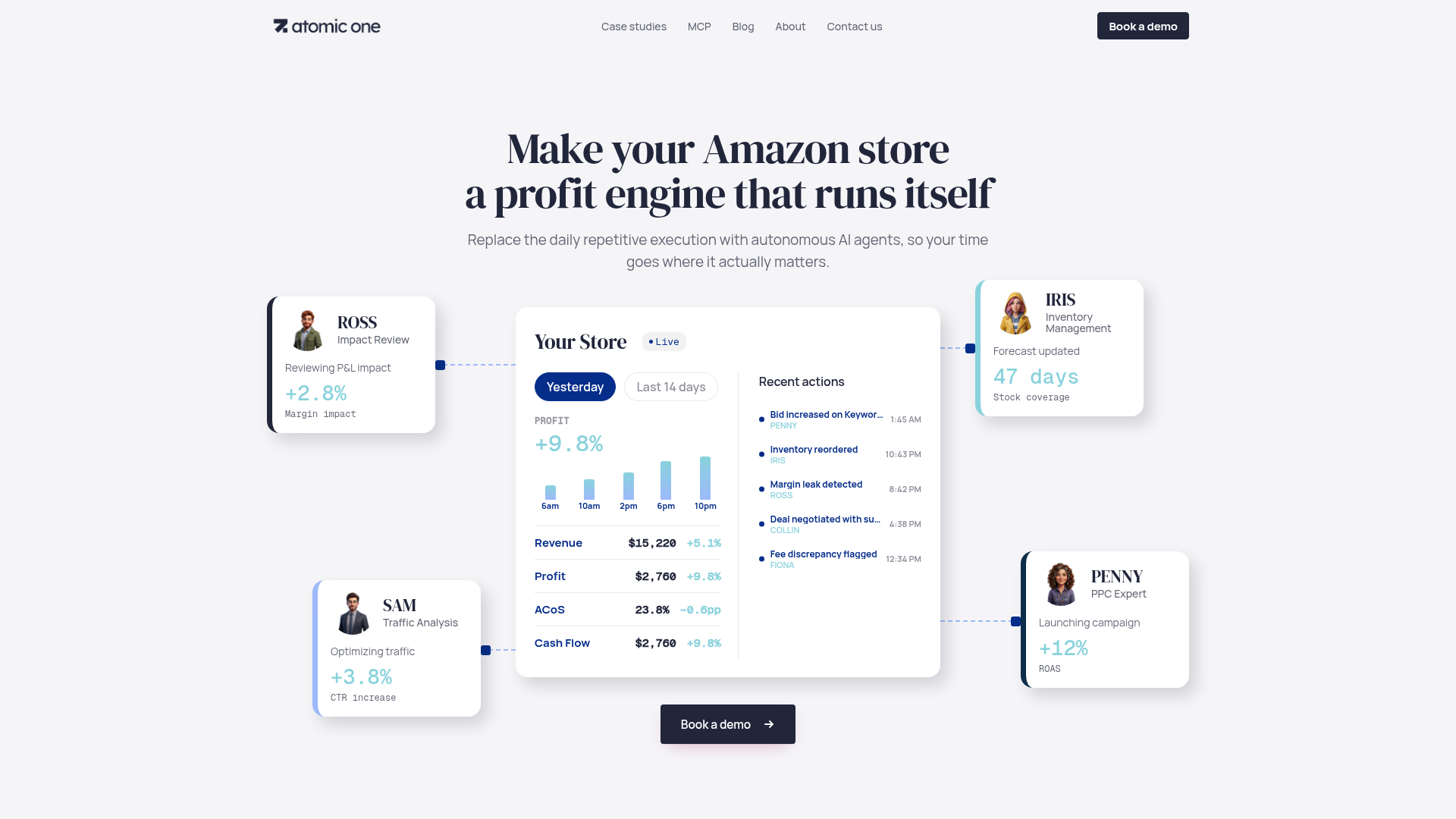


Atomic One is not another dashboard. It is a claim that the repetitive, high-volume execution of an Amazon business—bidding on keywords, reordering stock, auditing fees, tweaking listings—can be handed to a team of AI agents that never sleep, and that the right unit of measurement for that automation is not clicks or rank but contribution margin.
The company, founded in Málaga in December 2021 by operators who scaled Amazon brands, has raised €5.6 million in a two-tranche round, with Arcano Partners adding €660k to reach €2.5 million total from that fund. But the funding is less interesting than the product thesis: replace the daily grind of e-commerce operations with an 'AI-native operating layer' that manages the end-to-end P&L of an Amazon business.
The P&L as the operating system's unit of currency
Most e-commerce tools optimize a single lever—bids, inventory, listings—and report back in that lever's own metrics. Atomic One's twist is to make the P&L the central nervous system. Every agent action is tied to true COGS, FBA fees, and ad spend at the SKU level. Agents are instructed to bid against contribution margin, not just target ACOS or rank.
That is a subtle but important shift. A bid optimizer that maximizes ROAS might still lose money once you factor in storage fees and returns. Atomic One's agents are designed to make decisions that grow profit, not just revenue. The homepage's sample dashboard shows a +9.8% profit increase and a -0.6pp ACOS improvement, with agents flagging margin leaks and fee discrepancies. The message is clear: this is not automation for its own sake; it is automation with a profit filter.
Meet the agents: a named workforce, not a chatbot
Atomic One's most distinctive move is naming its agents. IRIS handles inventory risk, PENNY runs PPC, SAM owns keyword and traffic strategy, ROSS reviews P&L impact, FIONA audits Amazon fees, CHLOE optimizes listings, and DAVE executes deals. Each has a face, a job title, and a set of 'levers owned.'
This is a deliberate branding choice. A generic 'AI copilot' feels abstract; a team of named agents feels like a workforce. The names are human, approachable, and easy to reference in a meeting: 'Penny increased the bid on keyword APENNY at 1:45 AM.' That specificity builds trust—or at least familiarity—which matters when you are handing over control of your ad spend.
The agent roster also communicates scope. Atomic One is not a point solution; it is a suite that covers advertising, pricing, inventory, listings, and fees. The company claims it can automate up to 80% of operational tasks. The remaining 20%—the high-stakes calls—are left to human operators. That split is the core of the product's promise.
From chaos to operational silence: the 30-day handover
Atomic One's onboarding is designed to be fast and deliberate. Day 0–2 is a discovery and audit phase, where the company analyzes listings, ad performance, BSR trends, and operational gaps. Days 3–4 involve presenting a growth roadmap and getting approval on priorities. Days 5–7 see agents go live across advertising, content, pricing, and logistics. By day 7–30, the system is in 'full operational mode,' and the company promises 'operational silence.'
The phrase 'operational silence' is a clever inversion of the typical SaaS promise. Most tools promise more visibility, more alerts, more dashboards. Atomic One promises the opposite: fewer fires, fewer decisions, fewer 3 a.m. emergencies. The goal is to shift the operator's role from firefighting to strategy. One case study quotes a brand manager saying, 'My role has genuinely shifted from operational to strategic. I'm spending a lot more time asking 'what's next?' instead of 'what's on fire?''
That is the ideal outcome, but it also raises a question: how much control are you willing to give up? Atomic One's answer is that you approve the high-stakes calls—the 'operator-supervised' model. Agents draft actions; humans approve the big ones. It is a middle ground between full autonomy and manual management.
Why 'Atomic One' signals a category, not a tool
The name 'Atomic One' is a bold choice. 'Atomic' suggests indivisible, fundamental, powerful—the smallest unit of matter that retains its properties. 'One' implies unity, singularity, or a first mover. Together, they position the product as the foundational layer for e-commerce operations: not a tool you add, but the system you build on.
It is a name that aspires to category ownership. 'Atomic One' does not describe what the product does; it describes what the product wants to be. That is risky—if the product fails to deliver, the name becomes a punchline. But if it succeeds, the name becomes synonymous with AI-driven e-commerce operations, much like 'Salesforce' became synonymous with CRM.
The domain, atomic-one.com, is clean and memorable. The hyphen is a minor compromise, but it does not hurt the brand. The logo—a simple, modern wordmark—reinforces the 'atomic' theme with a clean, minimal aesthetic. The overall branding is confident and ambitious, matching the product's promise.