Impact-Site-Verification: 41b53a0c-6d04-458b-a457-fe9e29acde1a

AI & Machine Learning··7 min read

Axelrod

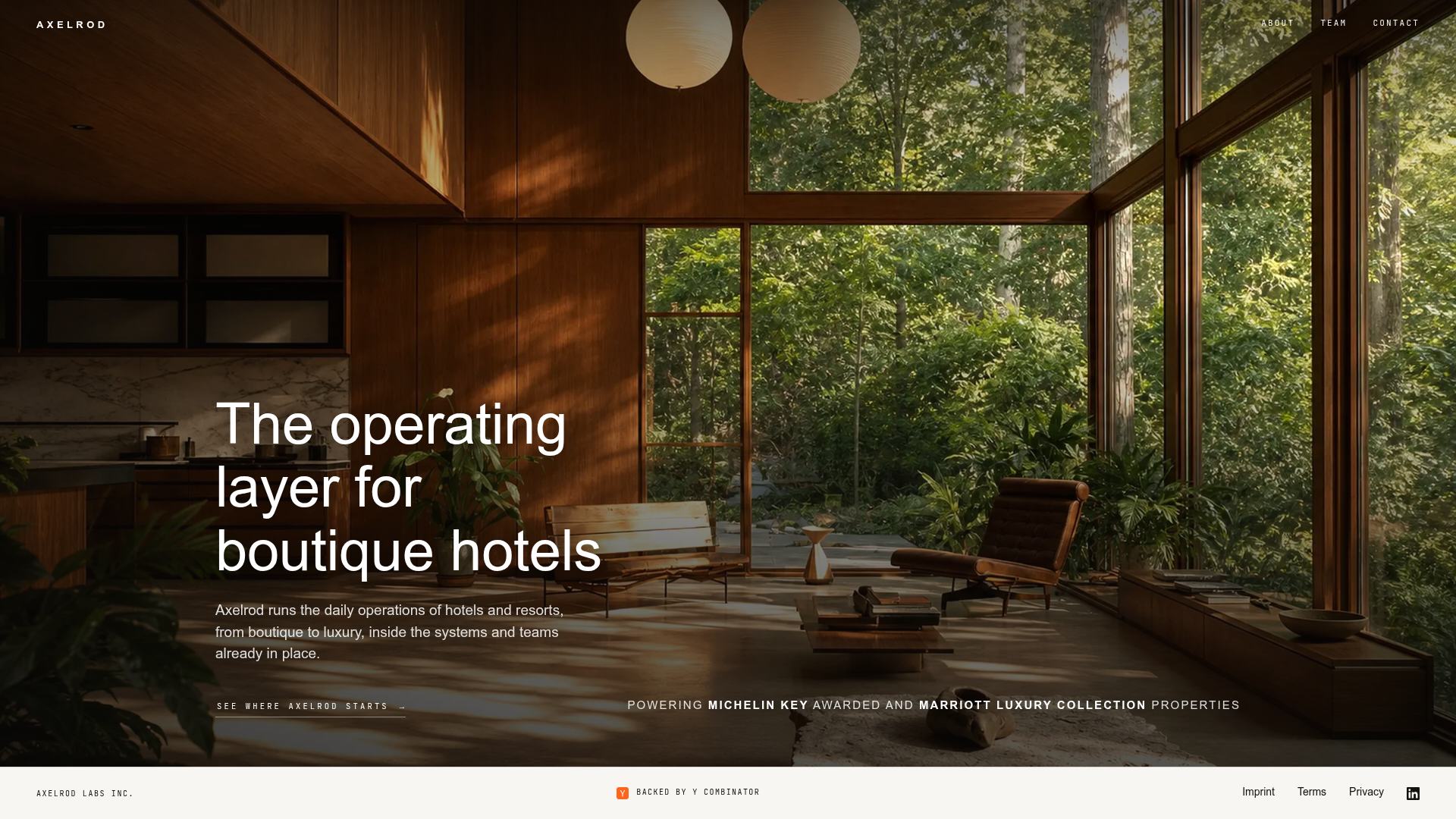
An invisible operating layer for boutique hotels, working inside the systems already running the stay.

NN

NewName Editorial

Editorial Team

Axelrod product image 1
Axelrod product image 2
Axelrod product image 3

Hotel software has a habit of adding screens. A new PMS, a new channel manager, a new messaging tool—each promises efficiency but demands that already-thin front-desk staff learn another login. Axelrod, a Y Combinator-backed startup from Axelrod Labs Inc., takes the opposite bet: don't give hotels another dashboard. Instead, run the work invisibly inside the systems they already use.

The company's tagline is blunt: "Autonomous agents that run luxury hotels." Its website clarifies the scope: agents that "execute every non-physical front- and back-of-house task inside the hotel's existing system." That is a sweeping claim, and the ambition is what makes Axelrod worth watching. This is not another chatbot that answers guest queries. It is an attempt to become the operating layer for the entire daily machinery of a hotel—arrivals, rooms, rates, maintenance, supplies, owner reporting—without asking the hotel to change its stack.

The operating layer, not another dashboard

Axelrod's own language is careful. It calls itself "an operating layer for the work behind every stay." That phrase is a quiet rebuke to the last decade of hospitality tech, which layered new tools on top of old ones. The pitch: Axelrod "sits above the systems already in place, coordinating the operational work that moves between guests, rooms, teams, owners, and channels."

What does that look like in practice? The website lists the systems it touches: PMS, channels, pricing, messaging, accounting. And it lists the work streams: arrivals, rooms, rates, access, maintenance, supplies, owner reporting. The agents are not meant to replace the PMS or the accounting software; they are meant to do the work that happens between those systems—the coordination, the follow-ups, the status updates, the reporting.

For a boutique hotel with a small staff, this is potentially transformative. A single person at the front desk often juggles check-ins, rate changes, maintenance requests, and supplier orders. Axelrod's agents could, in theory, handle the non-physical parts of those tasks: updating a room status, sending a maintenance ticket, reconciling a rate discrepancy, drafting an owner report. The human stays in the loop for judgment and physical action; the agent handles the digital busywork.

What 'every non-physical task' actually means

The phrase "every non-physical task" is both Axelrod's boldest promise and its murkiest. The website does not enumerate the exact tasks, nor does it specify how the agents decide what to do autonomously versus when to ask for approval. That ambiguity is typical for an early-stage AI product, but it matters more here because hotels run on trust and liability.

Consider a front-desk scenario: a guest requests a late checkout. The agent might update the PMS, notify housekeeping, and adjust the billing—all non-physical. But what if the guest is a VIP and the hotel has a policy that overrides standard checkout times? The agent needs to know that policy, or it needs to ask. The line between "execute" and "escalate" is where Axelrod will live or die.

The website's examples are deliberately high-level: "Arrivals, Rooms, Rates, Access, Maintenance, Supplies, Owner reporting." There is no mention of specific PMS integrations or a list of supported properties beyond the claim that it powers "Michelin Key awarded and Marriott Luxury Collection properties." That suggests real deployments, but the absence of detail also leaves room for skepticism. Is the agent truly autonomous, or is it a sophisticated workflow tool with AI-assisted decision-making? Public materials do not clarify.

Why the founders' hotel-floor past matters

Axelrod's founding story is unusually grounded for an AI company. Adrian Stoica "grew up in Berlin cleaning guest apartments." Saman Sayahpour "grew up behind the reception of a Vienna hotel." These are not typical founder bios for a YC-backed startup; they are the kind of details that signal a genuine understanding of the problem.

That background is a strategic asset. Hoteliers are notoriously wary of software built by people who have never changed a duvet or handled a walk-in guest. The founders can speak the language of the front desk, and they can credibly claim to know where the friction actually is. The website leans into this: the About page leads with their stories, not with technical architecture.

It also shapes the product philosophy. If you have cleaned rooms or worked reception, you know that the job is not one task but a thousand small ones, each connected to the next. A tool that automates a single step—say, sending a confirmation email—is not enough. You need something that coordinates the whole flow. Axelrod's "operating layer" framing is a direct response to that reality.

The trust problem in hotel software

Hotels are conservative buyers. They run on legacy systems, thin margins, and a zero-tolerance policy for guest-facing errors. A missed room assignment or a double-charged rate can ruin a stay and a reputation. Any software that touches the PMS is treated with suspicion.

Axelrod's answer is to be invisible. It does not ask hotels to replace their PMS or adopt a new dashboard; it asks them to connect the systems they already run. The terms of service make this explicit: "Customers connect systems their hotel already runs, such as a mailbox or a property management system, by signing in to the provider and granting access." The data stays with the customer, and the company says it does not use one customer's data to serve another.

That is a trust-first approach, but it also creates a high bar. The agents need to be right nearly 100% of the time, because even a small error in a hotel operation has outsized consequences. The website does not disclose error rates or human-in-the-loop safeguards, which is a gap for a product that promises autonomy.

What Axelrod's name signals—and what it hides

The name "Axelrod" is an interesting choice. It is a surname, not a descriptive term. It does not say "hotel" or "AI" or "operations." That is a deliberate move: the company is building a brand around a persona, not a category. The name feels authoritative, almost old-world—like a character from a noir film or a law firm. It suggests competence and discretion, which are exactly the qualities a hotelier wants in an operations partner.

But the name also hides what the product does. If you hear "Axelrod" without context, you have no idea it is an AI operating layer for hotels. That is a risk for early adoption. The tagline "Autonomous agents that run luxury hotels" does the explanatory work, but the name itself is an inside joke that only makes sense after you understand the product.

The domain, axelrod.live, is clean and memorable. The .live TLD fits the idea of a real-time operating layer, though it is less conventional than .com. For a company that wants to project stability, a .live domain is a slight gamble, but it is easy to type and distinctive.

Open questions: autonomy, liability, and the human desk

The biggest open question is how much autonomy the agents actually have. The website says they "execute" tasks, but it does not define the boundaries. In a hotel, the difference between "execute" and "recommend" is the difference between a useful tool and a liability nightmare. If an agent changes a rate incorrectly, who is responsible? The terms of service likely cover this in the customer agreement, but the public site is silent.

There is also the question of scale. The website mentions Michelin Key and Marriott Luxury Collection properties, which suggests early traction at the high end. But boutique and independent hotels—the other segments Axelrod targets—have different needs and budgets. Can a single operating layer serve both a 20-room guesthouse and a 200-room luxury resort? The website implies yes, but the evidence is thin.

Finally, there is the human element. Hotel work is deeply personal. Guests expect a human face at the front desk, and staff often take pride in their judgment. Axelrod is not trying to replace the front desk—it says it handles "non-physical" tasks—but the line between physical and non-physical is blurry. A maintenance request is physical to fix, but the decision to prioritize it is not. Who makes that call?

For now, Axelrod is a promising bet on a real problem: hotel operations are still run on spreadsheets, sticky notes, and institutional memory. If its agents can genuinely execute the coordination work without adding friction, it could become the quiet backbone of boutique hospitality. But the company will need to earn trust one property at a time, and that trust will depend on showing—not just claiming—that its agents are reliable enough to run the stay behind the scenes.