Azrivo
A team of AI specialists for decisions that deserve more than one answer
NewName Editorial
Editorial Team
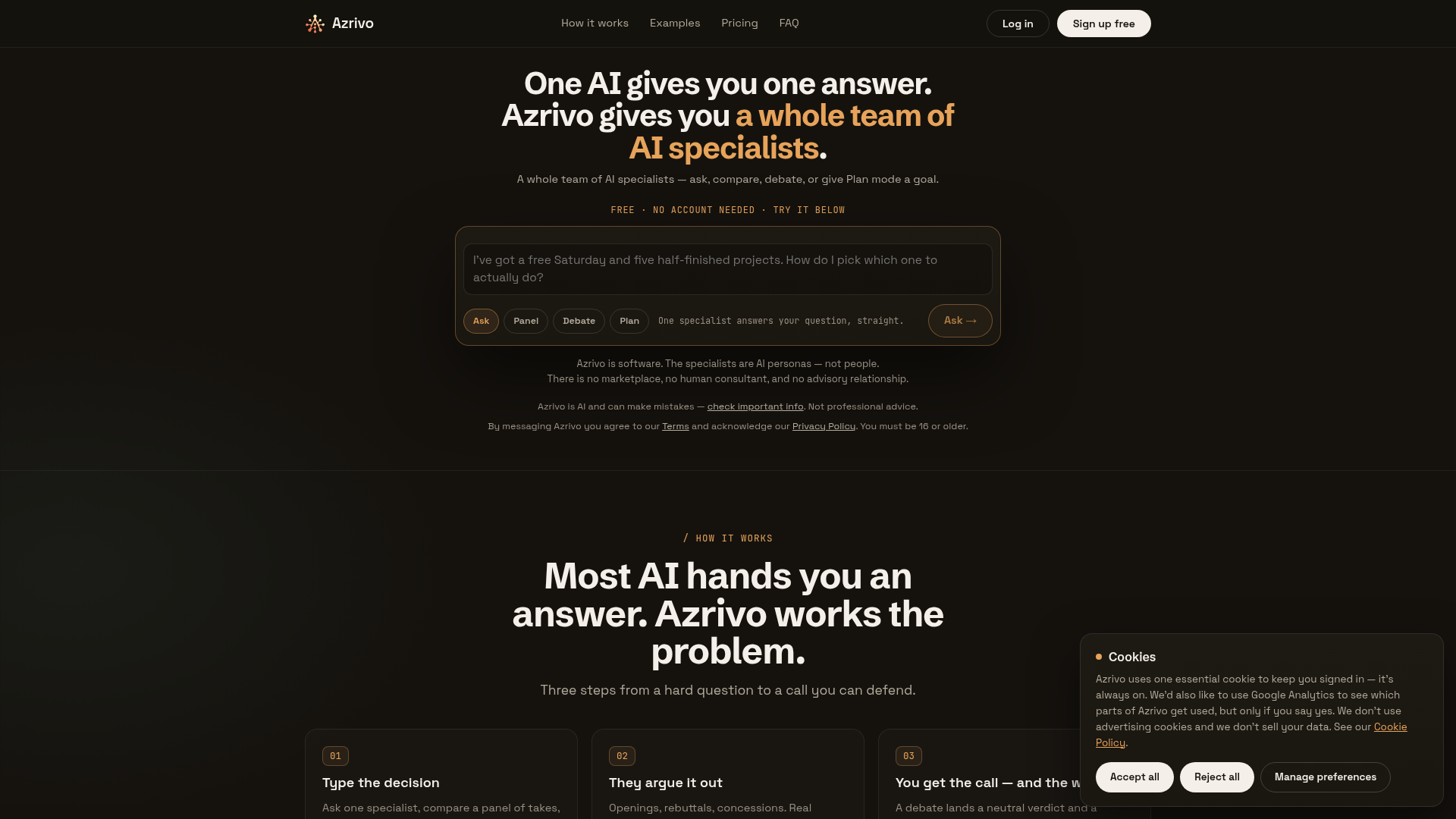
Most AI tools hand you a single answer. Azrivo's bet is that a decision worth making deserves a process — a team of AI specialists who argue it out, test assumptions, and land on a verdict you can defend. The tagline says it plainly: "Your AI team for answers, perspectives, debates, plans, and execution." But the real story is in the mechanics: Azrivo doesn't just give you more tokens; it gives you a structured workflow designed to mimic how a good team actually works a problem.
This isn't a wrapper with a fancy prompt box. The site is explicit: "A wrapper is a skin over one model's single reply. Azrivo is a system." That system convenes specialists with different lenses, runs a real process, and produces deliverables — decision memos, roadmaps, spreadsheets, even a landing page. Whether that distinction holds up is the question worth examining.
One AI, one answer — and why that stopped being enough
The core problem Azrivo targets is the limitation of a single AI response. When you ask ChatGPT or Claude a complex question, you get one answer — often hedged with "it depends." For a high-stakes decision — hiring, build vs. buy, career moves — that's not enough. You need to see the trade-offs from different angles, stress-test assumptions, and understand where the reasoning breaks.
Azrivo's answer is to simulate a team. Instead of one generic assistant, you get a "room" of AI personas — a Risk Analyst, a Financial Modeler, a Strategist, a Skeptic. Each brings a different lens to the question. The site's examples show a debate on "Build vs. buy — adjacent market expansion" where a Risk Analyst, Financial Modeler, and Strategist argue acquire-vs-build, then a neutral synthesis lands a decision memo with a clear boundary. That's not a single answer; it's a process.
The name itself — Azrivo — suggests "arrive" at a decision. It's a coined word that feels like a destination, not a chatbot. The branding avoids the "AI assistant" cliché and instead positions the product as a "room" you enter, a "team" you convene. That's a deliberate choice to distance from the one-shot Q&A paradigm.
The four modes: Ask, Panel, Debate, and Plan
Azrivo structures its workflow into four modes, each serving a different decision stage:
- Ask: Get a focused answer from one specialist. Good for straightforward questions or continuing a previous conversation.
- Panel: Compare multiple perspectives side by side. Have a marketer, a designer, and a skeptic review your landing page, for example.
- Debate: Set specialists arguing a real decision — openings, rebuttals, concessions — and end with a neutral synthesis that names the crux and produces a decision memo with trade-offs, failure modes, and decision boundaries.
- Plan: Hand it a goal — a strategy, a campaign, even a trip — and it researches, plans, and builds roadmaps, documents, spreadsheets, and diagrams you approve.
These modes aren't just gimmicks. They map to how people actually make decisions: gather information (Ask), get different viewpoints (Panel), stress-test assumptions (Debate), and then execute (Plan). The workflow is designed to take you from a vague question to a concrete deliverable.
What a real debate run looks like
Azrivo publishes real runs on its site, not just marketing fluff. One example is a debate on "Build vs. buy — adjacent market expansion." The prompt is a real strategic question, and the output includes a decision memo with a clear boundary — not a wishy-washy "it depends." The specialists argue, the neutral synthesis lands a verdict, and you see the reasoning.
This is where Azrivo differentiates from a single AI. A single model might list pros and cons, but it won't simulate a back-and-forth where a Risk Analyst challenges a Strategist's assumptions. The debate format forces the AI to consider opposition, which can surface failure modes you might not have thought of.
The site is careful to note that the specialists are AI personas, not people. There's no marketplace, no human consultant, no advisory relationship. That's an important legal and ethical boundary, but it also means the "team" is simulated — the quality depends entirely on the underlying models and the orchestration.
Plan mode: from goal to artifacts
Plan mode is Azrivo's most ambitious feature. It's not just about answering questions; it's about producing work. The examples show a plan run turning a vague objective into a full "automation operating system" — intake framework, weighted scoring model, AI-readiness gate, prioritization matrix, phased rollout roadmap, and a governance loop. Another example shows a fictional product brief turned into a self-contained HTML landing page, complete with research, conversion architecture, and generated visuals.
This is where Azrivo moves from a decision-support tool to an execution tool. The site's tagline includes "execution," and the Plan mode delivers artifacts you can actually use. The pricing page emphasizes this: "Debate decides. Plan executes. Artifacts prove it."
For a solo founder or a small team, this could be a game-changer. Instead of hiring a consultant to build a roadmap, you can hand Azrivo a goal and get a structured plan. But it also raises questions: How reliable are these artifacts? The site includes an AI disclaimer and says "check important info," acknowledging that AI can make mistakes. For high-stakes decisions, you'd still want human review.
The anti-wrapper argument — and the evidence
Azrivo is keenly aware of the "AI wrapper" criticism. The FAQ asks directly: "Is this just another AI wrapper?" The answer: "No. A wrapper is a skin over one model's single reply. Azrivo is a system: it convenes a team of specialists with different lenses and runs a real process."
Is that claim backed by evidence? The published examples suggest yes — the debate runs show a structured process with openings, rebuttals, and a neutral synthesis, not just a single prompt. The Plan mode produces multi-part artifacts. But ultimately, Azrivo is still built on top of large language models. The "system" is orchestration, not a fundamentally new AI. That's not a knock — orchestration is valuable — but it's worth being clear that the moat is in the workflow design, not the underlying technology.
The pricing model also supports the anti-wrapper stance. Free is a plan, not a trial, with daily and weekly usage limits. Paid plans ($25/mo Pro, $50/mo Max) raise limits and add features like custom branding and Telegram integration. This suggests Azrivo is betting on ongoing usage, not one-off queries.
Naming and positioning: Azrivo as a room, not a robot
The name "Azrivo" is a coined word that doesn't scream "AI." It's short, memorable, and suggests "arrive" — you arrive at a decision. The domain azrivo.com is clean and brandable. The product is positioned not as an assistant but as a "room" — a space where a team of specialists works your problem. The site's language reinforces this: "convene your first team," "the full room, every mode."
This positioning is smart. It moves away from the "AI assistant" trope and toward a "decision room" metaphor. It also sets expectations: you're not getting a single answer; you're getting a process. The risk is that the name is so coined it doesn't convey what the product does. But with the tagline and the site's clear explanations, that's mitigated.
Who should care, and what's still unproven
Azrivo is for anyone who regularly makes complex decisions — solo founders, consultants, product managers, even individuals planning a trip. It's also for teams that want to pressure-test ideas without the overhead of assembling a real panel.
The free plan is a smart entry point. You can try it without an account, which lowers friction. The examples are compelling, but they're curated. The real test is whether the output quality holds up across a wide range of decisions.
What's still unproven: the reliability of the artifacts, the depth of the "debate" (is it real reasoning or just clever prompting?), and the long-term value of the subscription. The site doesn't disclose usage limits or performance metrics. For now, Azrivo is a promising experiment in making AI a decision-making partner, not just an answer machine. If it works as advertised, it could change how we think about AI productivity tools.