Impact-Site-Verification: 41b53a0c-6d04-458b-a457-fe9e29acde1a

Fintech & Web3·Seed··5 min read

Blaze

An AI CFO that pays bills, collects invoices, and forecasts cash on stablecoin rails.

NN

NewName Editorial

Editorial Team

Blaze product image 1
Blaze product image 2

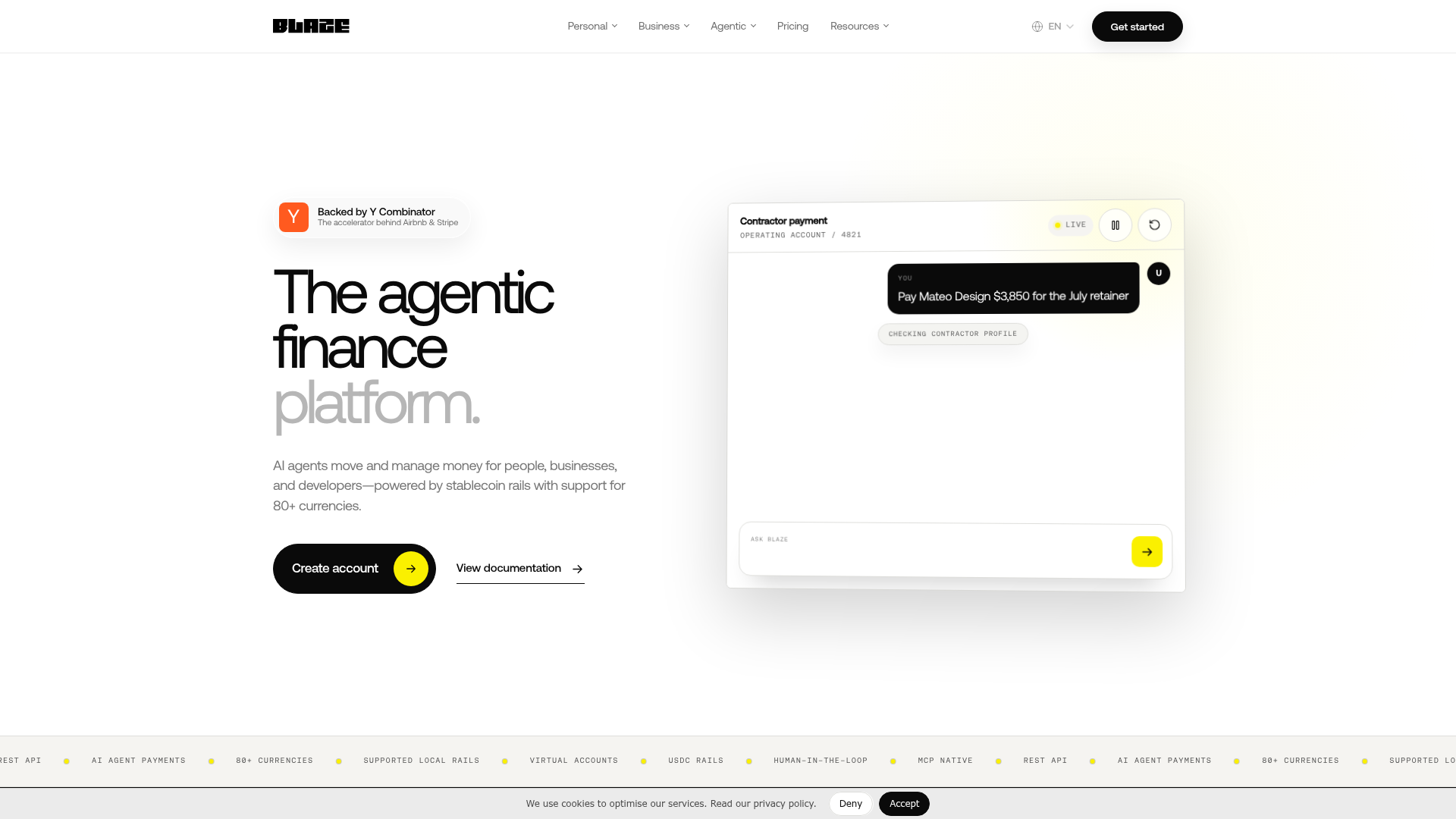
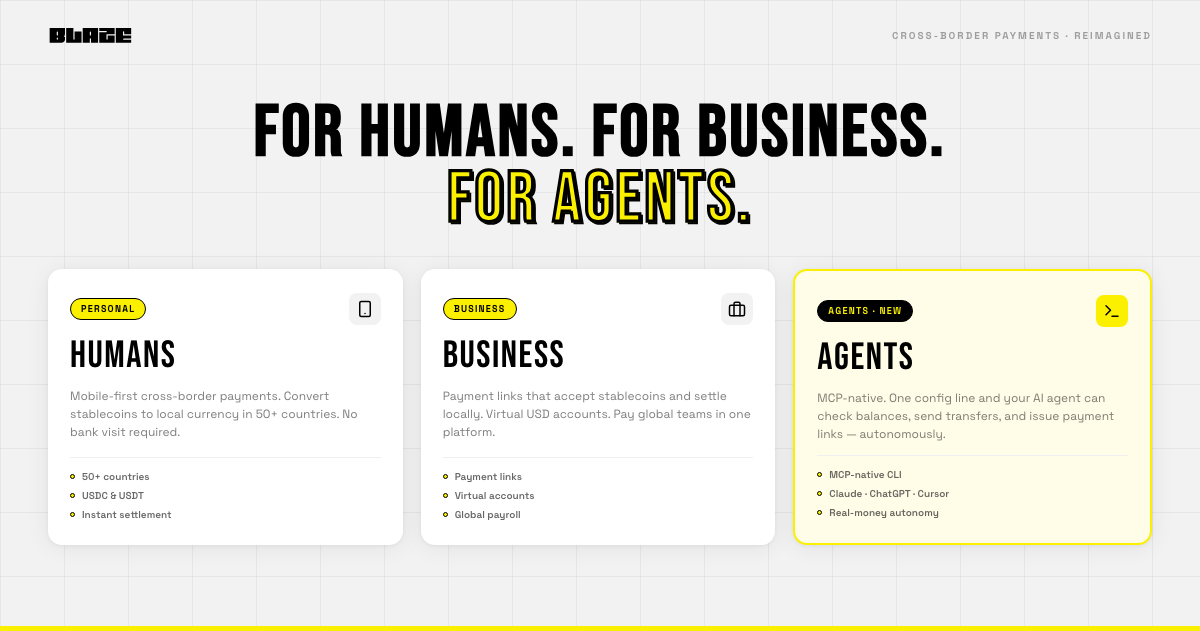
Blaze is not another neobank with a chatbot bolted on. It is an agentic finance platform that embeds an AI CFO directly into the money movement process. The pitch is simple: tell Blaze to pay a supplier, and it verifies the invoice, applies your approval rules, selects the best payment rail, and schedules the transfer — all while keeping you in the loop. Underneath that convenience sits a stablecoin-powered backbone that supports 80+ currencies and local rails like ACH, SPEI, and PIX. For a company backed by Y Combinator, Blaze is making a bold bet: that the future of finance is not just faster payments, but payments that think.

The agentic workflow: from instruction to execution

The core of Blaze is its agentic finance workflow, which the site describes as "Ask. Review. Done." Instead of navigating dashboards and filling out forms, you give Blaze a plain-language instruction. For example: "Pay Northstar Supplies $8,750 tomorrow." The agent then breaks that instruction into steps: it finds the relevant invoice, verifies the recipient, applies your approval rules, and selects the best payment rail. Each step is shown in a progress view, so you can see what the agent is doing and intervene if needed.

This is a significant departure from traditional payment platforms, which require you to manually initiate each transfer. Blaze's agentic approach means the software is not just a tool but an active participant in your financial operations. The site emphasizes human-in-the-loop control, so while the agent can act autonomously, it does so within the boundaries you set. This is a crucial trust mechanism for a product that moves real money.

The stablecoin backbone: USDC and 80+ currencies

Blaze's global reach is powered by stablecoin rails, specifically USDC. The site notes that you can "Hold USDC securely and manage payments from one operating view." This is a strategic choice: stablecoins enable near-instant settlement and reduce the friction of cross-border transfers. By combining USDC with local rails like ACH (US), SPEI (Mexico), and PIX (Brazil), Blaze can offer same-day or next-day payments in many corridors, and near-instant transfers where supported.

The platform supports 80+ currencies, which is a bold claim for a startup. The site lists flags for the US, Canada, Mexico, Brazil, Colombia, and Argentina, suggesting a focus on the Americas. This is a smart beachhead: these markets have high remittance flows and significant pain around cross-border payments. Blaze's blog posts, such as "How to Send Money to Colombia" and "The Venmo of Mexico," reinforce this focus.

Who Blaze is for: from digital nomads to small businesses

Blaze is positioning itself for two distinct audiences: individuals and businesses. For individuals, it offers a personal app with global account opening, a Blaze card, and the ability to send, receive, and hold money in multiple currencies. This is clearly aimed at digital nomads and expats, a segment the company's founders know well — they started Blaze after encountering payment friction while traveling post-COVID.

For businesses, Blaze offers an "AI CFO" that handles bill payments, invoicing, and cash flow forecasting. The site shows a dashboard with metrics like "Total cash position" and "Estimated runway," suggesting the agent provides financial intelligence, not just payment execution. This is a more ambitious value proposition: not just moving money, but helping you understand and plan your finances.

The business offering is further segmented into verticals like solopreneurs, home services, and Airbnb management. This suggests Blaze is targeting small businesses that may not have a dedicated finance team but still need sophisticated cash management.

The Blaze card: rules-based spending without borders

The Blaze card is a prepaid debit card issued by Lead Bank, with no foreign transaction fees and real-time transaction visibility. The card is integrated with the Blaze platform, so you can set rules and controls on spending. The site highlights "real-time control from Blaze," which likely means you can set limits, freeze the card, and get instant notifications.

The card is a key part of the ecosystem: it allows you to spend from your Blaze balance in multiple currencies, avoiding the fees and poor exchange rates typical of traditional bank cards. For digital nomads, this is a compelling feature. The card is also available in different tiers (Standard and Black), suggesting a premium option for frequent travelers.

The name Blaze: speed, energy, and the risk of ambiguity

The name "Blaze" evokes speed, fire, and energy — fitting for a platform that promises fast, frictionless payments. It is short, memorable, and works well in English. The domain blaze.money is clear and category-appropriate, reinforcing the financial focus. However, "Blaze" is a generic word used by many companies across industries, from Blaze Pizza to Blaze Media. This could create brand ambiguity, especially in search results. The company mitigates this by using the full name "Blaze Payments Inc." in legal contexts, but the consumer-facing brand remains generic.

The tagline "AI CFO for Businesses" is more specific, but it is also used by other fintech startups. The positioning as an "agentic finance platform" is more distinctive, but it may be jargon-heavy for the average user. Overall, the name is memorable and energetic, but it lacks the distinctiveness of names like Wise or Revolut.

What's missing and what's next

The site provides a lot of information about features and benefits, but it is light on specifics about pricing, security, and regulatory details. The pricing page mentions "From $100 per user / month" and a free trial, but it does not break down what features are included in each tier. The site also mentions that Blaze is "Licensed & Regulated" and follows KYC/AML procedures, but it does not specify which jurisdictions it is licensed in. This is a common gap for fintech startups, but it is important for building trust.

Another missing piece is the actual AI capabilities. The site shows screenshots of the agent in action, but it does not explain how the AI is trained, what models it uses, or how it handles edge cases. This is a significant question for a product that is supposed to handle your finances autonomously. The company's documentation may provide more details, but the marketing site is vague.

Despite these gaps, Blaze is an intriguing product. It is combining two hot trends — AI and stablecoins — into a single platform. If it can execute on its vision, it could become a category leader in agentic finance. But the road ahead is long, and the company will need to prove that its AI is reliable, its rails are truly global, and its brand can stand out in a crowded market.