BuildHop
BuildHop turns product pages into ongoing distribution loops for indie founders seeking traction beyond launch day.
NewName Editorial
Editorial Team


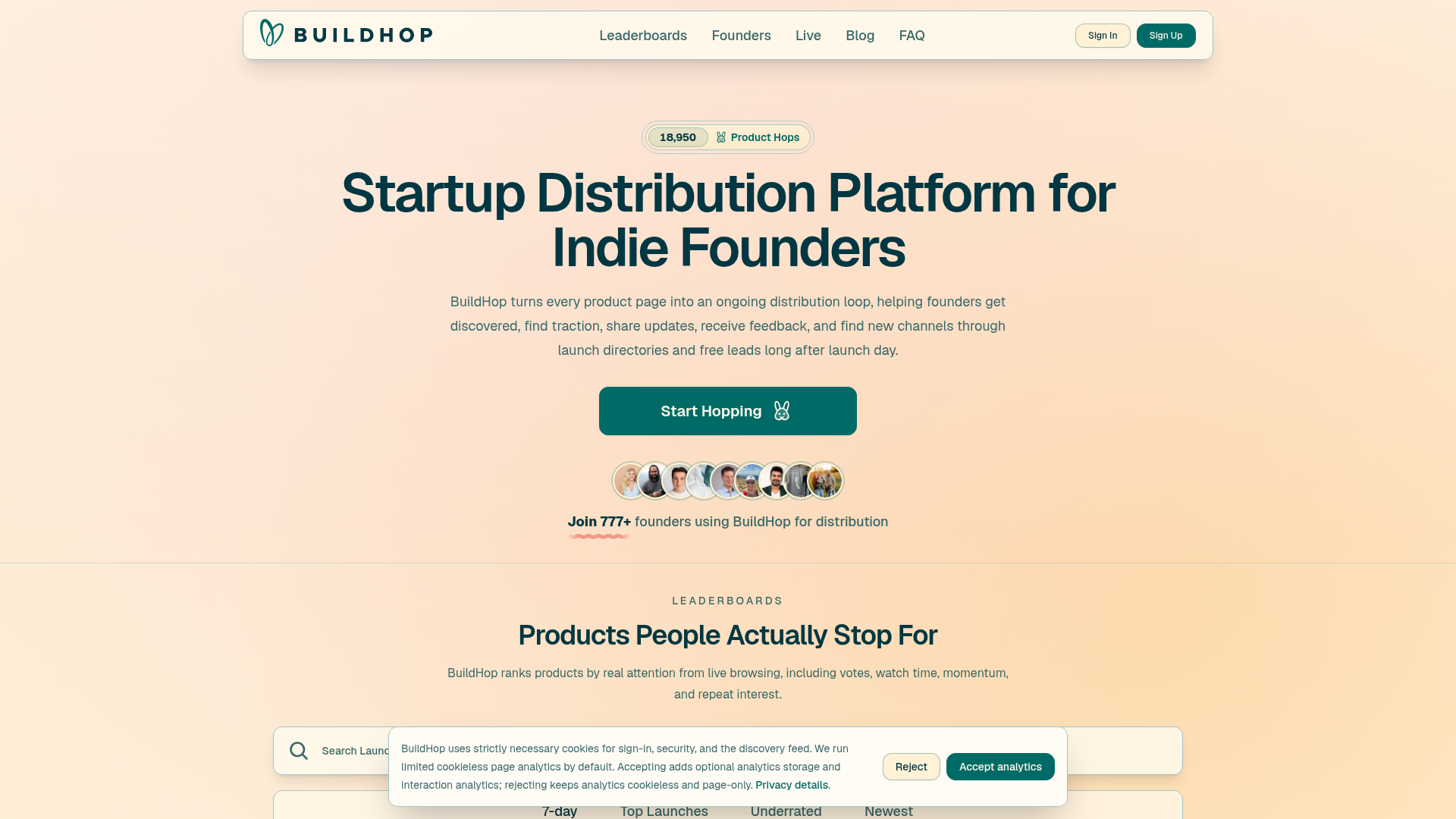
The launch-day spike is a drug. You post on Product Hunt, watch the upvotes trickle in, then watch the traffic evaporate by Friday. BuildHop, a startup distribution platform for indie founders, is built on a simple provocation: what if your product page kept working after the launch? Its homepage promises to turn every product page into an "ongoing distribution loop," helping founders get discovered, find traction, share updates, receive feedback, and find new channels long after launch day. That's not just a feature list—it's a rejection of the industry's obsession with launch-day virality.
BuildHop's answer is a mix of leaderboards, founder spotlights, and a live browsing signal that ranks products by real attention. The site tracks metrics like votes, watch time, momentum, and repeat interest, and it surfaces products that people actually stop for. It's a subtle but important shift: instead of rewarding who shouts loudest on launch day, BuildHop tries to reward who holds attention over time. The name itself—BuildHop—signals the philosophy: you build, then you hop to the next opportunity, but your product stays in the loop.
Beyond the Launch Day Spike
The problem BuildHop targets is familiar to any indie founder: the launch directory model is broken. You submit your product, get a burst of traffic, and then you're buried. BuildHop's homepage copy is explicit: "Launches never die on BuildHop and get real website traffic long after launching on the platform." That's a direct jab at the ephemeral nature of traditional launch platforms. The site's leaderboards—7-day, Top, Top Launches, Underrated, Newest—are designed to keep products discoverable for a full week after approval, not just a day. The "Underrated" tab is a particularly clever touch, giving a second chance to products that didn't get the initial attention they deserved.
This isn't just a theoretical promise. The homepage shows live metrics: 18,950 product hops, 44 new submissions this week, and 13 people discovering right now. These numbers are modest—this is a young platform—but they're real. BuildHop isn't pretending to be a traffic giant; it's building a niche community where discovery is ongoing, not a one-time event.
The Loop: How a Product Page Keeps Working
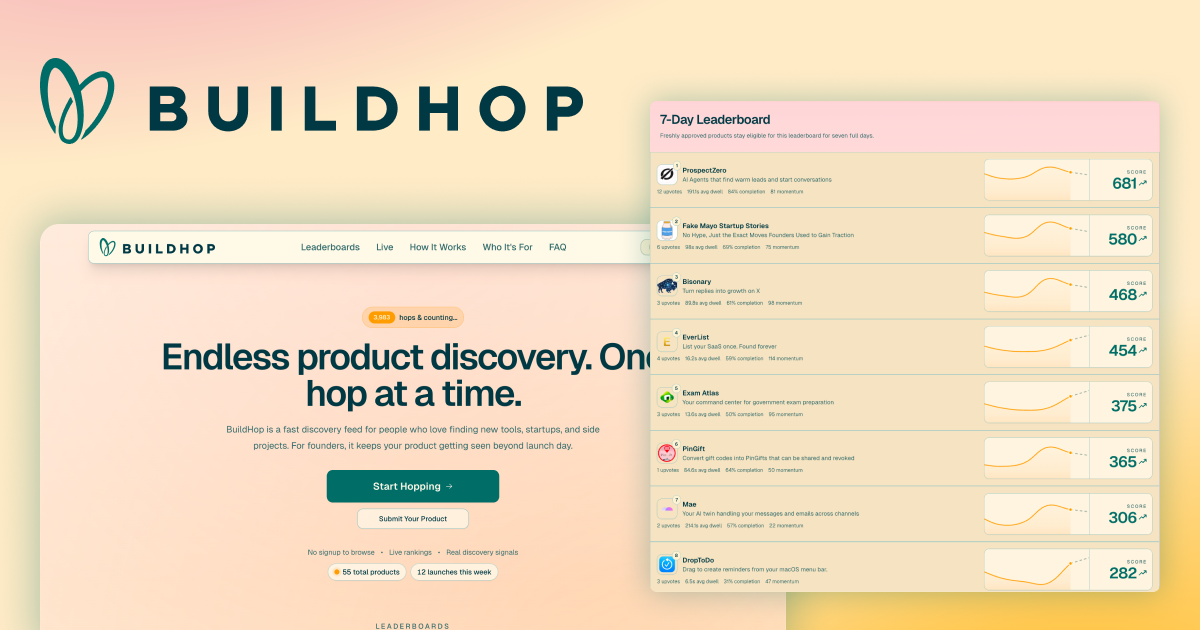
The core mechanism is the "hop." Users browse products in a Tinder-like fashion, and each interaction—voting, dwelling, clicking through—feeds into a product's score. The leaderboard score is a composite of upvotes, average dwell time, completion rate, and momentum. For example, RemyndAI, a Mac app that records your screen, shows 5 upvotes, 50.5s average dwell, 63% completion, and 16 momentum, resulting in a score of 482. This isn't just a popularity contest; it's an attention quality score. A product with fewer upvotes but longer dwell time can rank higher than one with more votes but less engagement.
This design has a clear incentive: founders are encouraged to create product pages that are genuinely interesting, not just clickbait. The metrics are displayed publicly, so there's transparency in what drives visibility. For founders, this means the work doesn't stop at submission. They need to craft a compelling description, a strong logo, and a clear value proposition to keep hop sessions engaged. The loop is self-reinforcing: better pages get more hops, which boosts their score, which leads to more visibility.
Leaderboards That Measure Attention, Not Votes
Most launch platforms rank by raw upvotes, which can be gamed or skewed by a founder's network. BuildHop's leaderboard is different. It ranks by "real attention from live browsing," combining votes, watch time, momentum, and repeat interest. This is a more honest signal of product-market fit. The 7-day leaderboard gives new products a fair shot, while the "Top" leaderboard rewards sustained performance.
The metrics are granular: average dwell time, completion rate, and momentum. For instance, Vectr4, a self-hosted analytics tool, has 264.1s average dwell and 56% completion, indicating that visitors are genuinely engaging with the content. This data is useful not just for ranking but for founders to understand what's working. It's a feedback loop that goes beyond vanity metrics.
The Community Layer: Founders Helping Founders
BuildHop isn't just a directory; it's a community. The "Founder Spotlights" section features public interviews with builders, showing their points, MRR, and what they're looking for—partnerships, feedback, or something else. This humanizes the platform and encourages networking. The homepage shows founders like Jacob Counsell with 42,990 points and $2,000 MRR, indicating that some are seeing real traction.
The community aspect is reinforced by the blog, which publishes articles like "Why Did Your Product Launch Get Traffic but No Signups?" and "Is This Launch Directory Legit? 12 Red Flags to Check Before You Pay." These are practical, no-BS guides that position BuildHop as a trusted advisor, not just a listing service. The tone is supportive, not salesy, which aligns with the indie founder ethos.
The Name as a Promise: Build, Then Hop
The name "BuildHop" is a compound of "build" and "hop," suggesting a rhythm of creation and movement. It's a verb-like name that implies action: you build your product, then you hop to the next opportunity. But the platform's promise is that your product doesn't get left behind—it keeps hopping through the discovery loop. The name also has a playful, energetic feel, fitting for a community of indie hackers.
The domain, buildhop.io, is clean and memorable, with the .io TLD signaling tech startup culture. The branding is consistent: the logo is a simple wordmark, and the site uses a bright, modern design with clear calls to action. The name is distinctive enough to avoid confusion with other products, though it's not descriptive—you wouldn't know it's a distribution platform without context. That's a tradeoff: it's brandable but requires explanation.
What BuildHop Doesn't Solve (Yet)
BuildHop is early. The numbers are small—18,950 product hops is a fraction of what Product Hunt sees in a day. The platform is free, with no visible premium tier, which raises questions about sustainability. How will it make money? The blog mentions "free leads" and "launch directories," suggesting it might eventually charge for featured listings or lead generation, but that's speculation.
There's also the chicken-and-egg problem: to attract founders, you need visitors; to attract visitors, you need quality products. BuildHop's live browsing feature is a draw, but it's unclear how it's driving traffic. The founder spotlights are a nice touch, but they're limited. The platform's success depends on whether it can grow its community and maintain the quality of its leaderboard.
For indie founders, BuildHop is worth a try. It's free, easy to submit, and offers a different approach to distribution. The focus on ongoing visibility and attention quality is a refreshing alternative to the launch-day rat race. But it's not a silver bullet. It's a tool that works best when combined with other distribution channels. The real test is whether BuildHop can scale its community without losing its indie spirit. If it can, it might just become the go-to platform for founders who want their products to keep hopping long after the confetti falls.