CaptchaInbox
Make unknown senders pay to reach your inbox — and keep 90% of the proceeds.
NewName Editorial
Editorial Team
Most spam filters are reactive: they learn what you already hate and try to catch the next similar message. Captchainbox is different. It doesn't try to recognize spam at all. Instead, it charges a toll to anyone who isn't already in your trusted circle. The sender's message is held until they pay the price you set — and when they do, 90% of that payment goes to you, the Internet Archive, or the Electronic Frontier Foundation. It's a radical inversion of the inbox economy: your attention becomes a priced resource, and the people who want it must put money behind the interruption.
The inbox as a toll booth
The core idea is simple: make unknown senders pay to reach you. Captchainbox holds any message from a sender who isn't on your trusted list, and the sender sees a payment page before their email is delivered. You set the price — the site's calculator suggests $1 per email as a default, and the example flow shows a $1.00 charge. The message stays out of your inbox until the sender pays. Trusted contacts, like your existing correspondents, get through as usual. This isn't a filter; it's an economic barrier.
Why spam filters fail at the personalized cold email
The pitch is that traditional spam filters catch obvious junk but miss the personalized cold outreach that still consumes your time. AI-generated emails, tailored to your name and industry, slip past rules and Bayesian filters because they look like legitimate correspondence. Captchainbox doesn't care about content. It only asks: do I know this sender? If not, they pay. This sidesteps the arms race of spam detection entirely. The site's blog posts, like "Gmail Spam Filter Not Working on AI Cold Email," position this as the definitive fix for the AI outreach flood.
The trusted circle: learning from your sent history
To avoid charging people you actually know, Captchainbox scans your sent history. The sign-in flow shows it analyzing 2,847 messages and building a list of 284 trusted contacts. It also recognizes accounts like Stripe and Linear — services that send you transactional emails. Introductions through trusted contacts get through as well, as shown in the interface with "Intro via David." This means the system learns your real-world network without you having to manually whitelist anyone. It's a clever use of metadata: the service claims to never read message content, only sender identity.
The payout: monetizing your own spam problem
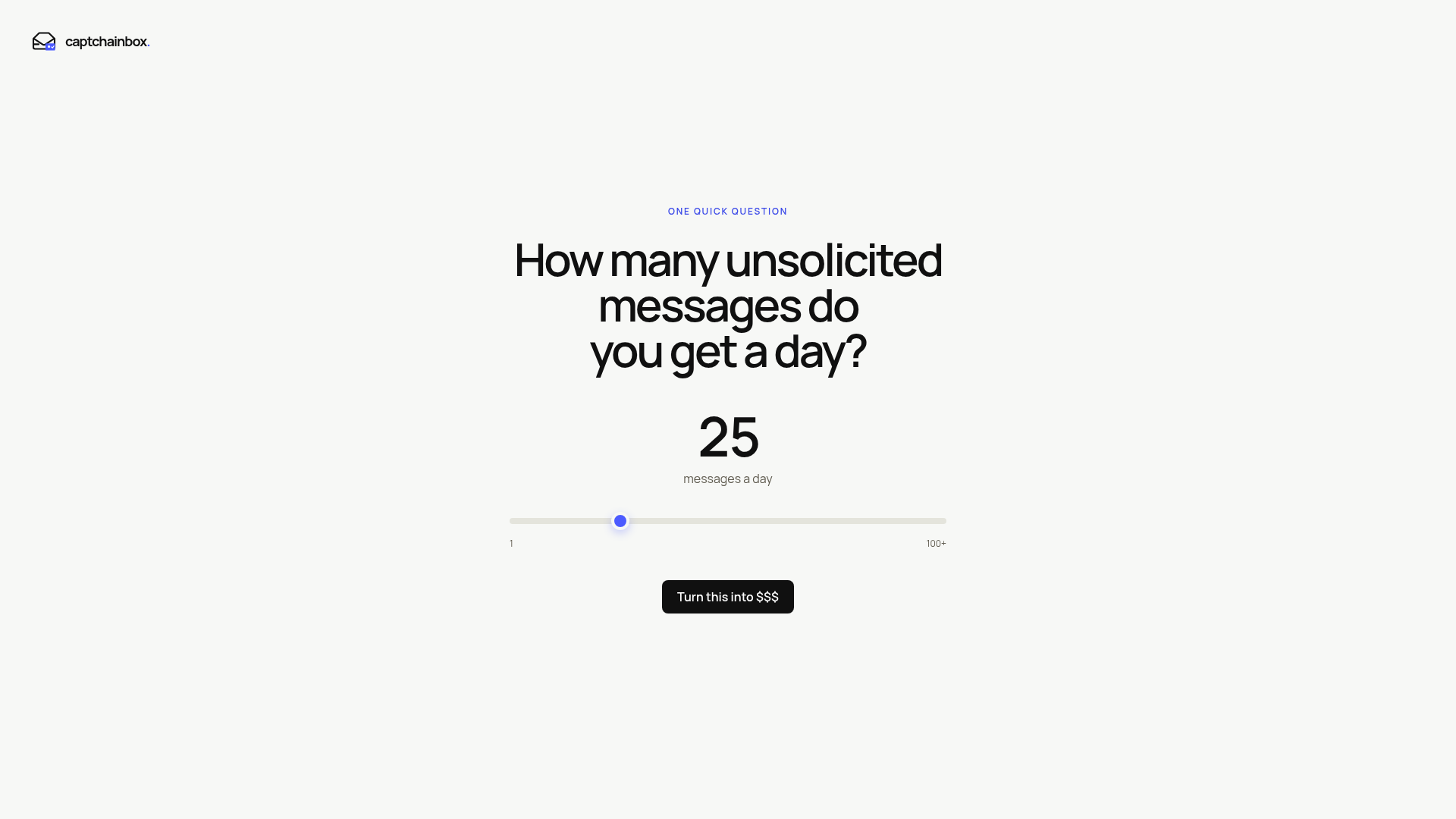
Here's where Captchainbox gets interesting. When a sender pays, the money doesn't just disappear into the company's pocket. After Stripe's processing fee, Captchainbox keeps 10% and the remaining 90% goes to a destination you choose: your own Stripe account, the Internet Archive, or the Electronic Frontier Foundation. The site's calculator suggests you could earn $153 a month, or $1,866 a year, based on 25 emails per day and a $1.00 price. This turns an annoyance into a revenue stream. It also aligns the product with the open internet — you can fund a nonprofit just by letting spam hit your inbox.
The verification flow: what senders see
If you're a sender, the experience is a clean, Stripe-powered payment page. It says "This inbox uses pay-to-deliver" and asks you to pay $1.00 to get your message through. After payment, a confirmation appears: "You're verified. Your message is on its way to their inbox." The sender is then trusted for a grace period, so repeat emails don't require repeated payments. For recipients, the dashboard shows a live feed of held messages, with statuses like "Delivered," "Archived," and "Payment requested." You can review held messages and whitelist senders manually.
The free tier and the 10% cut
Captchainbox is free to install — no subscription, no credit card. The company earns only when you earn, taking 10% of each successful payment after Stripe fees. This is a usage-based model that aligns incentives: the service only makes money when it successfully filters a paying sender. The site also mentions a CAPTCHA mode as an alternative to payment, for those who don't want to charge but still want a barrier. Currently, Gmail and Google Workspace are fully supported, with Outlook in the works. The service passed a CASA Tier 2 security assessment, which is Google's required audit for apps accessing Gmail data.
Captchainbox is not for everyone. If you receive few cold emails, the toll booth is an empty highway. But for those drowning in AI outreach, it offers a way to make the problem pay for itself. The question isn't whether it will stop all spam — it won't. It's whether the economic barrier is enough to make senders think twice. And for that, the answer is likely yes.