Impact-Site-Verification: 41b53a0c-6d04-458b-a457-fe9e29acde1a

Developer Tools·Unknown··4 min read

Caution

Caution: verifiable compute for workloads you can't afford to have hacked.

NN

NewName Editorial

Editorial Team

Caution product image 1
Caution product image 2

The cloud industry spent a decade convincing us to trust the operator. Then came confidential computing, which asked us to trust the hardware. Caution, a Y Combinator-backed startup, is making a bolder argument: don't trust either—verify the entire software stack yourself, down to the compiler.

Caution is a hosting platform for "software you can't afford to have hacked." It deploys workloads to secure enclaves in minutes and provides cryptographic proof of exactly what code is running. The pitch isn't just isolation; it's verifiability. In a world where supply-chain attacks and insider threats are constant headlines, Caution's thesis is that the only reliable foundation is one you can check yourself.

The cloud's last black box: software

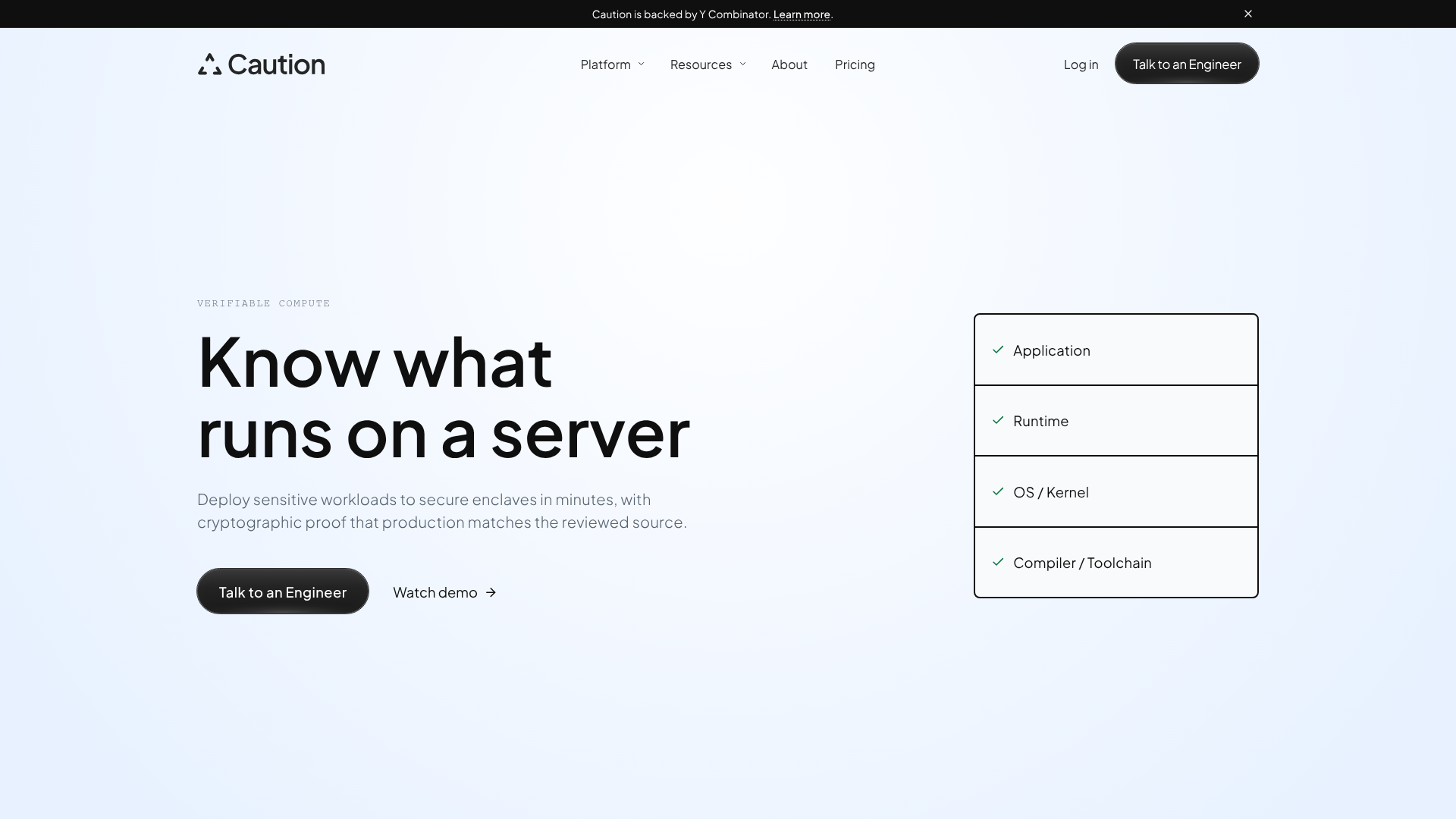
Traditional cloud computing is a black box: you hand your code to a provider and hope they run it as promised. Confidential computing (like AWS Nitro Enclaves) added a hardware root of trust, but the software stack—the runtime, OS, kernel, and compiler—remained opaque. Caution's website illustrates this gap with a simple diagram: regular cloud shows "Trust the operator," confidential compute shows "Trust the hardware," and Caution's verifiable compute says "Don't trust. Verify every layer yourself, down to the compiler."

That last layer is the key. Even if you trust the enclave hardware, you still need to know that the application, runtime, and OS inside it haven't been tampered with. Caution closes this gap by linking the enclave's measurement back to auditable source code and reproducible builds. It's not replacing Nitro; it's extending it.

From 'trust us' to 'verify the build'

Caution's core mechanism is reproducibility. The platform builds a deterministic enclave image from your source code, then lets anyone verify that the running enclave matches that image. The caution verify command rebuilds the image from source, compares hashes, and confirms attestation. If a binary doesn't match the expected source, you know immediately—before it reaches production.

This is a fundamental shift from the "trust us" model of cloud security. Instead of relying on audits or compliance certificates, Caution gives you cryptographic evidence. For industries like fintech, healthcare, and blockchain, where integrity failures are catastrophic, this could be transformative. The website lists use cases like verifiable LLM inference, custody operations, and staking infrastructure—all scenarios where proving what's running is as important as keeping data private.

The deployment workflow that fits your CI/CD

One of Caution's smartest moves is meeting developers where they already are. The workflow is familiar: caution init creates a Procfile, git push caution main builds and deploys, and caution verify checks the result. It integrates with existing CI/CD, infrastructure-as-code, and deployment tooling. "Caution fits into what you already use rather than replacing it," the site says.

This is crucial. Security tools often fail because they require a parallel infrastructure. Caution's approach—a thin layer on top of your existing Git workflow—lowers the barrier to adoption. The promise of "deploy to enclaves in minutes" instead of weeks of custom infrastructure engineering is compelling, especially for teams that have been avoiding confidential computing due to complexity.

Why the name 'Caution' is a warning, not a promise

The name "Caution" is a deliberate double-edged sword. On one hand, it signals prudence and security—the right vibe for a security product. On the other, it's a warning: be careful, because the stakes are high. The tagline "software you can't afford to have hacked" reinforces this. The domain caution.co is short, memorable, and fits the brand perfectly. The logo, a simple caution icon, is instantly recognizable.

But there's a risk. "Caution" could also imply that the platform is only for the paranoid or that it's overly cautious about performance. The company seems aware of this, positioning itself as a tool for "high-assurance workloads" rather than a general-purpose cloud. That's a smart niche, but it may limit mass-market appeal.

The road ahead: more enclaves, more proof

Caution currently supports AWS Nitro Enclaves, with Intel TDX, AMD SEV-SNP, and TPM 2.0 attestations planned for 2026. This multi-TEE roadmap is essential for a platform that aims to be the verification layer for confidential computing. The open-source nature of the platform also allows teams to self-host, which could appeal to enterprises with strict data sovereignty requirements.

Still, there are open questions. The site doesn't disclose pricing or detailed performance benchmarks. The Y Combinator backing is a signal of investor confidence, but the real test will be whether Caution can move from early adopters in crypto and fintech to mainstream enterprise. The promise of verifiable compute is compelling, but the proof will be in the deployments.

For now, Caution is a name to watch—a reminder that in the cloud, the last black box might finally be opening.