CheapFoodMap
A map of good meals under $10, curated by community votes and Google ratings.
NewName Editorial
Editorial Team
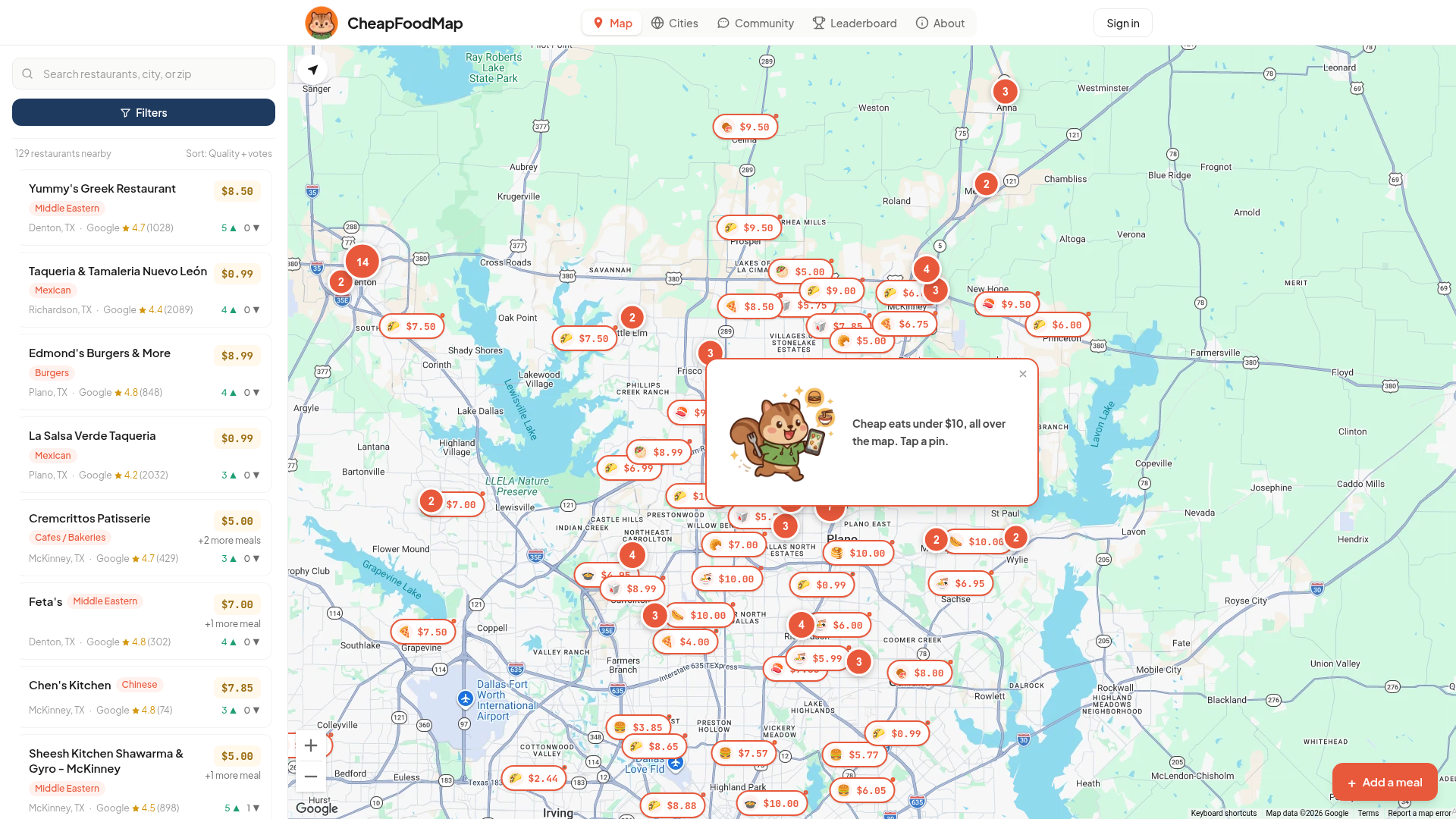
CheapFoodMap opens with a deceptively simple promise: a map of good meals under $10. In a food-tech landscape cluttered with delivery apps, reservation platforms, and influencer-driven discovery, this web app strips away everything except one hard constraint. That constraint—the $10 ceiling—is not a feature; it's a philosophy. It says something about what food discovery should prioritize: not the newest fusion spot, not the chef's tasting menu, but the unpretentious places where a full meal doesn't break the bank.
What makes CheapFoodMap interesting is not the map itself—maps are everywhere—but the editorial judgment embedded in that price filter. The site doesn't just show cheap food; it shows "good" cheap food, and it tries to prove "good" with data pulled from Google ratings and a community voting system. This is a product that understands the difference between a list and a recommendation, even if its execution is still rough around the edges.
The $10 ceiling as a design principle
The $10 threshold is the product's entire identity. Scroll through the map and you'll find a taco shop in Richardson, TX selling items at $0.99, a Greek spot in Denton with a meal at $8.50, and a Vietnamese banh mi in Carrollton for $6.99. The range is wide—from under a dollar to the hard cap of $10—but the ceiling forces a kind of democratic curation. It excludes the $14 poke bowl and the $18 burger, not because they're bad, but because they fail the test of affordability.
This is a deliberate editorial stance. CheapFoodMap is not Yelp, which tries to be everything to everyone. It's not DoorDash, which is optimized for delivery fees and convenience. It's a niche discovery tool that says: here are meals that won't make you wince at the receipt. For a generation squeezed by rent and student loans, that's a value proposition with real emotional weight.
The ceiling also creates a sense of adventure. Because the price is fixed, the variety comes from cuisine and location. The map in the default view shows 129 restaurants nearby, spanning Mexican, Middle Eastern, Chinese, Vietnamese, and more. The constraint doesn't narrow the world; it reframes it. You're not looking for "cheap food"—you're looking for what's good within a budget.
Where the data comes from: Google scores meet local gems
CheapFoodMap doesn't pretend to be the source of truth. Each listing pulls in a Google rating and review count, displayed right next to the price. Yummy's Greek Restaurant in Denton, TX, shows a 4.7 with 1,028 reviews; Taqueria & Tamaleria Nuevo León in Richardson shows 4.4 with 2,089 reviews. This is a smart move—it borrows credibility from a trusted platform while adding the price filter that Google itself doesn't offer.
But the reliance on Google data is also a limitation. Google ratings are often skewed by volume and recency, and they don't always reflect the kind of "good meal" that a food lover might define. A taqueria with 4.2 stars and 2,032 reviews might be a reliable choice, but it's not a discovery. CheapFoodMap's value would be higher if it could layer its own editorial voice on top of those scores—say, a note about the best taco al pastor or the fact that the pupusas are hand-made.
The site does try to add a human touch through its community features, but the core data remains third-party. That's not a fatal flaw, but it means CheapFoodMap is currently a filter, not a curator. The difference matters: a filter says "these are cheap and well-rated"; a curator says "these are worth your time." The latter requires taste, and taste is hard to scale.
The community layer: votes, leaderboards, and the trust gap
CheapFoodMap includes a community section with voting (up/down arrows on each spot) and a leaderboard. The interface hints at a Reddit-like ethos: users can push a good find to the top or flag a dud. In the default view, some spots show a few votes—5 up, 1 down for Sheesh Kitchen Shawarma & Gyro in McKinney—while others show zero. This is early-stage community behavior: sparse but functional.
The leaderboard adds a gamification layer, but it's unclear what it rewards. Is it the most votes? The highest ratio? The cheapest? Without explanation, the leaderboard feels like a placeholder. The community section itself is also opaque—there's no visible discussion thread or review text, just votes. That's a thin layer of engagement, and it raises a question: will people bother to vote if they can't see the impact?
The trust gap is real. Google ratings are a baseline, but they don't tell you if the $5.75 rice roll in Plano is actually good or just cheap. Community votes could fill that gap, but they need critical mass. Until then, CheapFoodMap is a map with a price filter and a promise of community that hasn't fully materialized.
Naming that promises exactly what it delivers
The name CheapFoodMap is blunt, almost to a fault. It doesn't try to be clever or aspirational—it tells you exactly what you're getting. That's a double-edged sword. On one hand, it's instantly clear and memorable; you know what the site does the moment you hear the name. On the other, it locks the product into a "cheap" positioning that might feel limiting as it grows. Could it expand to $15 meals? The name would be a lie. Could it add premium filters? The name would fight against it.
The domain cheapfoodmap.com is a perfect match—it's descriptive, easy to type, and likely cheap to acquire. The brand doesn't have the polish of a "Hutchins BBQ" or the whimsy of a "Flaming Burger," but it doesn't need to. This is a utility, and the name signals utility. The risk is that "cheap" carries a connotation of low quality, even when the site's whole point is to find good food at a low price. A name like "ValueBites" or "BudgetEats" might have softened that edge, but CheapFoodMap is honest to a fault.
What CheapFoodMap doesn't solve yet
The biggest gap is the lack of original content. The site aggregates Google ratings and prices, but it doesn't tell you why a meal is good. Is the $8.50 Greek platter at Yummy's worth the drive? Is the $0.99 taco at Nuevo León a hidden gem or a sad tortilla? Without photos, descriptions, or user reviews, the map is a skeleton. It needs flesh—stories, tips, and maybe even a "best of" list to give it a point of view.
Another open question is coverage. The default view shows restaurants in the Dallas-Fort Worth area, but the site has a Cities page and a Community page, suggesting ambitions beyond Texas. How many cities are covered? The evidence doesn't say. If CheapFoodMap wants to be a go-to resource, it needs density in multiple markets, not just one.
Finally, the business model is unclear. There's no visible advertising, no premium tier, no affiliate links. That's fine for a hobby project, but it raises sustainability questions. Will it stay free forever? Will it sell data? The site doesn't say, and that's a risk for users who invest time in voting and building the community.
CheapFoodMap is a promising idea with a clear thesis: good food shouldn't be a luxury. Its $10 ceiling is a refreshing antidote to the endless stream of "best restaurants" lists that assume unlimited budgets. But to move from a useful map to a trusted guide, it needs to add its own voice, expand its coverage, and give the community a reason to participate. The name sets a high bar—it promises cheap, but also good. Right now, it delivers on the first half. The second half is still in progress.