Chromie
Chromie: the AI OS that turns government contracting from a search problem into a pipeline problem.
NewName Editorial
Editorial Team
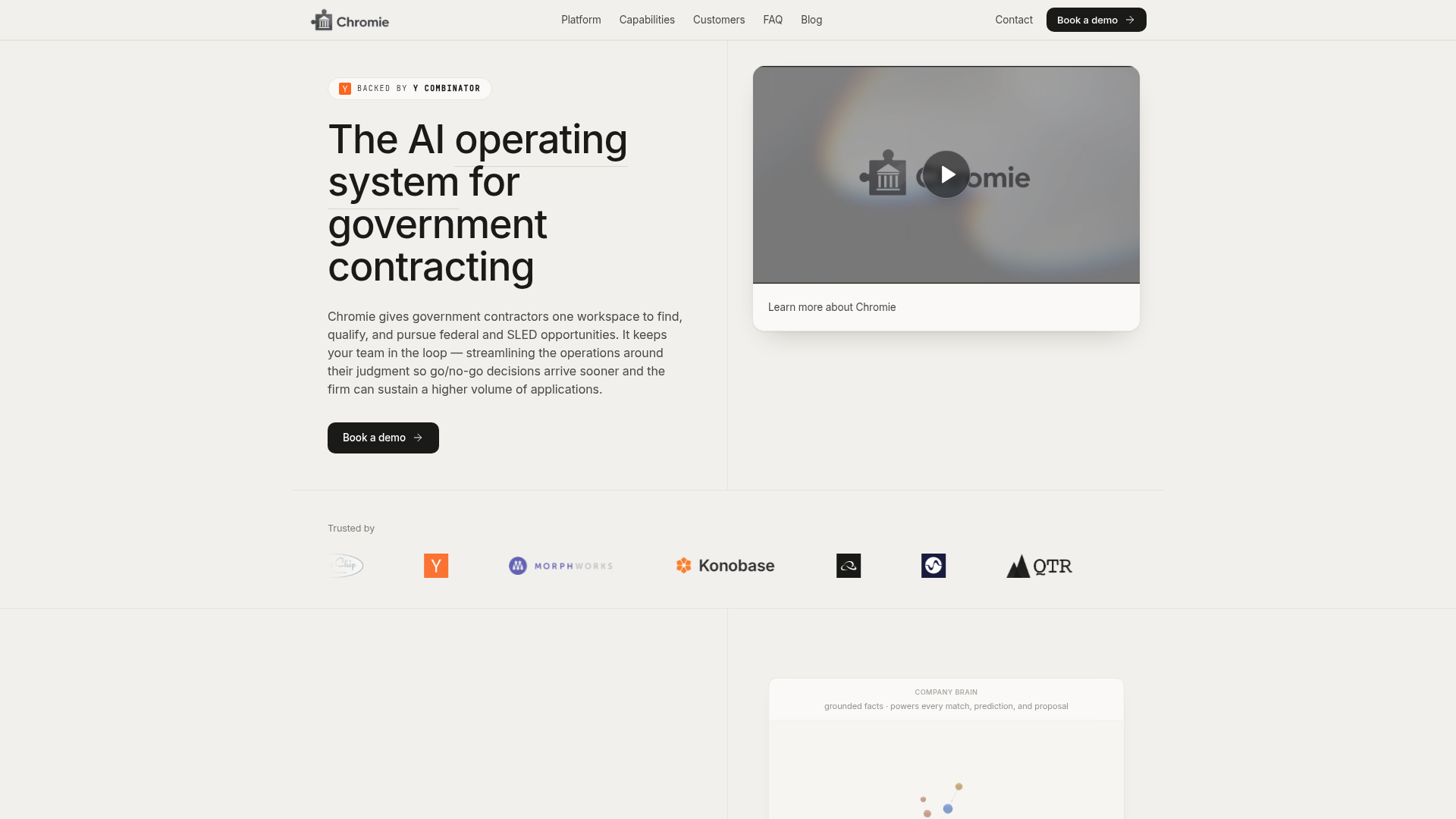
Government contracting has a dirty secret: the hardest part isn't finding opportunities. It's figuring out which ones are worth pursuing. A typical BD team at a mid-sized firm spends hours each week scrolling SAM.gov, cross-referencing NAICS codes, and reading 100-page solicitations — only to make a go/no-go decision on gut feel. Chromie, a Y Combinator-backed startup, is betting that the answer is an 'AI OS' that doesn't just surface opportunities but qualifies them, extracts requirements, and tracks every pursuit to a decision. The pitch is bold: replace the spreadsheets and portal checks with a single workspace grounded in a 'Company Brain.' But the real insight might be in how Chromie reframes the problem — not as discovery, but as pipeline management.
The real bottleneck in GovCon isn't discovery
Ask any government contractor what slows them down, and they'll likely mention the sheer noise of SAM.gov. New solicitations post daily, but most are irrelevant. The classic approach is to set up keyword alerts and then manually filter through hundreds of results. Chromie's tagline — 'AI OS for Government Contracting' — signals a different ambition. Instead of a search tool, it positions itself as an operating system for the entire business development lifecycle. The website's language is deliberate: 'find, qualify, and pursue' opportunities. That middle verb is key. Chromie's thesis is that the bottleneck is qualification, not discovery. The platform's Discover module doesn't just list opportunities; it scores each one against your firm's profile, with a rationale for the score. This turns go/no-go from an instinct into an evidence-based review.
Company Brain: why fit scores need a knowledge graph
What makes Chromie's fit scores different from a keyword match? The answer is the Company Brain. This is a living map of your firm's knowledge — past performance, team credentials, capabilities, and even documents. Instead of a static profile, the Brain grounds every match and prediction in verified facts. For example, if a solicitation mentions a specific past performance requirement, Chromie can check whether your firm has a relevant contract in its history. The Brain is visualized as a 3D graph, which is a nice touch for demos, but the substance is in the grounding. It's not just a vector database; it's a structured knowledge graph that powers every fit score, capture assessment, and draft. This is a meaningful differentiator from generic AI copilots that lack context.
Recompete radar: reading the tea leaves before SAM.gov
The most intriguing feature on Chromie's site is the Recompete module. It analyzes expiring contracts, incumbent positions, and agency budget signals to predict when a contract will return to market — before the official notice posts. This is the kind of intelligence that can give a contractor a serious edge. The examples on the site show predicted windows and estimated values, along with the program contacts who own the requirement. This moves beyond simple discovery into strategic capture. It's the difference between waiting for an RFP and positioning yourself months in advance. The feature is still early, and the accuracy is unproven, but the concept is compelling.
Capture as a checklist, not a novel
Once an opportunity is flagged, Chromie's Capture module reads the solicitation and extracts the key details: evaluation criteria, page limits, deadlines, set-asides. It maps each requirement against your capabilities and produces a readiness assessment. The demo shows a solicitation text on the left and structured fields on the right — a clean transformation. This is where AI can genuinely save hours. Instead of a BD analyst manually parsing a 100-page PDF, Chromie does it in seconds. The extracted requirements are tied to their source sections, so your team can verify the AI's work. This is a smart design choice: it keeps humans in the loop, which is critical in a field where mistakes are costly.
The pipeline that closes the loop
All of this feeds into the Pipeline module, a lifecycle board that tracks each pursuit from flagged to awarded. It monitors amendments and award notices automatically, so the record stays current. This is the operational backbone that makes the 'OS' claim credible. The pipeline isn't just a CRM; it's a feedback loop. When a contract is awarded, the outcome feeds back into the Company Brain, improving future fit scores and capture assessments. This is the kind of compounding value that makes a platform sticky.
What 'Chromie' says about the ambition
The name itself is a choice. 'Chromie' doesn't scream 'government contracting.' It sounds more like a color or a browser extension. But that might be intentional. The brand is aiming for a broader vision — an AI OS that could extend beyond GovCon. The domain, chromie.dev, reinforces a developer-friendly, modern vibe. It's a departure from the typical GovCon naming conventions (think 'GovWin' or 'Deltek'). This could be a risk: it might confuse buyers who expect a more traditional brand. But it also signals a new generation of tools that treat government contracting as a data problem, not a paperwork problem. The Y Combinator backing adds credibility, but the name is a bet that the category is ready for a fresh identity.
Who should care (and what's still unproven)
Chromie is built for small and mid-sized government contractors who want to scale their BD efforts without hiring a team of analysts. The customer testimonial from Snovation — a firm that found an RFI their existing process missed — is a good sign. But the site doesn't disclose pricing, and the accuracy of the recompete predictions is unverified. The platform is also new, so the long-term value of the Company Brain is yet to be proven. Still, for a firm drowning in SAM.gov alerts, Chromie offers a compelling alternative: a system that doesn't just find opportunities but qualifies them, extracts the details, and tracks every pursuit to a decision. That's the kind of tool that could change how small firms compete with the big players.
Chromie is a product to watch. It's tackling a real pain point with a thoughtful architecture that puts evidence first. The name might be unconventional, but the approach is anything but. If the recompete radar works as advertised, Chromie could become the default OS for GovCon BD teams.