COACH
AI coaching for field sales: analyze every call, master one skill at a time.
NewName Editorial
Editorial Team

Field sales has a coaching problem that software has mostly ignored. Inside sales got Gong, Chorus, and a dozen other conversation-intelligence tools. But the rep knocking on doors, standing in a showroom, or sitting at a kitchen table during an in-home pitch? They still get feedback the old way: a manager rides along once a quarter, takes a few notes, and hopes the next ride-along happens before bad habits harden.
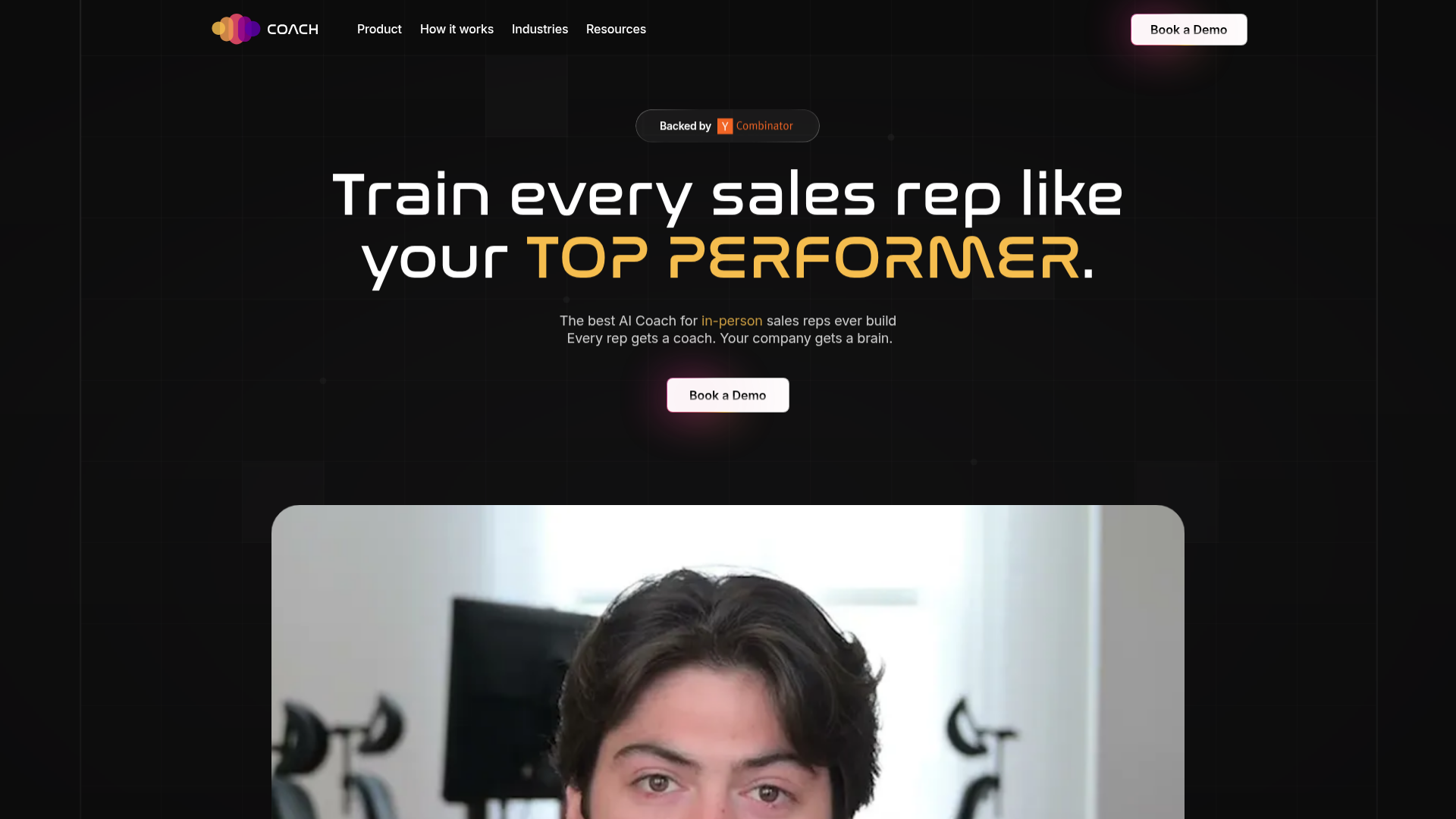
COACH, a Y Combinator-backed startup, is building specifically for that neglected slice of the sales world. Its pitch is blunt: "Make every rep sell like your best one." The product records and analyzes in-person sales conversations, then delivers automated coaching that focuses on one skill at a time. The company calls itself "the AI coach for in-person sales reps," and the name is both a category statement and a promise that most sales tools don't make.
The 20% rule that breaks traditional coaching
The site opens with a statistic that will feel familiar to anyone who has managed a sales team: "20% of reps drive 80% of the revenue." It's the Pareto principle applied to sales, and COACH's argument is that the gap between the top fifth and everyone else isn't a talent problem—it's a coaching problem. Top performers get there because they've internalized the right questions, the right objections, and the right closing techniques. Everyone else is left to figure it out through trial and error, with a manager who has maybe ten reps and hundreds of meetings to oversee.
"Managers can't be everywhere" is the headline, and it's the core problem COACH is trying to solve. One manager, ten reps, hundreds of meetings—the math doesn't work. Traditional coaching depends on a human being physically present, which means it's rare, inconsistent, and often too late. COACH's answer is to make coaching asynchronous and always available, using AI to analyze every conversation and tell each rep what to work on next.
The ride-along problem: why coaching feels like chaos
The site calls out the chaos of ride-alongs: "Three ride-along this week. None the next." That inconsistency is a feature of the old model, not a bug. When coaching depends on a manager's calendar, it's inevitably sporadic. Reps don't know what to fix first, or whether they're improving, because the feedback comes in bursts and then disappears.
COACH's solution is to replace the ride-along with a continuous loop. Every customer meeting is recorded from the rep's phone, then analyzed instantly. The AI identifies patterns—what the rep did well, where they stumbled, which objections they failed to handle—and delivers personalized feedback. The key is that it focuses on one skill at a time, and it won't move on until that skill is mastered. That's a deliberate design choice: instead of overwhelming a rep with a list of twenty things to improve, it picks the single most impactful blocker and works on that until it's fixed.
The site shows a mock conversation where the AI says, "I analyzed your last 6 meetings. Your biggest blocker: objection handling." It's a concrete example of how the product is meant to feel: not a dashboard of metrics, but a coach that actually talks to you.
One skill at a time: how COACH turns feedback into a loop
This is the heart of COACH's methodology. The product isn't just recording and transcribing conversations; it's actively coaching. The step-by-step flow on the site shows the loop: set a coaching goal, record every customer meeting, get instant feedback, and then improve the whole organization.
The "one skill at a time" approach is a deliberate contrast to the typical sales enablement tool that dumps a library of training videos and calls it a day. COACH is trying to create a continuous improvement loop that increases adoption and accelerates ramp-up. For new reps, that could mean getting them to close deals faster. For struggling reps, it could mean identifying the specific blocker that's holding them back. For top reps, it could mean refining skills that are already strong.
The site claims this loop "turns coaching into measurable revenue," and while that's a bold claim, the logic is sound: if every rep improves even slightly, the aggregate impact on revenue could be significant. The question is whether the AI feedback is good enough to actually move the needle, and that's something the site doesn't yet prove with hard numbers.
The sales brain: what happens after the meeting
Beyond individual coaching, COACH positions itself as building a "Sales Brain" for the company. Every conversation becomes knowledge. The AI can identify winning behaviors, spot trends across teams, and answer leadership questions like "Why is Texas performing 2x better than California?" Instead of dashboards, managers get answers. Instead of gut feelings, they get data.
This is where COACH moves from being a coaching tool to a strategic asset. The same recordings that train individual reps also feed a company-wide intelligence layer. If the product works as advertised, it could reveal why certain regions outperform others, which objections are most common, and which closing techniques actually lead to deals. That's the kind of insight that could change how a company hires, trains, and deploys its sales force.
But this is also the most ambitious part of the pitch, and the site doesn't offer much detail on how the Sales Brain works in practice. It's a promise that every conversation makes the company smarter, and it's a compelling vision. The risk is that it's easier to imagine than to execute—especially for a startup that's just getting off the ground.
Naming a category: why 'COACH' is both a promise and a risk
The name "COACH" is a bold choice. It's generic, but it's also aspirational. The company is claiming the category for itself: if you want an AI coach for sales, this is it. The domain getcoach.com is clean and memorable, and the brand is immediately understandable. There's no need to explain what the product does—the name says it all.
But the genericness is also a risk. "Coach" is a common word, and it's already used by many other products and services. It's hard to trademark, and it could be confusing in search results. The company is betting that it can own the term in the context of sales coaching, and that's a big bet. The tagline "The AI coach for in-person sales reps" helps narrow the meaning, but it also limits the product's scope. If COACH ever wants to expand beyond sales, the name could become a constraint.
For now, the name works because it's memorable and it promises a human-like relationship—a coach, not a tool. That's a clever positioning move in a market full of "conversation intelligence" and "sales enablement" jargon. COACH is saying: we're not just another analytics platform; we're the thing that makes you better.