Impact-Site-Verification: 41b53a0c-6d04-458b-a457-fe9e29acde1a

Fintech & Web3·Unknown··4 min read

Codelet

Drop-in usage and credit-based billing for Stripe & Paddle, with agent-ready setup.

NN

NewName Editorial

Editorial Team

Codelet product image 1
Codelet product image 2
Codelet product image 3

Codelet is not another billing platform trying to replace Stripe. It's a layer that sits on top, taking over the metering and rating logic that Stripe and Paddle handle poorly. The pitch is simple: keep your payment provider, add Codelet for the complex billing math. And it's betting that AI agents, not sales calls, will be how developers integrate it.

The billing layer Stripe never became

Stripe and Paddle are excellent at checkout, tax, and payouts. But their native usage-based billing is often a second-class citizen—rigid tiers, limited hybrid models, and a catalog that's hard to change without engineering work. Codelet's founding observation is that billing logic shouldn't be fused to payment processing. It separates the two: Stripe or Paddle moves money, Codelet decides how much to charge.

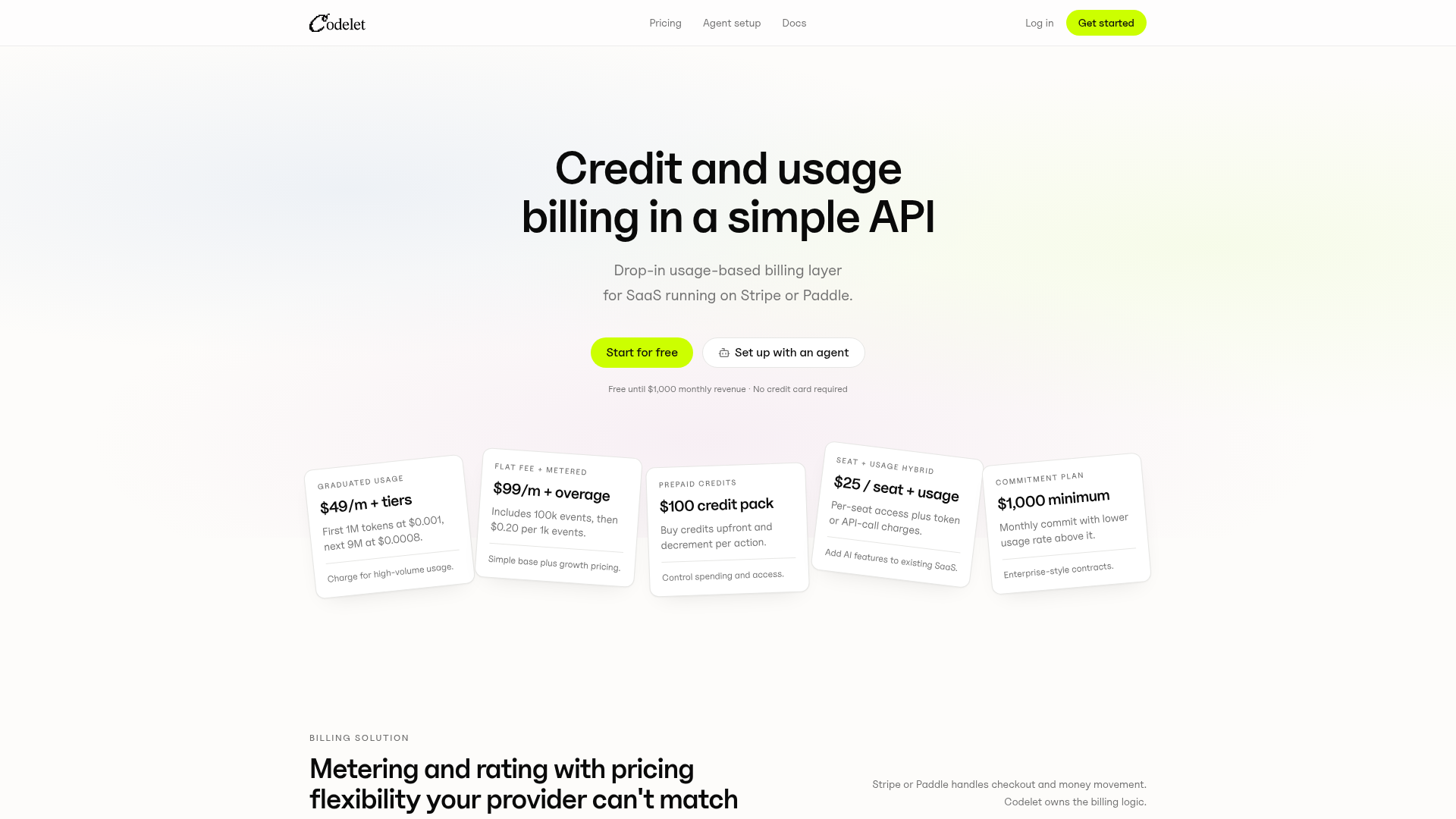
That separation lets Codelet offer what the providers can't: graduated usage, flat fee plus metered overage, prepaid credits, seat-plus-usage hybrids, and commitment plans. The website shows concrete examples—$49/month plus tiers for tokens, $99/month with 100k events included then $0.20 per 1k, a $100 credit pack, $25 per seat plus usage. These are the pricing models that AI startups and API products actually need, but which are painful to build natively on Stripe.

Codelet positions itself as the "billing logic" owner, while the provider handles "checkout and money movement." That's a clean division, and it's what allows Codelet to promise pricing changes without a redeploy—edit a tier in the dashboard, and new rates go live instantly.

Five pricing models, one API

The core of Codelet is a small API: ingest usage, create checkouts, check balances. The docs show a POST to /v1/ingest with a customer ID, metric, and quantity, plus an idempotency key. That's it. No complex catalog objects, no webhook spaghetti. The balance endpoint returns included and purchased credits remaining, which enables real-time feature gating.

What's notable is the breadth of pricing models packed into that simple interface. Codelet supports:

  • Graduated usage (e.g., first 1M tokens at $0.001, next 9M at $0.0008)
  • Flat fee plus metered overage
  • Prepaid credit packs
  • Seat + usage hybrid
  • Commitment plans with minimums

Each model is a different way to monetize, but they all flow through the same ingest and checkout endpoints. That's a deliberate design choice: the complexity is hidden in Codelet's rating engine, not in the developer's integration. The site even claims "unlimited pricing models," which is marketing hyperbole, but the range is genuinely broader than what Stripe's standard usage billing offers out of the box.

For AI startups, the token-based graduated tiers and credit packs are particularly relevant. The "billing for AI" resource page suggests Codelet is targeting that segment explicitly.

The agent-native bet: billing without a sales call

Codelet's most distinctive move is its agent-native setup. The site provides a SKILL.md file that coding agents like Cursor, Claude Code, or Codex can read. A starter prompt tells the agent to sign up, create a project, and mint a sandbox API key. The agent can then wire the full integration—mapping customers, adding checkouts, reporting usage, and gating features.

This is a bet that the next generation of developers will delegate infrastructure setup to AI agents, and that billing should be one of the easiest things to set up that way. It's a clever differentiator: while other billing tools compete on API cleanliness or dashboard UX, Codelet is optimizing for the agent's ability to integrate it without human hand-holding.

The agent skill is not just a gimmick. The docs include a full API reference and guides for monetizing an MCP server, which is a concrete use case for agent-driven billing. If the agent-native workflow works, it lowers the barrier to adoption significantly—no sales call, no lengthy onboarding, just a prompt.

EU infrastructure as a quiet differentiator

Codelet emphasizes that it's "Built in Europe. Hosted on EU infrastructure." The site states it's EU-made and runs on EU-based infrastructure owned by an EU company, not a US cloud with an EU toggle. For European SaaS companies dealing with GDPR and data residency concerns, this is a meaningful selling point.

It also reflects a broader trend of European startups building alternatives to US-dominated infrastructure. Codelet's pricing page even notes that it runs on Paddle to charge its own customers, which is a nice dogfooding detail.

What Codelet doesn't tell you

Codelet's public materials are light on specifics about its own traction. There's no mention of funding, customer counts, or revenue. The site says it's "free until $1,000 monthly revenue" and then takes 1% on usage-based billing above that—a simple, transparent pricing model that aligns incentives.

What's missing is clarity on how Codelet handles edge cases like proration, refunds, or complex tax scenarios. The docs cover subscriptions and invoicing, but the details are thin. For a billing tool, these are the areas where trust is built or lost. The lack of public case studies or customer logos is also notable; early adopters will need to take a leap of faith.

The bigger question is whether the agent-native approach will resonate beyond early adopters. It's a bold bet, but if coding agents become the standard way to integrate infrastructure, Codelet is well-positioned. If not, it's still a solid billing layer with a strong API.

Overall, Codelet is a thoughtful product for a specific pain point: flexible usage-based billing on top of existing payment providers. Its agent-native setup and EU focus are genuine differentiators. The pricing is fair, and the API is clean. For SaaS and AI startups that need hybrid pricing without rebuilding billing, Codelet is worth a look.