ColdVerdict
Multiple AI models debate your question until they reach a defensible verdict.
NewName Editorial
Editorial Team


When the AI says yes, but you should hear no
Ask a single chatbot a hard question, and it will usually tell you what you want to hear. That's not a bug—it's how these models are trained. They optimize for plausible, satisfying answers, not for poking holes in your reasoning. ColdVerdict's entire premise is that this is a problem worth fixing, and its fix is refreshingly literal: instead of one AI giving you a single perspective, it assembles a panel of frontier models and makes them argue until they converge on something you can actually defend.
The pitch is direct: "One question. Multiple AIs. One verdict." The site doesn't mince words about what it's selling. It's not another chatbot that answers questions; it's a structured adversarial process that cross-examines arguments from several models. The tagline is almost a dare—a verdict sounds final, like a jury's decision, not a suggestion. That's the point. ColdVerdict wants to be the tool you use before you make a decision you can't afford to get wrong.
The adversarial process: parallel stances, not polite agreement
The core mechanic is what ColdVerdict calls a "structured adversarial process," and it's designed to avoid the two failure modes of ordinary AI interaction: sycophancy and anchoring.
First, all models read your question in isolation and commit to a stance before any debate begins. This is a deliberate move to prevent anchoring—the phenomenon where an early answer contaminates later ones in a sequential chain. In a typical prompting chain, the first model's response biases everything that follows. ColdVerdict initializes all models in parallel, so each position is genuinely independent. As the site puts it, "This eliminates anchoring, the root cause of AI sycophancy."
Then comes the cross-examination. Each model sees the full panel's arguments and must respond: challenge weak points, defend its position, or explicitly concede. The site is blunt about what this is for: "A confident argument that can't survive one round of challenge is a bad argument." Up to three rounds of this pushback force the models to either harden their reasoning or admit defeat.
Finally, the models converge on what they agree on and what they still contest. The output isn't a summary—it's a structured verdict with the consensus conclusion, the strongest arguments, and the dissenting view that didn't win. This is the "minority report" that appears in the Pro plan, and it's a clever touch: even the losing argument gets documented, so you can see what the panel almost decided.
Arena modes: the question shapes the debate
ColdVerdict doesn't just offer one generic debate format. It has five arena modes, each tuned for a different kind of decision. This is where the product shows its understanding of how people actually think about hard choices.
- Hard Decision is for personal or professional stakes. The example questions are painfully specific: "Should I quit my Big Tech job to join a Series A startup as employee #12?" or "Should we let go of our best engineer who's damaging team morale?" These aren't abstract dilemmas; they're the kind of questions that keep people up at night.
- Break This puts models in the role of adversarial critics. Their only job is to find holes in your plan. The site's example: "We're launching a SaaS for freelancers to automate invoicing at $29/mo. We have a waitlist of 600 and plan to go live in 8 weeks with a team of 2." You can almost hear the models sharpening their knives.
- Startup Pitch simulates a VC-style critique. Models act as experienced investors and focus on market size, unit economics, and founder-market fit—"without the politeness."
- Brainstorm is the creative mode. Models generate ideas independently, then challenge each other's suggestions. The adversarial format filters out the obvious and surfaces the overlooked.
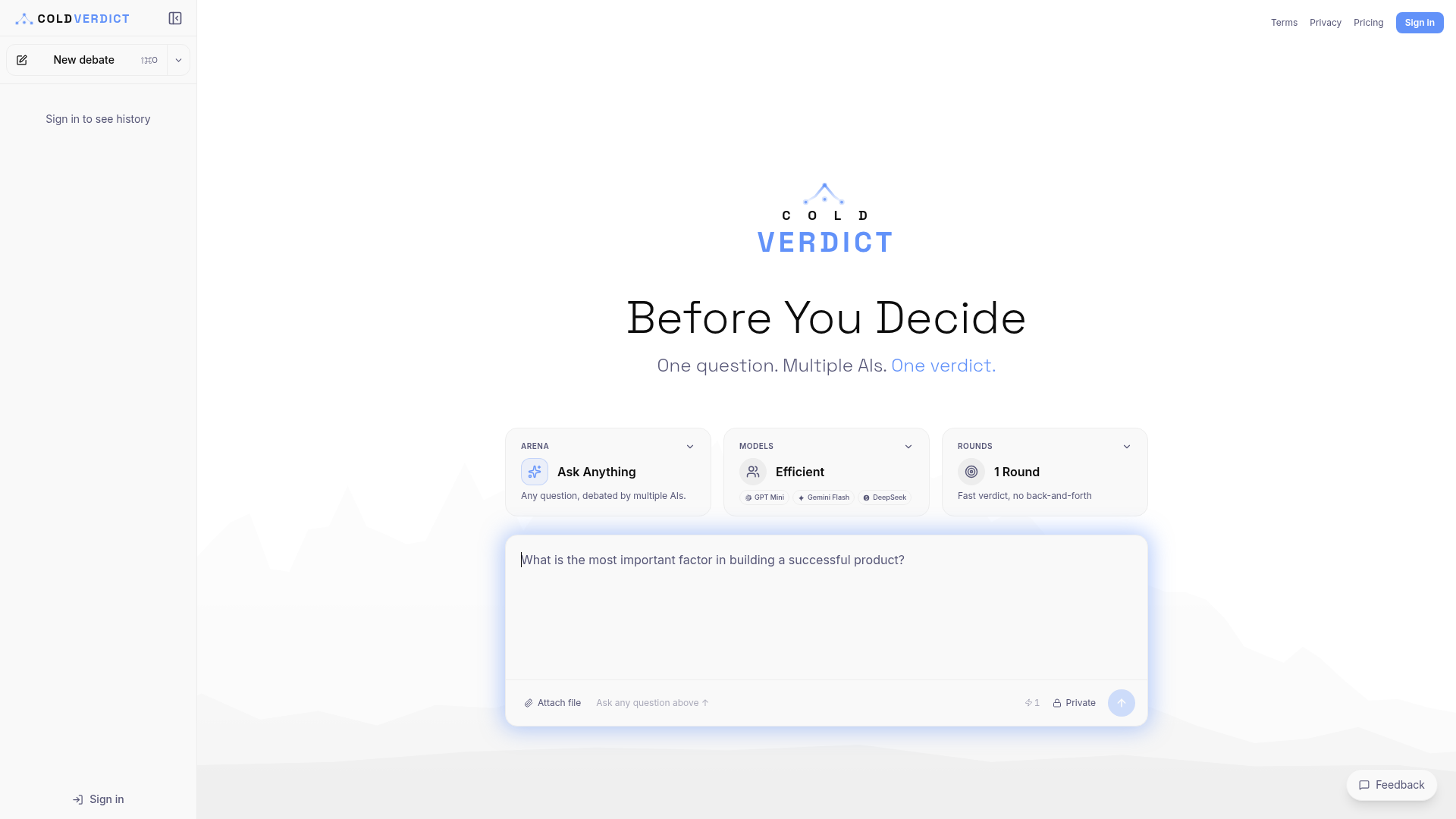
- Ask Anything is the general-purpose mode, for when you suspect the obvious answer is wrong and want a full debate.
Each mode has its own example prompts, which are remarkably well-written. They read like real problems from real people, not generic filler. This specificity suggests the team has put real thought into who their users are and what they're struggling with.
Verdict, not answer: the output is a decision memo
The output of a ColdVerdict debate isn't a chat log. It's a "Decision Memo"—a structured document that includes the consensus conclusion, the strongest arguments, and the dissenting view. On the Pro plan, you can export this as a PDF in either a magazine style or a formal style. The enterprise tier offers white-label output.
This is a deliberate positioning choice. A memo is something you can take to a meeting, share with a co-founder, or file away as documentation of your reasoning. It's not just an answer; it's evidence that you considered multiple perspectives before acting. The site's language reinforces this: "Not a summary. A verdict the panel was forced to reach."
There's also a "consensus score" mentioned in the Uneed Best listing, showing how strongly the models agreed. This adds a quantitative element to the qualitative debate, giving users a quick sense of how much confidence to place in the result.
Pricing the debate: credits, model tiers, and the free plan
ColdVerdict uses a credit system that scales with model quality and debate depth. Efficient models (GPT-5 Mini, Gemini Flash, DeepSeek) cost 1 credit per debate, while deep frontier models (GPT-5.5, Claude Opus 4.8, Gemini 3.1 Pro) cost 3 credits. Any number of rounds is included in that flat price.
The free plan gives you 3 credits per month, which is just enough to try it out. The Starter plan at $19/month gives you 20 credits, which works out to 6 debates with frontier models or 20 with efficient ones. Pro at $49/month bumps that to 75 credits (25 frontier debates) and adds features like custom model selection, panel analytics, and the minority report. Ultra at $99/month offers 200 credits and no watermark on exports.
This pricing structure is interesting because it ties cost to the value of the debate, not just the number of questions. A hard decision that requires frontier models and multiple rounds costs more than a quick brainstorm with efficient models. It's a sensible way to align pricing with the perceived stakes of the decision.
The name says it all: cold, final, and a little intimidating
The name "ColdVerdict" is a strong piece of branding. "Cold" suggests objectivity, detachment, and a lack of emotional bias—exactly what you want from a tool that's supposed to challenge your thinking. "Verdict" implies a final, authoritative decision, not just a suggestion. Together, they promise a process that is dispassionate and conclusive.
The domain, coldverdict.com, is clean and memorable. It's a compound word that's easy to spell and type, and it communicates the product's purpose immediately. The brand voice on the site matches: direct, confident, and unafraid to be blunt. "A confident argument that can't survive one round of challenge is a bad argument" is the kind of line that makes you trust the product.
There's a slight risk in the name: "cold" can also feel impersonal or harsh. But for a tool that's explicitly designed to be adversarial, that's probably the right tone. You're not coming to ColdVerdict for comfort; you're coming for a stress test.
What ColdVerdict won't do for you
The site is refreshingly honest about the product's limitations. In a section titled "What this is not," ColdVerdict explicitly says it's not a chatbot, a real-time research tool, or a writing assistant. It even links to ChatGPT, Claude, and Gemini for those use cases, and to Perplexity for web-grounded answers.
This is a smart positioning move. Instead of trying to be everything to everyone, ColdVerdict owns its niche: structured adversarial debate on reasoning, not retrieval. The site notes, "Cold Verdict works on reasoning, not retrieval. If your question depends on today's data, you need web search." That's a clear-eyed acknowledgment of what the product can and can't do.
There's also a disclaimer at the bottom: "For informational purposes only. Not legal, financial, medical, or fiduciary advice." This is prudent, given the high-stakes decisions the product is marketed for. It's a reminder that even a panel of AIs isn't a substitute for professional counsel.
ColdVerdict is a bold bet on a simple idea: that forcing AI models to disagree will produce better decisions than letting one model agree with you. Whether it works depends on whether users trust a verdict from a panel that can't truly disagree—but the product is designed to earn that trust, one debate at a time.