CVoria
From CV analysis to interview prep, one connected job search workflow.
NewName Editorial
Editorial Team


The job search has a dirty secret: most tools only fix one piece of it. You polish your resume on one site, guess at keywords on another, and then improvise the interview. CVoria, a Sweden-based startup, is betting that the real pain isn't a single document—it's the disconnected pipeline from application to offer.
The product's tagline—"Turn your CV into job offers with AI"—sounds like another resume booster, but the website reveals a more ambitious thesis: a single workflow that carries you from a raw CV to a scored job listing, a tailored cover letter, and even mock interview practice. The question is whether that integration is a genuine advantage or just a bundle of features.
The job search is a pipeline, not a document
Most job seekers treat the CV as the product. They polish it, send it out, and wait. But the hiring process is a sequence of gates: the ATS filter, the recruiter's 30-second scan, the cover letter, the interview. Each gate has its own failure mode, and fixing one doesn't help if the next one trips you up.
CVoria's website makes this explicit with a "one connected job search workflow." The homepage walks through four stages: create or improve your CV, score real job listings, generate tailored cover letters, and practice interviews for the jobs that move forward. This isn't a feature list; it's a funnel. The product is designed to keep you inside its ecosystem from first application to final interview.
That's a meaningful departure from category norms. Tools like Jobscan focus on ATS optimization, while Zety is a builder. CVoria is trying to be the control center for the entire search. The risk is that breadth dilutes depth, but the company's early tester feedback—quotes from a UK recruiter and a US tech entrepreneur—suggests the workflow feels coherent.
Where CVoria sits in the workflow
The core entry point is the CV analyzer. You upload a PDF or DOCX, and CVoria returns a score with sub-scores for content, formatting, and structure, plus an ATS readiness check. The site shows an example: 84/100 overall, with improvement suggestions like "Add measurable results to your latest role." This is the hook—free, instant, and actionable.
But the analyzer is just the front door. Once you have a CV, you can paste a job listing to see a "resume fit score"—the example shows 92% fit for a Marketing Manager role—and save the job to track its status. From there, CVoria generates a cover letter tailored to that specific job, using both your CV and the job description. Finally, it offers interview practice with role-specific questions and feedback on clarity, relevance, and structure.
This is a deliberate sequence. Each step feeds the next: the CV is the base, the job score tells you where to target, the cover letter is built from the saved job, and the interview prep uses the same context. It's a closed loop, and it's what separates CVoria from a generic AI prompt.
The CVoria Engine vs. the generic AI prompt
The website includes a direct comparison that reveals the product's core value proposition. On one side, a "Generic AI Prompt" produces: "I am a highly motivated and passionate individual seeking a role in your esteemed organization..." The site labels this with "Fluff words | Ignored ATS | No metrics." On the other side, the "CVoria Engine" generates: "Architected automated email flows for 12,000+ users, reducing churn by 14% and directly increasing Q3 MRR by $24,000. Leveraged Agile methodologies to align cross-functional marketing and engineering teams, delivering the project 2 weeks ahead of schedule." The labels: "Hard metrics | ATS mapped | Action verbs."
The point is clear: generic AI writes prose; CVoria writes evidence. The engine is tuned for what recruiters and ATS systems actually look for—quantifiable results, action verbs, and keyword alignment. This isn't a vague promise; the FAQ explicitly contrasts CVoria with ChatGPT: "ChatGPT is a general-purpose assistant. CVoria is built specifically for resumes and job applications, with focused checks for ATS readability, structure, keyword alignment, and job-search feedback."
The company even published a benchmark blog post claiming a 60-comparison blind AI-judged test of CVoria V2 against ChatGPT, Gemini, Claude, and CVoria V1. The post is dated May 25, 2026, and the site doesn't share the raw results, but the existence of such a test signals a data-driven approach to differentiation.
The 90-day guarantee as a trust signal
The most unusual element is the "Active Search" guarantee: if you don't get hired within 90 days of active use, CVoria gives you another 3 months free. The homepage frames it with a cost calculator: adjust your target salary (say, $65,000), see that one week unemployed costs $1,250, and note that the 90-day pass is $95. The implied net gain if you get hired one week sooner is $1,155.
This is a bold move. Most SaaS products guarantee satisfaction or a refund; CVoria guarantees an outcome—a job—which is largely outside its control. The company hedges by requiring "active use," but the message is clear: we're so confident in our product that we'll stake our revenue on your results. It's a trust signal that generic AI tools can't replicate, and it aligns with the founder's stated mission in the About page: "job searching can take too much time, energy, and confidence."
Naming: CVoria and the CV-first positioning
The name "CVoria" is a portmanteau of "CV" (curriculum vitae) and a suffix that evokes "gloria" or "victoria"—winning. It's a clever construction: it leads with the document, not the job search, which reinforces the product's entry point. The domain cvoria.com is clean and brandable, and the name is short enough to remember.
But the naming also reveals a positioning choice. By anchoring on "CV," CVoria risks being pigeonholed as a resume tool, even though the product covers the entire pipeline. The tagline "Turn your CV into job offers" mitigates this by implying a transformation, but the name still points to the artifact rather than the process. In a category crowded with "resume builders" and "CV analyzers," CVoria needs to communicate its broader scope through its marketing and workflow, not just its name.
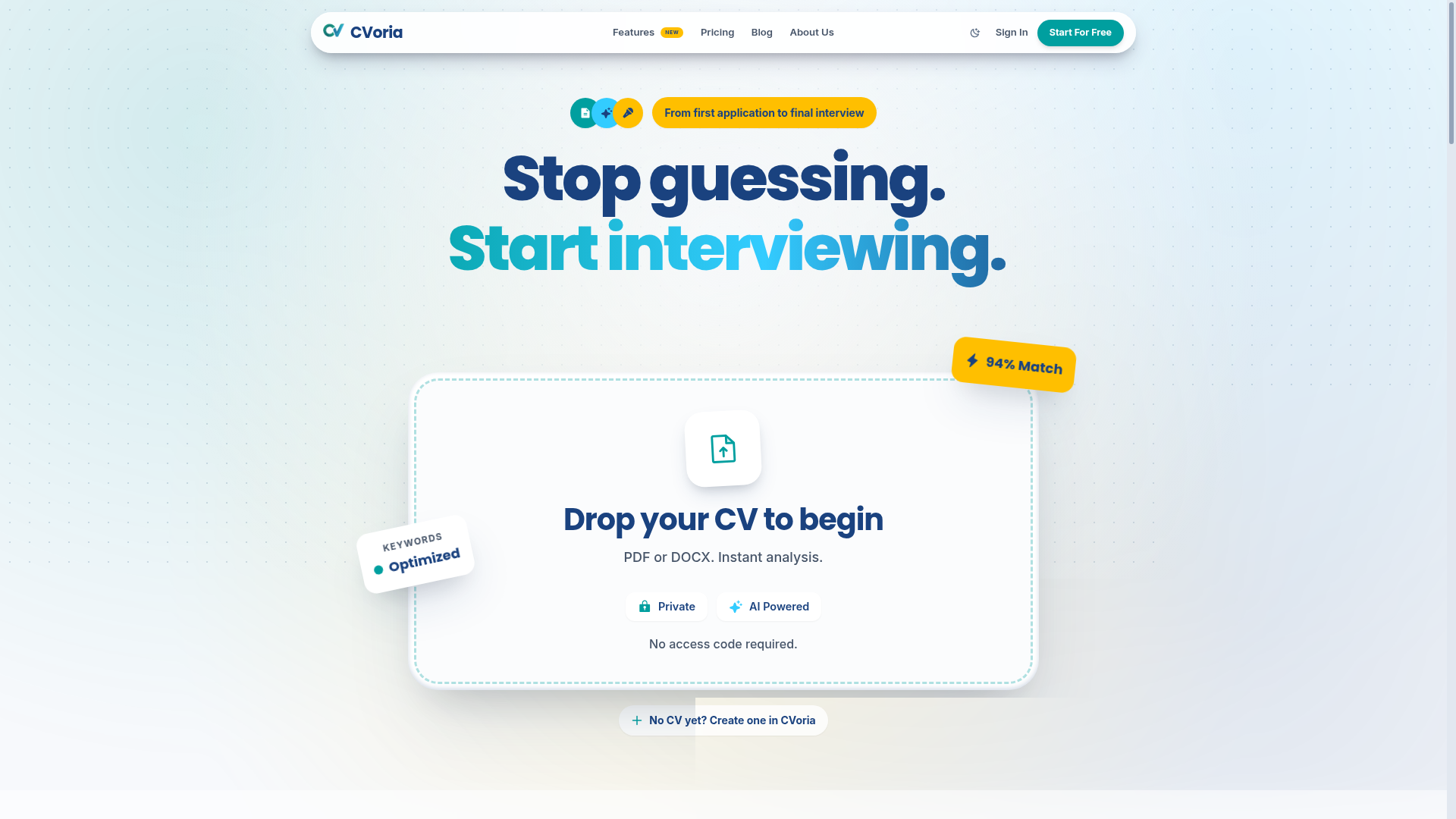
The brand voice is consistent: professional, direct, and slightly contrarian. The homepage copy—"Stop guessing. Start interviewing."—is a call to action that frames the product as a solution to uncertainty. The blog's comparison posts (vs. Resume Genius, Jobscan, Teal) position CVoria as a strategic alternative to point tools, reinforcing the workflow story.
Open questions and competitive reality
The biggest question is whether the integrated workflow is sticky enough. Job seekers are often in a hurry; they might use the free CV analysis and then bounce to a cheaper or more established tool. The 90-day guarantee helps, but it's a promise that's hard to verify from the outside.
Competition is fierce. Jobscan, Teal, and Resume Worded all have strong followings, and ChatGPT is free. CVoria's edge is its end-to-end design and its focus on outcomes, but the company is founder-led (Nils, with advisors Per and Mattias), which means limited resources for marketing. The blog's aggressive comparison content is a smart SEO play, but it remains to be seen if it converts to paying users.
Public materials don't disclose pricing beyond the "90-Day Pass" hint, and there's no funding information. The site's "Business" page suggests a B2B angle, but details are thin. For now, CVoria is a promising underdog with a clear thesis: the job search is a pipeline, and it deserves a tool that treats it that way.
Tags