Dailybot
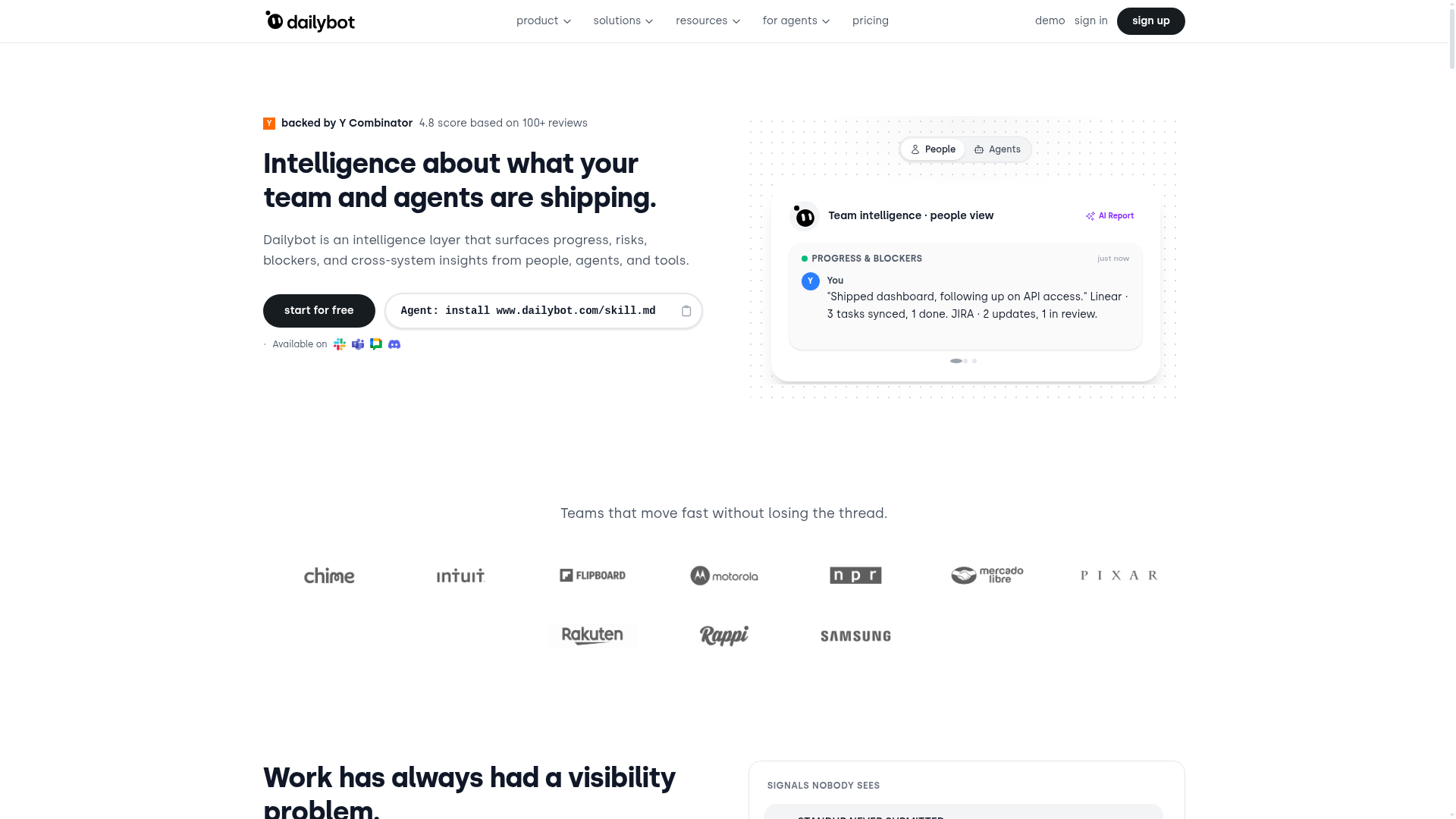
Dailybot turns private agent work into team updates, approvals, and workflows in chat.
NewName Editorial
Editorial Team


The average engineering team is running 3–8 AI agents right now. None of them report to anyone. That line, buried in Dailybot's marketing copy, is the clearest articulation of the problem the company is trying to solve. For years, async standup tools have chased a simpler goal: getting humans to type what they did yesterday. Dailybot—a Y Combinator-backed chat-native platform—has decided that's no longer enough. Its new open-source CLI and agent skill are a bet that the next collaboration layer isn't a new dashboard, but a reporting fabric where AI agents show up to standup just like people do.
The Visibility Gap That Grew When Agents Joined the Team
Work has always had a visibility problem. Updates die in threads. Blockers hide in DMs. Being busy is easy—knowing what's actually happening is the hard part. Dailybot's homepage doesn't mince words about this. But the company's sharper observation is that in 2026, that problem just doubled. Agents are already in your stack. They don't show up to standup. A visibility tool that only sees humans is half blind.
This is not a hypothetical. The site cites that the average engineering team is running 3–8 AI agents, and none of them report to anyone. Whether that number is precise is less important than the structural truth it points to: AI agents are becoming regular actors in software delivery, but they operate outside every existing reporting mechanism. A code review bot merges a PR, a deploy agent rolls back a release, a monitoring agent auto-scales infrastructure—and the team lead finds out by accident, if at all.
Dailybot's answer is to treat agents as first-class citizens in the same check-in system used by humans. The product page shows an "Agent heartbeat" view where deploy agents, CI agents, and monitoring bots post updates like "Run completed 8:45 AM, releases ready" or "Build #847 passed, coverage 94%." It's a small shift in framing, but it changes what a standup report means: not just what people did, but what the whole system—human and machine—accomplished.
From Standup Bot to Agent Reporting Layer
Dailybot started as a straightforward async standup bot for Slack, Teams, Google Chat, and Discord. The core loop is familiar: a bot asks "What did you complete yesterday?" at a scheduled time, collects responses, and compiles them into a report. Blockers get flagged, participation is tracked, and managers get a digest. That's table stakes for the category.
What's new is the agent layer. The company now positions itself as an "intelligence layer" that surfaces progress, risks, blockers, and cross-system insights from people, agents, and tools. The product has evolved from a simple polling bot to a platform with check-ins, automations, intelligence, tables, and kudos. But the most telling addition is the "for agents" section of the site, which includes an agents hub, a CLI, and agent skills. The CLI is open-source, and the skill can be installed via www.dailybot.com/skill.md. This is a deliberate move to embed Dailybot into the tooling that agents already use, rather than asking agents to log into yet another web app.
Where the CLI and Skill Fit In
The CLI is the most concrete expression of Dailybot's agent-first thesis. It allows scripts and CI pipelines to post updates to a team channel without a human typing anything. The skill, meanwhile, is a markdown file that an AI agent can read to learn how to report its work. This is a clever pattern: instead of building a proprietary agent protocol, Dailybot is piggybacking on the emerging convention of skill files that agents can ingest. The skill tells the agent how to format its updates, what channels to post to, and how to request approvals.
The practical effect is that an agent can now do what a human does in a standup: report what it did, flag a blocker, or ask for a decision. The site shows an example where a Cursor agent posts "Added API timeout handling in user-sync.ts and fixed 2 failing notification tests." That's not a human typing on behalf of the agent; it's the agent itself, speaking in the same channel where humans post their updates.
The CLI also opens the door to automation beyond reporting. Dailybot's documentation mentions approval gates for CI/CD, workflow triggers, and incident intake—all built on interactive messages. A deploy agent can request approval in Slack, and a human can approve with a click. The agent can then proceed, and the whole interaction is logged in the same thread as the standup report.
The Workflow: From Check-In to Blocker Automation
Dailybot's pitch is that visibility should lead to action, not just awareness. The product includes automations that turn check-in results into follow-up steps. The site shows a four-step example: a blocker is detected in a standup ("API key expired"), a ticket is created in Linear, the owner is notified in Slack, and the standup digest is updated. This is not just a notification—it's a workflow that moves work forward.
The intelligence layer is what makes this possible. Dailybot's AI summarizes standups, surfaces patterns, and pulls in activity from tools like Linear, GitHub, and Figma. The AI report can highlight that "Santiago has reported blockers 3 of the last 5 standups" and suggest a 1:1. This is a step beyond raw data aggregation; it's pattern recognition that a human manager might miss.
But the real differentiator is the blending of human and agent signals. A manager can ask the bot "send me today's standup report" and get a response that includes both Sarah's update and the deploy agent's status. The report is not two separate streams; it's a single view of what the team—people and machines—accomplished.
The Name That Signals a Shift
The name "Dailybot" is a relic of the product's origin as a daily standup bot. It's simple, descriptive, and easy to remember. But as the product expands beyond daily check-ins into agent reporting, real-time automations, and cross-system intelligence, the name starts to feel narrow. It still works because the daily rhythm is the anchor—the bot still checks in every day, even if the updates now come from agents too. But the "daily" part undersells the platform's ambition. It's not just about a daily report; it's about continuous visibility.
The domain dailybot.com is clean and brandable, and the name is easy to say and spell. In a category full of generic names like "Standuply" or "Geekbot," Dailybot stands out for its clarity. The risk is that it pigeonholes the product in the minds of potential customers who think "we already have a standup tool." Dailybot's marketing tries to counter this by emphasizing the "intelligence layer" and "agent reporting," but the name will always carry the legacy of its simpler past.
What Dailybot Doesn't Solve Yet
Dailybot's vision is compelling, but there are open questions. The site does not disclose how the agent skill handles authentication or whether it works with all AI agents or only specific ones. The CLI is open-source, but the platform itself is proprietary, so there's a question of lock-in. The company claims SOC 2 compliance and enterprise-readiness, but specifics on data handling for agent interactions are thin.
Another gap is the human side. Dailybot includes kudos and recognition features, but the emphasis is clearly on productivity and visibility. The site's tone is utilitarian, focused on blockers and approvals. The emotional side of work—morale, burnout, team culture—gets a nod with kudos, but it's not the core. As agents take on more routine tasks, the human need for recognition and connection may become even more important, and Dailybot's current feature set may not fully address that.
Finally, there's the question of whether teams will actually adopt a tool that requires their agents to report. Many agents are autonomous by design, and adding a reporting step could be seen as overhead. Dailybot's answer is that the CLI makes it trivial—just a few lines in a script—but it's still an extra step. The value proposition is that the visibility gained outweighs the cost. For teams already drowning in agent sprawl, that tradeoff might be worth it. For others, it might be one more tool to manage.
Dailybot is making a bet that the future of work is not human or agent, but a hybrid where both report to the same system. Whether that bet pays off depends on whether teams see agents as colleagues to be managed or as tools to be used. If the former, Dailybot is well-positioned to be the layer that makes it work. If the latter, it may be a solution to a problem that hasn't fully materialized. For now, it's a thoughtful, well-executed answer to a question that most collaboration tools are only beginning to ask.