Dawn Industries
Reads the whole cell, finds the root cause, stages a safe fix — in under a minute.
NewName Editorial
Editorial Team


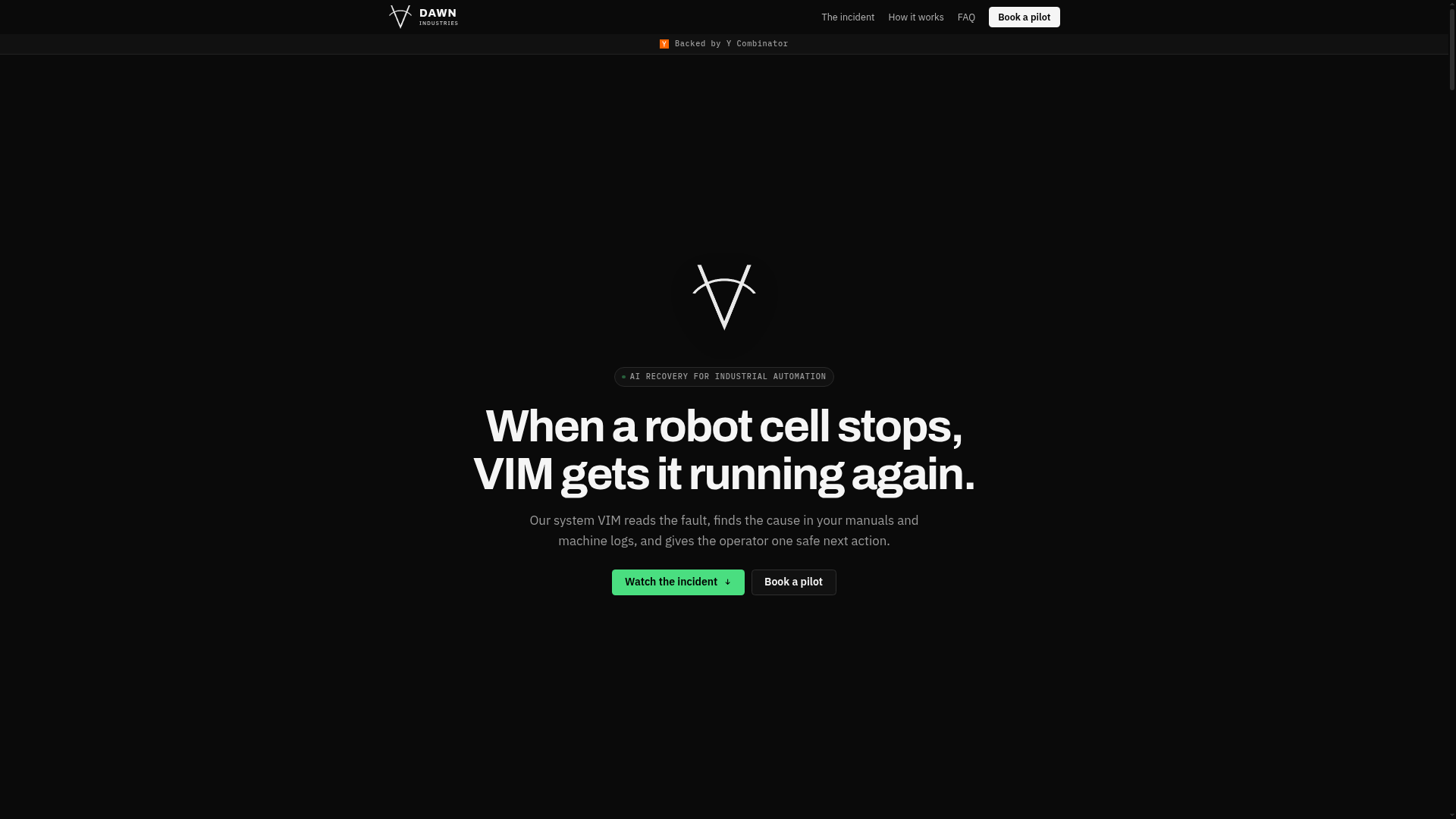
When a FANUC palletizer stops on the line, the operator doesn't need a 900-page manual. Dawn Industries' VIM system reads the fault, cross-references the OEM manual, and presents one safe next action — in 58 seconds, according to the company's simulated incident. That's the pitch, and it's a sharp one: not another monitoring dashboard, but a closed loop from alarm code to approved recovery.
The company, backed by Y Combinator, calls VIM "AI recovery for industrial automation." The product's core claim is that it understands the entire industrial cell — PLC, HMI, robot, sensors, drives — and stages the fix in minutes. The website's centerpiece is a live simulation of a real fault: a vision system raises E-4012, the arm freezes, and VIM identifies the root cause as a lighting change from a maintenance swap 22 minutes prior. The recovery plan: adjust camera exposure from 12 ms to 8 ms, verify detection, and re-home the robot. The operator approves, and the cell restarts.
The 58-second incident that defines the product
The simulated incident is the clearest articulation of what VIM does. At 14:02:19, the cell stops. VIM opens incident 2481, reads the PLC input (part present), the camera frame (98.7% of pixels clipped), and the cell history (lighting changed 22 minutes ago). It concludes with 97% confidence that the camera didn't fail — the light changed. The source is cited: Keyence CV-X manual, §14.2. The recovery plan is three steps, with a safety chain verified. Elapsed time: 58 seconds.
That timeline is the product. The alternative, shown side-by-side on the site, is 30 minutes of HMI cycling, manual searching, integrator voicemail, and a work order. VIM's value isn't just speed — it's the reduction of ambiguity. The operator gets a diagnosis with a confidence score and a source citation, not a blinking red light.
The read-only pilot: trust before write access
The FAQ is explicit: a pilot starts read-only. Write access is scoped by cell and only enabled when the team is ready. This is a critical trust mechanism. Industrial operators are rightly wary of AI that can change machine behavior. By starting read-only, Dawn Industries positions VIM as an advisory layer, not a replacement for control. The pilot measures diagnosis quality and response time before expanding scope — a sensible, low-risk entry point.
This approach also solves a classic adoption problem: the data integration. VIM reads PLC, HMI, robot, and sensor state "without changing the controls you already trust." That's a strong promise, and the read-only pilot makes it testable.
The human in the loop: why approval is a feature
VIM's recovery plan is not executed automatically. The operator must approve it. The website repeats this: "Nothing runs without a person." The safety chain — interlocks, light curtain, area scanner — is treated as a hard gate. VIM cannot bypass safety logic.
This is a deliberate design choice. In industrial settings, autonomy is a hard sell. By keeping a human in the approval loop, Dawn Industries sidesteps liability and builds trust. The operator remains in control, but with the benefit of a machine that has already done the reading and reasoning. The 30-second rollback window, shown in the mobile interface, adds another layer of safety.
Mixed-vendor by design: the integration bet
The site lists FANUC, Universal Robots, Siemens, Allen-Bradley, Cognex, and Keyence as supported vendors. That's a bold claim for a startup. Industrial automation is fragmented, and each vendor has its own protocols and manuals. VIM's ability to read across these systems is its core technical challenge. The company's bet is that a mixed-vendor cell is the norm, not the exception, and that a single AI layer can make sense of the chaos.
The evidence for this is thin — the site doesn't detail the integration architecture or list real deployments. But the product's logic is sound: if VIM can only work with one vendor, its market is limited. By targeting mixed-vendor environments, Dawn Industries is aiming at the pain point that integrators and plant engineers know well.
What the simulated timeline reveals about the pitch
The simulated incident is effective, but it's also a warning. The site is careful to label it: "Incident 2481 is simulated · Timings and economics illustrative." That's honest, but it means the 58-second claim is aspirational, not measured. The 97% confidence score is also simulated. Prospective customers should ask: how does VIM perform on real faults, especially ones that aren't in the manual?
The site doesn't disclose pricing, deployment timelines, or the size of the team. It does mention a pilot with zero upfront cost, which lowers the barrier to trial. The contact email and phone number are provided, suggesting a direct sales motion.
The limits of the evidence: what we still don't know
Public materials don't reveal how VIM handles novel faults, how it learns from cell history, or how it scales beyond a single cell. There's no mention of compute requirements, edge hardware specs, or the accuracy of the manual retrieval. The site says VIM runs on existing controls and hardware, but the details are absent.
That's not a fatal flaw — early-stage products often lack public technical depth. But it means the strongest evidence is the simulated incident itself, which is carefully constructed to show VIM at its best. The real test will come from pilots in actual plants, where the lighting changes aren't always so obvious and the manuals aren't always so clear.
Dawn Industries has built a compelling narrative: AI that doesn't just monitor, but diagnoses and stages a fix, with a human in control. The read-only pilot and safety-gated approval are smart trust signals. The mixed-vendor ambition is the right bet for the market. What remains to be seen is whether VIM can deliver on that promise outside the simulation.