DeepSmith
Track AI search visibility and produce the content to win, in one loop.
NewName Editorial
Editorial Team


Most AI content tools are half a story. They either track how your brand appears in ChatGPT, Perplexity, or Gemini — or they generate blog posts from a prompt. Rarely do they connect the two. DeepSmith's central bet is that these belong in one loop: see where AI search sends buyers to a competitor, then produce the article that wins that answer, then measure the citation rate climb. It's a simple idea, but executing it well requires more than bolting a writer onto a tracker. It requires the tracking data to feed the production pipeline directly, and the production to feed back into the metrics. That's the loop DeepSmith is trying to close.
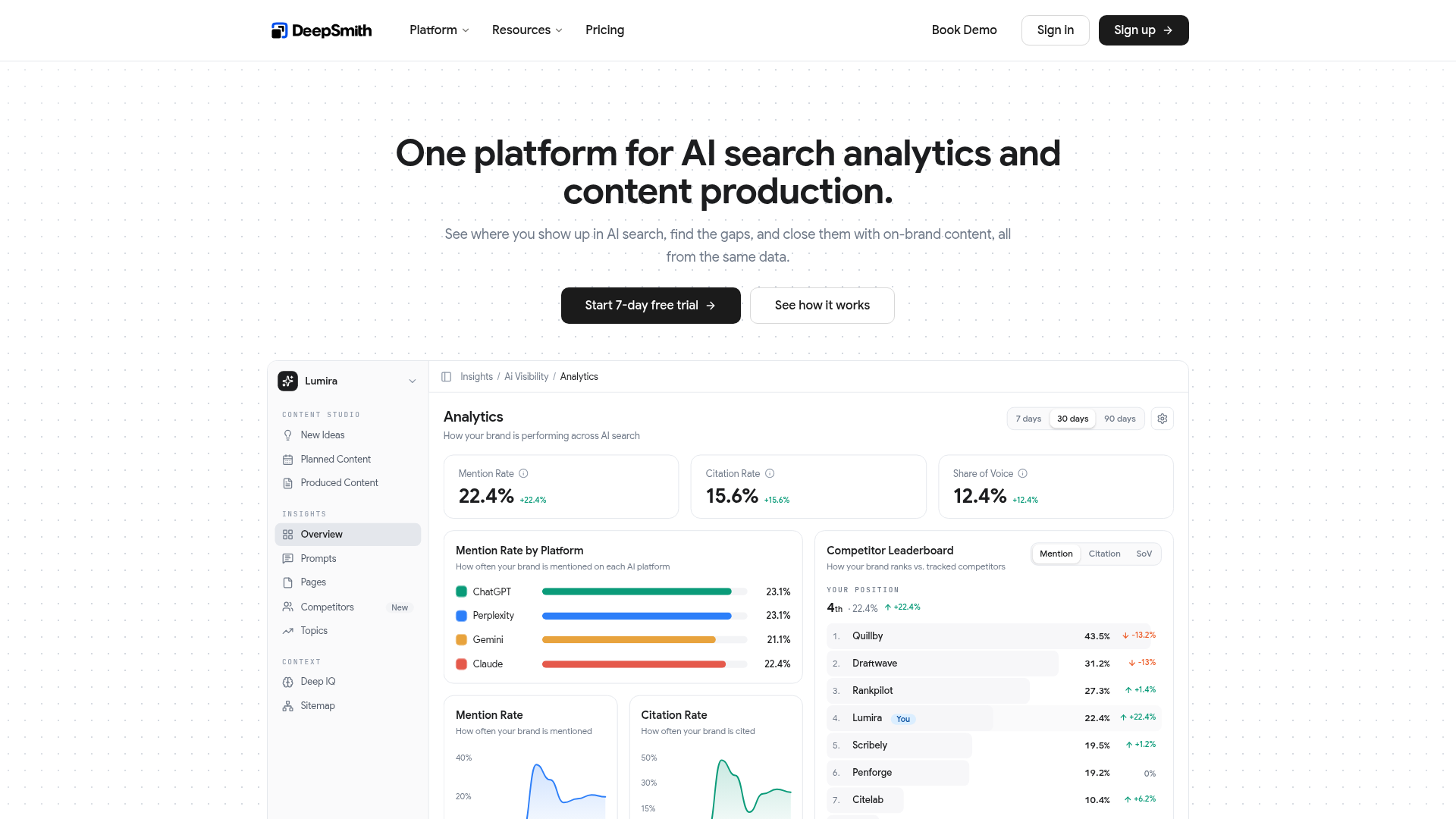
The company's tagline — "Automate content from strategy to publish, grounded in your brand context" — hints at the ambition, but the website's demo data makes it concrete. The platform tracks a fictional brand called Lumira, shows it ranking 4th for a tracked prompt, and then walks through producing an article to close the gap. It's a clever way to demonstrate the product without exposing a real customer's data, and it doubles as a case study in dogfooding.
The Loop That Most AI Content Tools Miss
The core problem DeepSmith addresses is the linear scaling of content production. Every article requires research, writing, editing, SEO optimization, internal linking, image creation, formatting, and publishing. Triple your output, and you either triple your headcount or your agency spend. DeepSmith's pitch is that AI can absorb most of that work, but only if it's grounded in your brand context — your products, personas, and voice — and only if it's pointed at the right opportunities.
What's unusual is that DeepSmith doesn't start with keywords. It starts with AI-search visibility. The platform tracks how often your brand is mentioned, cited, and given share of voice across ChatGPT, Gemini, Perplexity, Claude, and Google AI Mode. It also tracks competitor citations, watching their sitemaps daily to see which pages they publish. This is the intelligence layer that most content tools lack. They generate content based on keyword volume or search intent, but they don't know whether AI engines actually recommend your brand for a given query. DeepSmith flips that: it finds the prompts where you're losing, then produces content to win them.
Tracking the Answers You're Losing
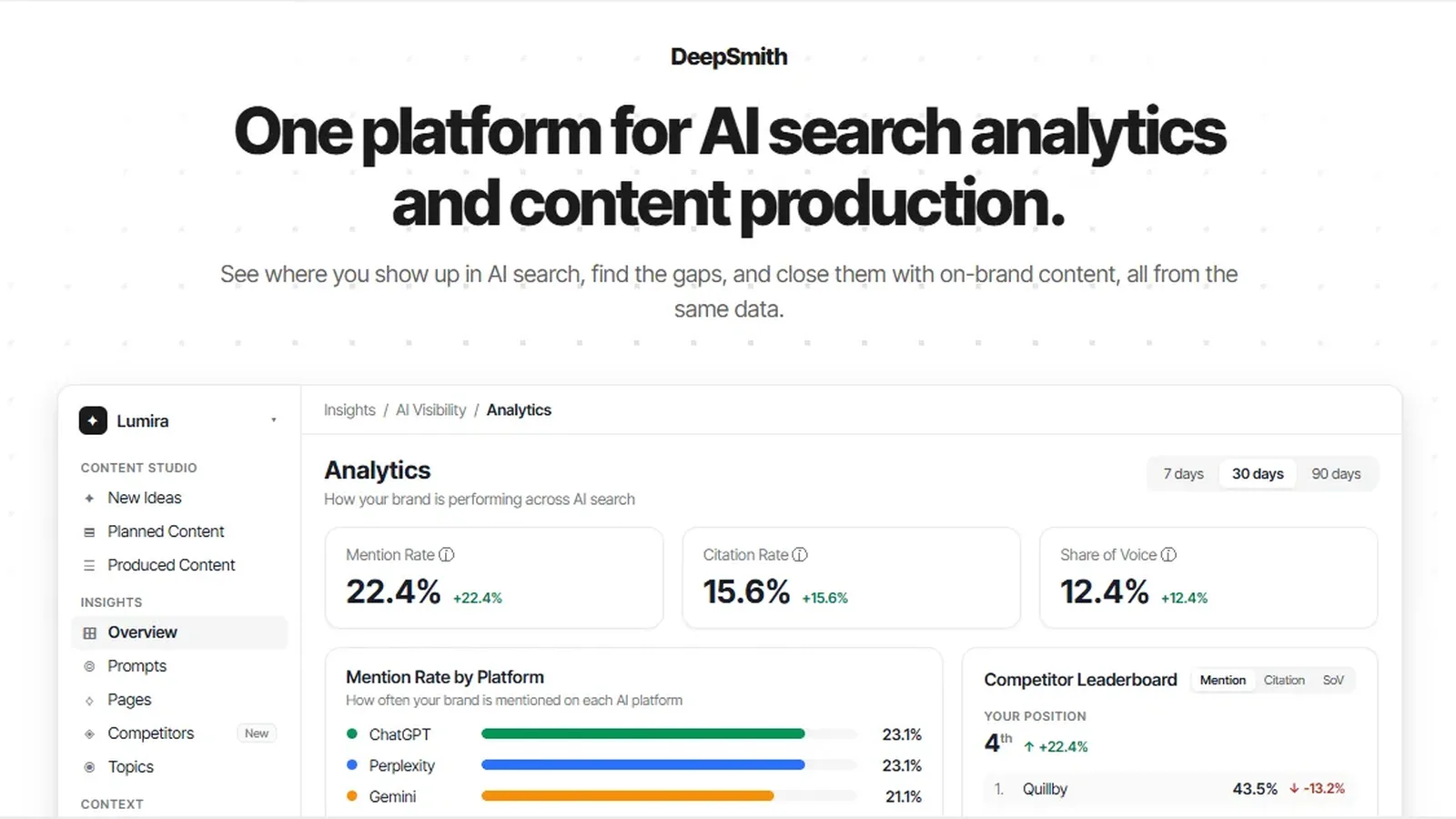
The analytics dashboard is the front door. It shows mention rate, citation rate, and share of voice over time, broken down by platform. In the demo, Lumira has a 22.4% mention rate and a 15.6% citation rate, with a competitor leaderboard showing Quillby at 43.5% and Draftwave at 31.2%. This is the kind of data that tells a marketing team exactly where they stand — and where they're invisible.
DeepSmith also tracks which of your pages get cited. The demo shows that only 38 of 142 sitemap pages are cited, with the top page earning 12 citations. That's a powerful signal for content strategy: double down on what's working, fix what's ignored, and fill the gaps where competitors win. The platform even lets you track specific prompts, like "What's the best marketing automation tool?" and see which competitors AI cites instead of you.
This is not just a vanity metric. As one customer testimonial puts it, "We are able to track the prompts for which we are ranking in AI answers and that is generating meetings for us." That's a direct revenue link, not just an SEO vanity number.
From Losing Prompt to Publish-Ready Draft
Once you've identified a gap, DeepSmith's Content Studio takes over. It generates "write-ready ideas" grounded in your product and personas, drawing from losing prompts, keyword clusters, or competitor pages. The demo shows five ideas, each tagged with a funnel stage — awareness, consideration, decision — and each aimed at answers you're losing.
From there, the platform produces a publish-ready draft. The demo article, "The Lifecycle Marketing Playbook," arrives with an SEO score of 96, an AEO checkmark, internal and external links, and a cover image already done. The draft reads like a real article, not a generic AI output. It's grounded in the brand's context through something called Deep IQ, which the FAQ describes as "your real products, personas, and voice." This is the key differentiator from a generic AI writer: the system already has the context it needs, so the drafts come out close to final.
The workflow doesn't stop at the article. Every finished piece comes with social posts ready to go — LinkedIn, X, newsletter, blog recap — all in the brand voice. This is the "strategy to publish" part of the tagline, and it's what makes the platform feel like a full editorial department rather than just a writing tool.
The 'Lumira' Demo: A Case Study in Dogfooding
One of the most interesting branding choices is the use of a fictional brand, Lumira, throughout the demo. It's not a real customer, but it serves as a perfect example of the platform's capabilities. Lumira is positioned as a lifecycle marketing automation tool for B2B SaaS, and the demo shows it losing to competitors like Quillby and Draftwave. Then it shows how DeepSmith would help Lumira win those answers.
This is smart dogfooding. It demonstrates the product in action, shows the kind of data a user would see, and makes the benefits tangible. It also avoids the awkwardness of showing a real customer's data without permission. The demo brand is woven throughout the site, from the analytics dashboard to the content studio, and it makes the product feel real even before you sign up.
From a naming perspective, "Lumira" is a strong choice — it sounds like a legitimate SaaS brand, with a nod to "luminous" or "illumination," which fits the idea of shedding light on AI visibility. It's a subtle but effective way to build credibility.
Who Actually Sits in This Workflow
DeepSmith is built for several distinct roles, and the website is careful to segment them. SEO and AEO teams get real keyword data on one side and prompt-level tracking on the other. AI-strategy teams track visibility across engines and close gaps. Content teams produce on-brand content at volume without the briefing grind. Marketing leaders get board-ready numbers: mention rate, citation rate, and share of voice, benchmarked against competitors. PR and brand teams see how often and where their brand shows up in AI answers, and which sources AI pulls from. Agencies get client workspaces, with separate brand, content, and reporting per client.
This multi-persona approach is smart because it widens the addressable market. The platform isn't just for SEO specialists; it's for anyone who owns content or AI search. The testimonial from a GTM lead at Skooc is telling: "What used to be three tools and a spreadsheet is now a single workflow. We went from four articles a month to fifteen with the same two people." That's the core value proposition: more output without more headcount.
What DeepSmith Doesn't Tell You
The website is strong on features and benefits, but it's thin on specifics about pricing, funding, or the team. The pricing page is linked but not detailed in the provided materials, and the funding stage is listed as unknown. The company behind it, OneJam CloudTech Private Limited, is mentioned in the footer, but there's no information about founders or investors. This is common for early-stage products, but it's worth noting for potential buyers who want to assess long-term viability.
There's also the question of content quality. The FAQ addresses this head-on, claiming that drafts arrive "near-final" and that the pipeline builds in structure, internal links, and E-E-A-T signals. But the proof is in the pudding — and the demo article is convincing. It reads like a real blog post, not a generic AI output. Still, the platform requires human review before publishing, which is both a safeguard and a limitation. If you're looking for a fully autonomous content engine, DeepSmith isn't that. It's a tool that makes your existing team dramatically more productive.
Another open question is the accuracy of AI-search tracking. Measuring mention and citation rates across five engines is a complex technical challenge, and the methodology isn't fully disclosed. The demo numbers look plausible, but real-world accuracy could vary. This is an area where DeepSmith will need to build trust through consistent, reliable data.
Despite these unknowns, DeepSmith's positioning is clear and compelling. It's not just another AI writer or another SEO tracker. It's a platform that closes the loop between AI-search visibility and content production, and that's a category worth watching.