Dialogus
Enterprise voice agents built for control, not just conversation.
NewName Editorial
Editorial Team
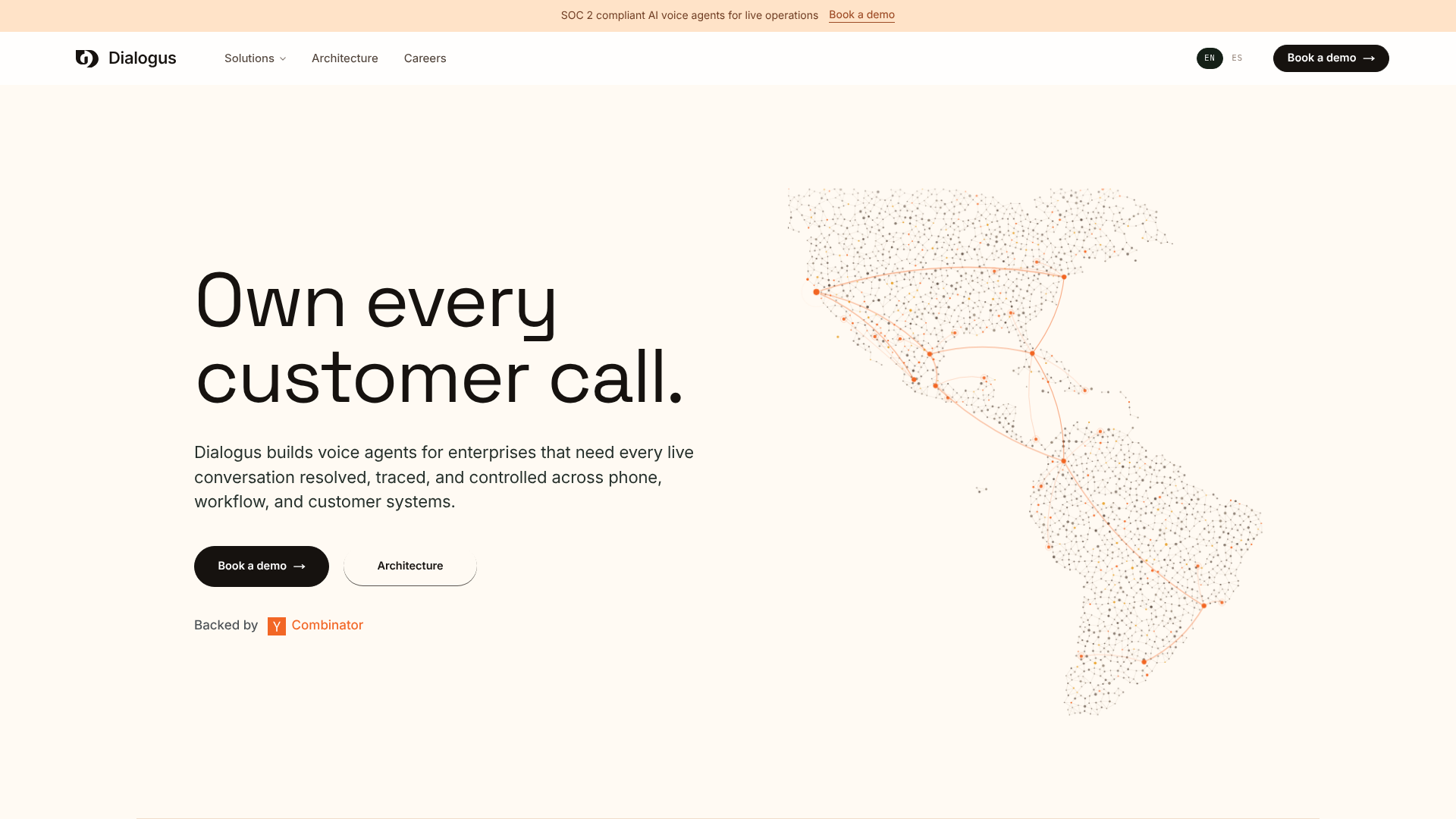


Most voice AI startups sell you a smoother conversation. Dialogus is selling something closer to a switchboard with a black box recorder: infrastructure that lets an enterprise hand live phone calls to an AI agent and still know exactly what happened, why, and what it did. The company, backed by Y Combinator, positions itself not as a chatbot vendor but as a "frontier AI voice lab" for operations where a wrong action—a misfired order, a collections call that violates policy, a support promise that isn't kept—costs more than a awkward pause.
The pitch is deliberately unglamorous. Dialogus's homepage doesn't lead with natural language breakthroughs. It leads with the word "owned": "Own every customer call." That's a promise about accountability, not fluency. And it's backed by a set of named enterprise customers—Papa Johns, KFC, Totalplay—that suggest the system is already handling real volume, though the site doesn't disclose exact call counts or performance metrics.
The voice agent that treats every call as an audit trail
Dialogus's core insight is that for enterprises, a call is not a conversation; it's a transaction with legal, financial, and operational consequences. A support agent who promises a refund, a phone order taker who enters the wrong size, a collections agent who crosses a regulatory line—these are not just conversational failures, they're liability events.
That's why Dialogus's architecture is built around a step called "evidence." Every call produces a structured record: transcript, tool results, state snapshots, latency, outcomes, and errors. This isn't a post-hoc log for debugging; it's a first-class output. The site lists "auditable tool calls" as a trust feature alongside SOC 2 compliance and human handoff. For an enterprise, that's the difference between a black box that sometimes works and a system that can be audited, defended, and improved.
The company's tagline—"Building the infra for enterprise voice agents"—signals that it wants to be the layer beneath the AI, not the AI itself. That's a bold bet in a market where most startups are racing to be the most conversational. Dialogus is betting that the enterprise buyer cares more about control than charisma.
Wildfire: a runtime that reasons inside guardrails
The heart of Dialogus's technical story is "Wildfire," its agent runtime. The name suggests speed, but the design is about constraint. Wildfire doesn't let a language model roam free; it "sees only the workflow state, policy, customer context, and tools that are valid for the current turn."
That's a meaningful departure from generic copilots. A general-purpose assistant might be able to answer any question; Dialogus's agent is confined to a specific operational context. It knows the menu, the CRM, the collections policy, the order system—and it cannot act outside those boundaries. This is how the company squares the circle of "frontier" AI and "enterprise" risk: use powerful models, but put them in a cage of business logic.
The runtime also handles the messy realities of phone audio—accents, pauses, interruptions, background noise. Dialogus treats perception (speech recognition, endpointing, barge-in) as part of the runtime, not a separate concern. That's a sign that the team understands voice is not just text with a microphone; it's a real-time, turn-based interaction where timing and interruption are as important as word choice.
Why order calls and collections are the wedge
Dialogus's solutions page lists three vertical use cases: customer support, order calls, and collections. The last two are particularly telling. Order calls—taking phone orders straight into the POS—are high-stakes, high-frequency, and relatively rule-bound. Collections calls are even more sensitive, requiring strict adherence to policy and regulation.
These are not the flashy demos you see from consumer voice assistants. They are boring, operational, and full of edge cases. But they're also where the ROI is immediate: a wrong order means a refund and a lost customer; a collections call that violates policy can mean a fine. Dialogus is targeting the workflows where mistakes are expensive, not the ones where a chatbot is just a nice-to-have.
The site's copy for each solution is terse: "Resolve live support calls end to end," "Take phone orders straight into the POS," "Recover past-due accounts within your policy." The phrase "within your policy" is the key. It's not just about getting the job done; it's about getting it done within the guardrails the enterprise defines.
The evidence layer is the product
If you read the architecture section closely, you'll notice that Dialogus's pipeline doesn't end with "act." It ends with "report." The final step writes "the transcript, latency, tools, outcome, and handoff trail for audit." This is not an afterthought; it's the product.
For an enterprise, the ability to replay a call and see exactly what the agent did—and why—is what makes AI adoption possible. It's the difference between a pilot and a deployment. Dialogus's "voice lab" loop turns production failures into "replayable scenarios, regression tests, and safer agent versions." That's a continuous improvement cycle that requires evidence as fuel.
This focus on evidence also explains the company's emphasis on "human handoff." The system escalates when needed, and that handoff is part of the auditable record. The enterprise isn't losing control; it's gaining a more detailed view of every interaction.
What Dialogus does not claim
It's worth noting what Dialogus doesn't say. The site doesn't promise 100% automation or zero human involvement. It doesn't claim to handle every call perfectly. Instead, it talks about "safe" resolution and "escalat[ing] only when needed." That's a mature, credible stance for a pre-seed company.
The public materials also don't disclose pricing, specific performance benchmarks, or detailed customer case studies. The evidence is mostly architectural and directional. That's fine for a pre-seed stage, but it means buyers will need to push for hard numbers in a demo.
Dialogus's bet is that enterprises will pay for control, not just conversation. If the evidence layer delivers on its promise, the company could become the quiet backbone for voice agents in industries where mistakes are measured in dollars and compliance fines. The name itself—Dialogus, from the Latin for "conversation"—belies the real product: not dialogue, but documentation.