DiffUI
Diffusion-generated UI options at API cost — a per-image bet against LLM design tools
NewName Editorial
Editorial Team
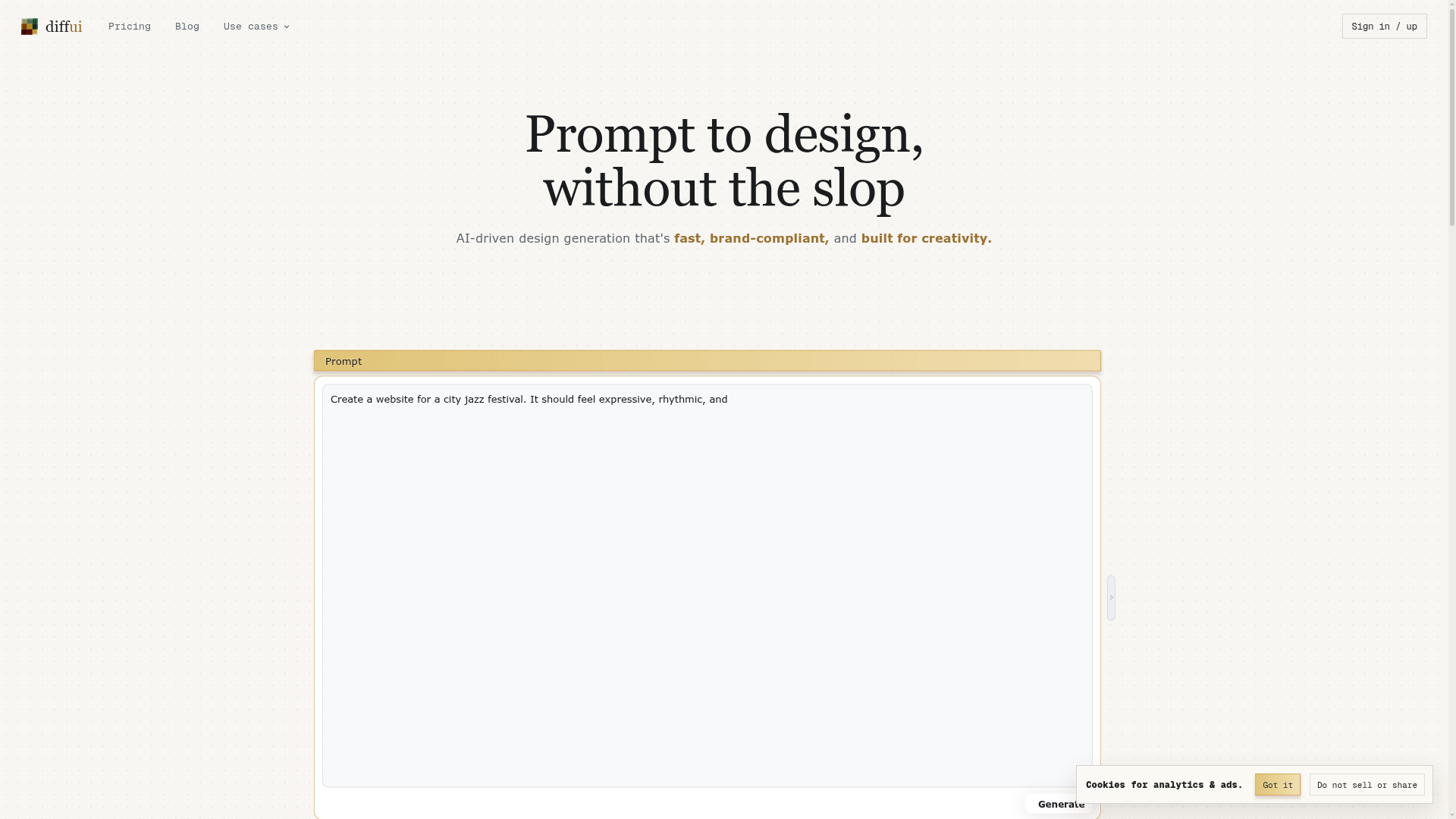
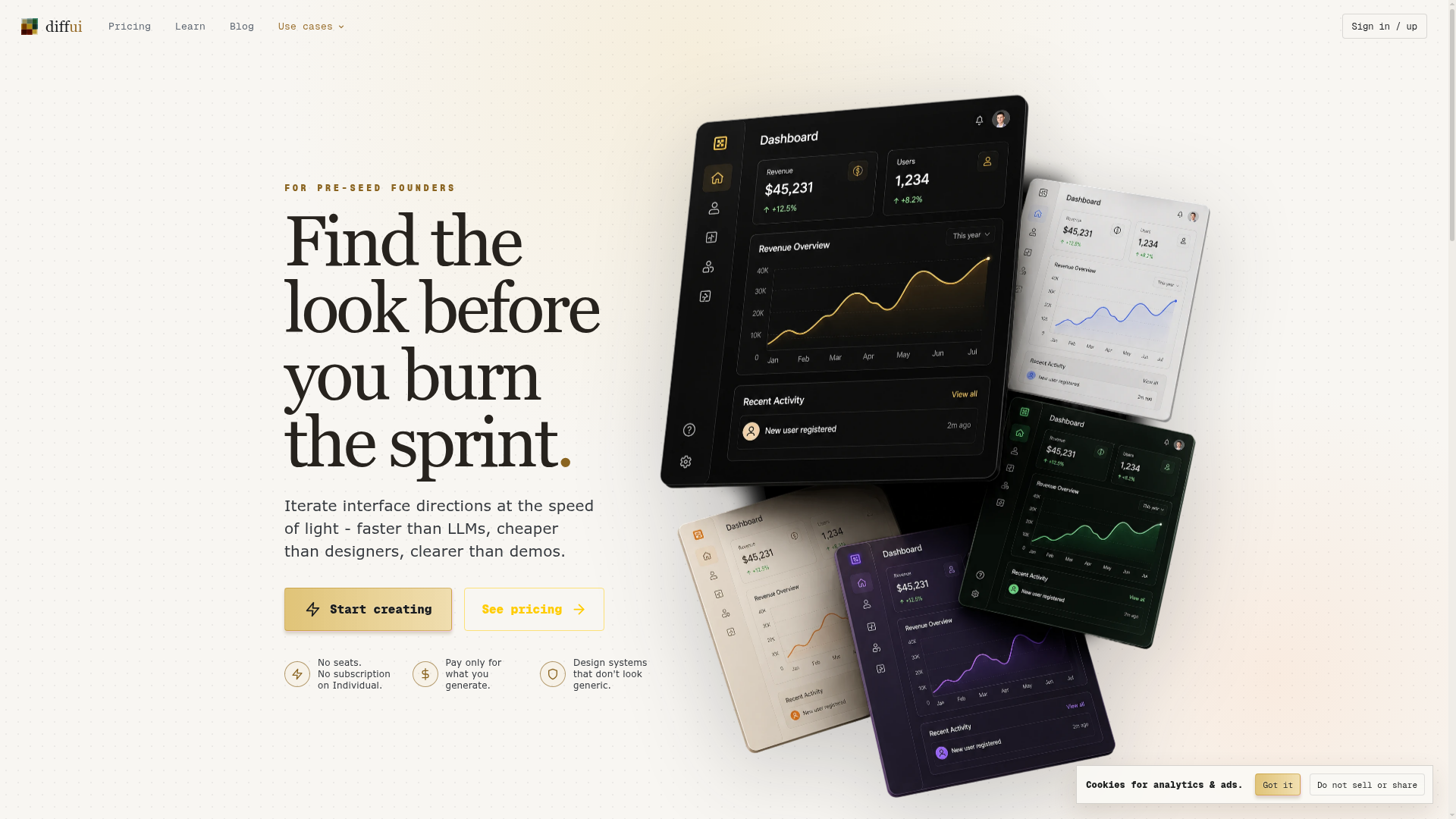
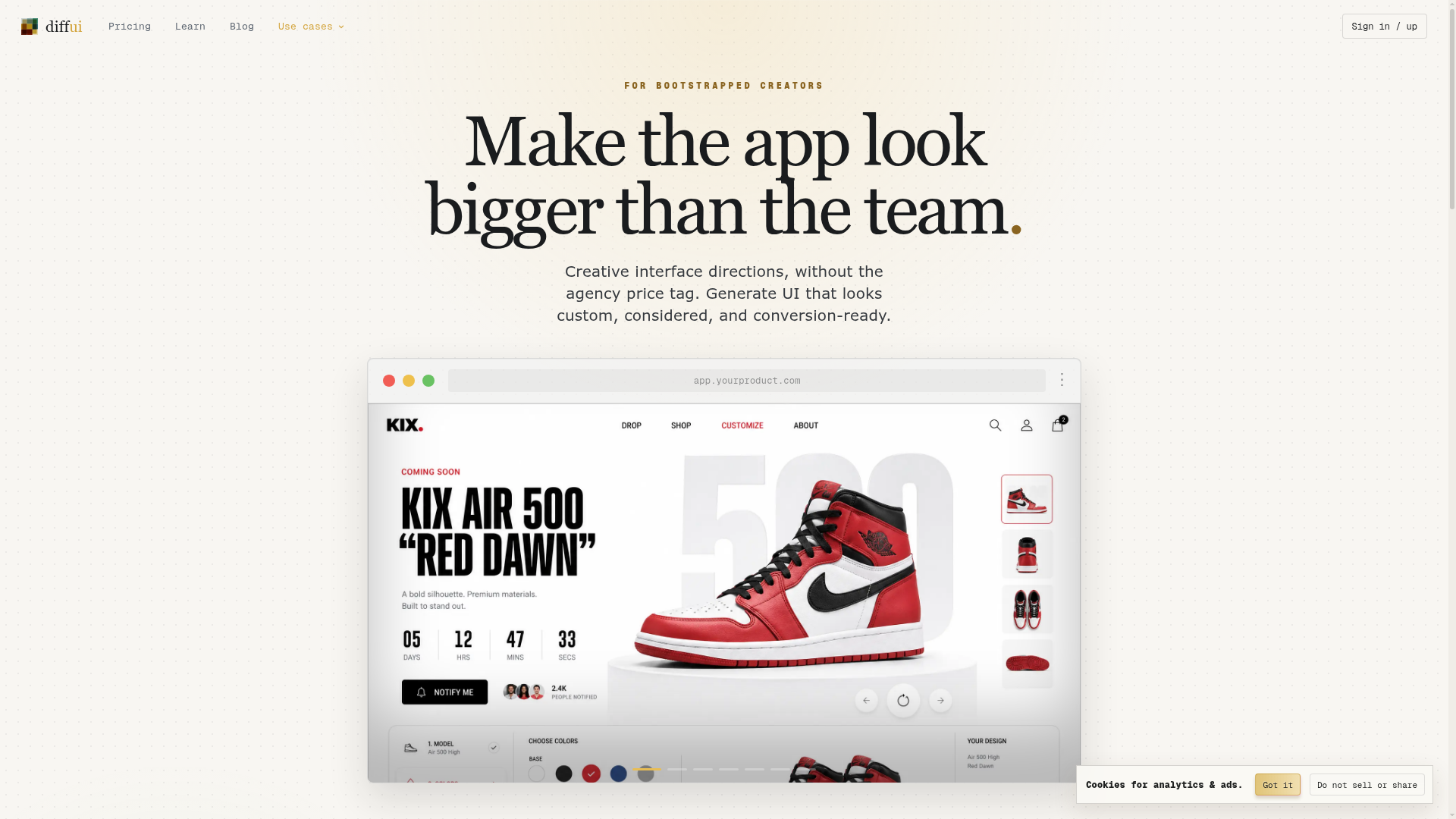
Most AI design tools are built on the same assumption: that a large language model should emit code or structured markup, and that the designer's job is to prompt and then clean up. DiffUI, a solo-founder product from a former Figma employee, rejects that assumption at the architectural level. It uses diffusion — the model family behind image generators — to render pixel-level UI directly, and it sells the output by the image at what it claims is raw model cost. The interesting question is not whether the 80-second generation claim holds up. It is whether a per-image, parallel-sampling workflow can carve out a durable position between Figma's canvas and the LLM-based design tools now crowding the category.
The 80-Second Claim Is a Business Model, Not a Benchmark
The landing page runs a side-by-side timer: DiffUI at 80 seconds, "existing LLM-based competitors" at 3–5 minutes, for a single page. The site does not disclose the models, hardware, or benchmark methodology behind that number, so treat it as a marketing claim rather than a measured result. But the comparison points at something real about the two architectures. LLMs generate tokens sequentially; producing a second, distinct design direction means running the model again. Diffusion models sample in parallel, so multiple candidates can be drawn from one prompt pass.
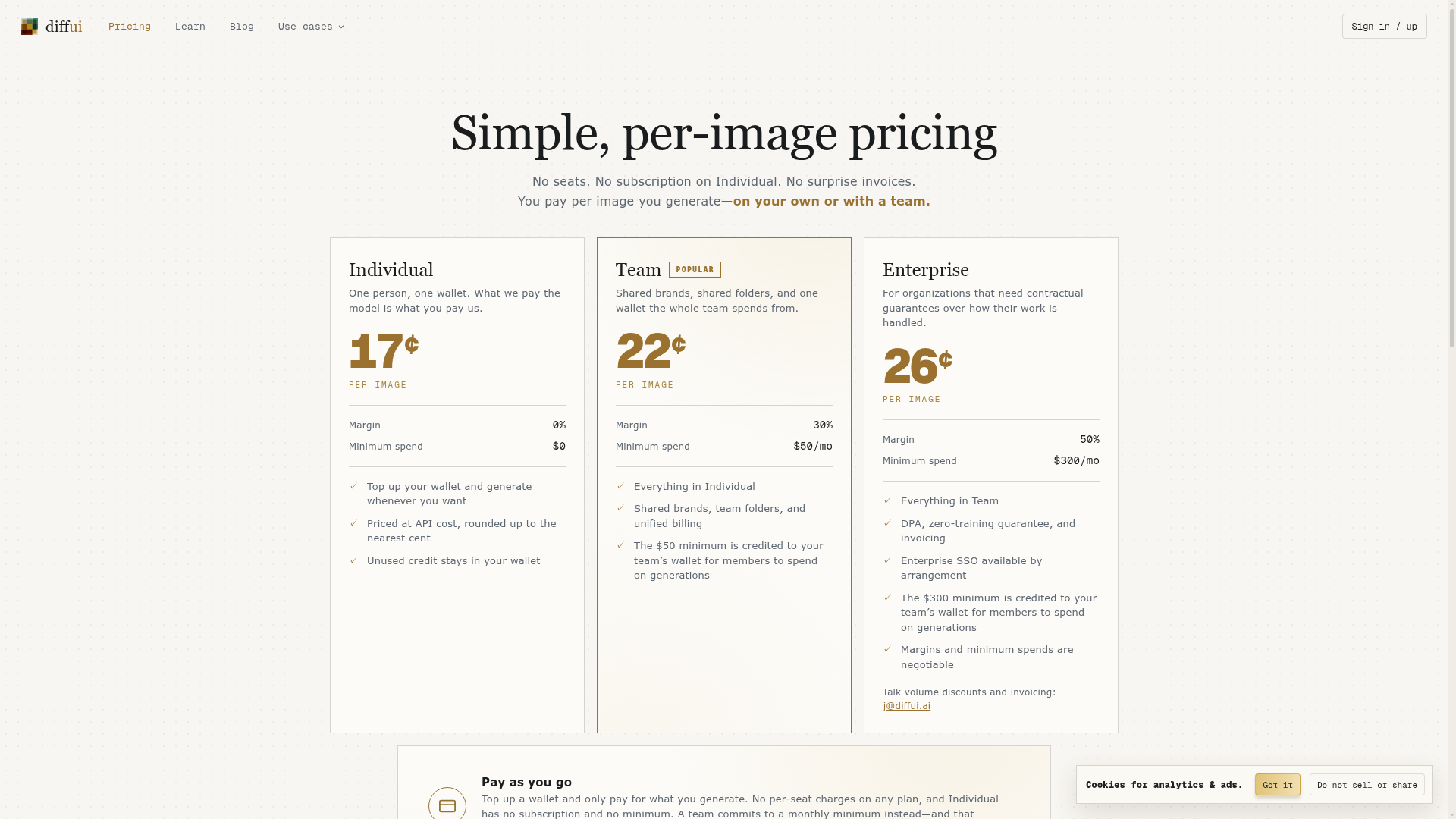
That difference is what makes DiffUI's pricing page coherent. The company charges 17¢ per design on its Individual plan, and states plainly that the margin is 0% — "what we pay the model is what you pay us." Team is 22¢ (30% margin), Enterprise 26¢ (50% margin). There are no seats, no subscription on Individual, and unused wallet credit is not forfeited. This is not a conventional SaaS price ladder. It is a cost pass-through with a team-tier margin bolted on, and it only works if generation is cheap enough to sell at roughly inference cost. Speed and price are the same argument here.
Parallel Sampling: Why Diffusion Changes the Unit of Design Work
The canvas is organized around a prompt node on the left and up to eight image slots fanning out to the right. The API documentation confirms the constraint: the generate endpoint accepts slotNodeIds, described as "Image slot node IDs to fill (up to 8)." So the unit of work is not one screen — it is a grid of candidate directions. A designer prompts "a modern coffee shop landing page" and gets eight rendered options, then branches: "Ask for edits" on any one, or "Add to brand" to fold it into the brand library.
The interface exposes generation controls that are unusual for a design tool — SPEED, FUZZ, GRAIN, RIM, plus entropy-style sliders labeled SYNTHESIS, DIMENSION, EXPANSION, WEIGHT, VARIANCE, BIAS, FREQUENCY, CONVERGENCE, OUTPUT. These are levers on a sampling process, not a prompt box. That is a deliberate bet on a power-user audience willing to tune the model rather than just type at it. It also implies a real onboarding cost: a designer who has never thought about sampling parameters will find this intimidating, and the product does not appear to hide those controls behind a simple mode.
The workflow closes the loop with code. Once a direction is chosen, DiffUI offers "Copy for agent" — the design and prompt are handed to the user's coding agent of choice, which builds the page in their codebase. DiffUI does not try to own implementation. It owns the exploration step and hands off the build.
Brand Learning as the Actual Moat Against Figma and LLM Tools
The more defensible feature is brand learning. Upload screenshots — the site demonstrates Reddit, Netflix, and Slack — and the model biases subsequent generation toward that visual language. The API carries a brand_id field on generation requests, and any generated image can be added back to the brand. The pitch is specific: "Generate new features that look like they've always been there," with promises of consistent components, unified interactions, and matching data visuals.
That is the pain point of every design system team. The alternatives today are manual: a designer opens Figma, matches tokens and spacing by hand, and hopes the new screen is indistinguishable from the old ones. LLM-based tools can be told about a style guide in a prompt, but they describe components rather than render them, and consistency tends to drift across generations. If DiffUI's brand library actually holds style across dozens of screens, that is a workflow no prompt-only tool replicates cleanly.
The competitive field is not empty. Figma itself is the incumbent canvas and is adding AI features; LLM-based generators are numerous and improving. DiffUI's counter is architectural: rendered pixels with brand biasing, sold cheaply, in parallel. Whether that is enough against a Figma that already owns the file, the team, and the design system is the central open competitive question — and the site offers no customer evidence to settle it.
A Zero-Margin Individual Plan and the Team Upsell Math
The pricing structure is the most revealing business decision. Individual is explicitly a customer-acquisition tier: 0% margin, no minimum, no credit card required. The company is not trying to make money on solo designers. It is trying to make the tool frictionless enough that individuals adopt it, build brand libraries, and pull it into their teams.
Team is where the economics live: 22¢ per image, 30% margin, $50/month minimum — and the minimum is credited to the shared wallet rather than kept as a fee. Enterprise adds a DPA, a zero-training guarantee, invoicing, and SSO by arrangement, at 26¢ and 50% margin, with a $300/month credited minimum. The margin ladder (0% → 30% → 50%) is essentially a tax on collaboration features: shared brands, team folders, unified billing, and contractual guarantees. The bet is that the brand library becomes more valuable shared than solo, which is a plausible retention mechanic.
The risk is obvious. A 0% individual tier means DiffUI captures no gross profit from its most likely early users, and its revenue depends entirely on teams converting. If model costs rise, the pass-through price rises with them, and the company has no margin buffer on Individual to absorb it. The site does not disclose whether the 17¢ figure covers all inference costs or only part, so the true unit economics are not verifiable from public materials.
The Solo-Founder Constraint and the Figma Alumni Problem
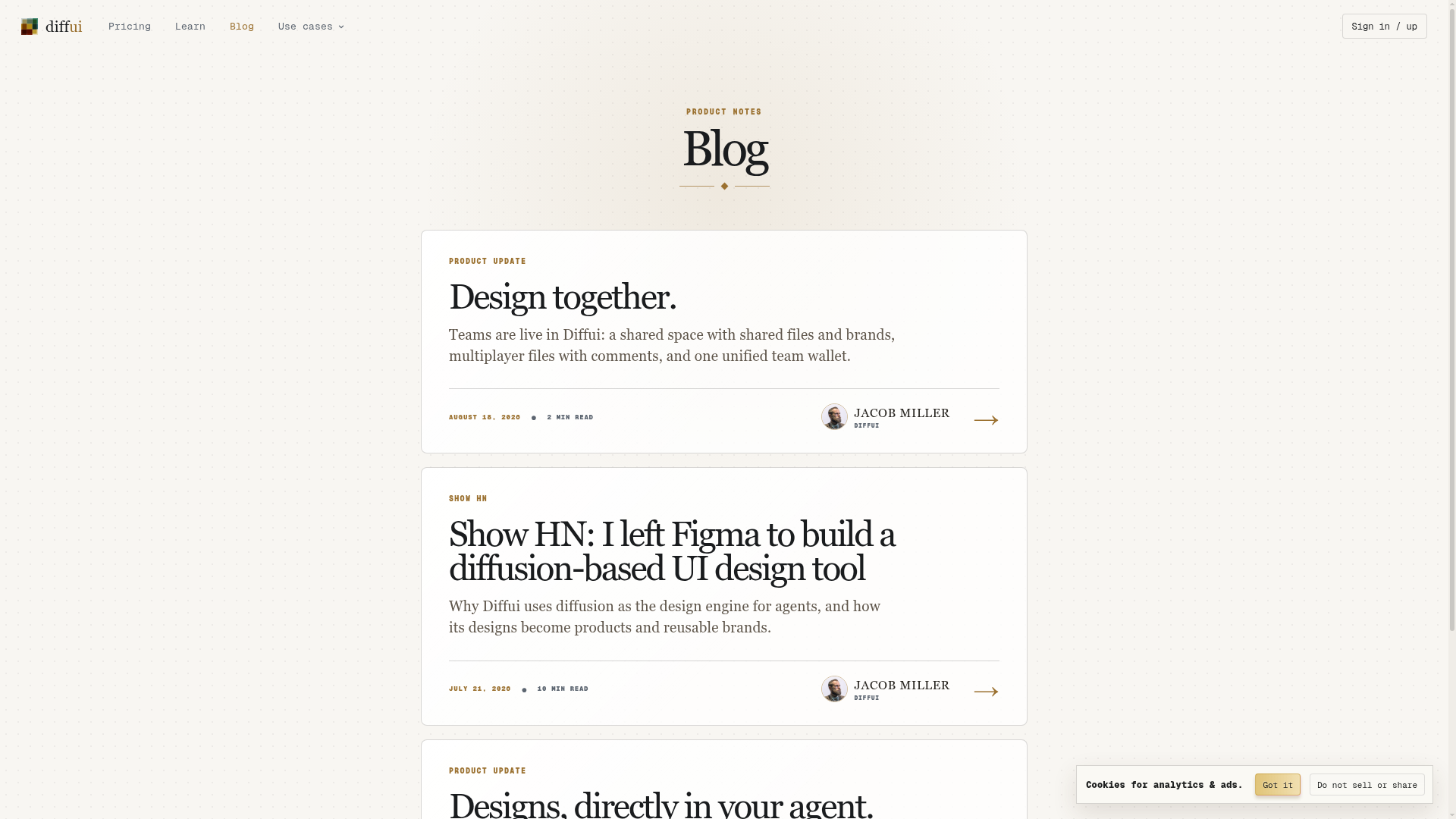
The founder, known publicly as jjcm, frames the project through a Show HN post: "I left Figma to build a diffusion-based UI design tool." That is a credibility signal and a constraint in the same sentence. Figma alumni understand the design workflow deeply, which shows in choices like the brand library and the agent handoff. But DiffUI is a solo operation with a Discord, an X account, and a changelog — no team page, no disclosed funding, no public roadmap. The product is real and the API docs are detailed, but the pace of iteration against funded competitors and a resurgent Figma is an execution risk the site does not address.
There is also a positioning tension. The tool is built for power users who want sampling controls, but the growth motion — free individual tier, no credit card — targets broad adoption. Those two audiences want different products. Resolving that tension, not the 80-second claim, is the operational challenge.
What Has to Be True for Diffusion UI Design to Become a Category
For DiffUI's thesis to hold, three things need to be true. First, rendered pixel output has to be meaningfully better than code-emitting LLMs for the exploration phase — plausible, given the texture and finish argument, but unproven publicly. Second, brand learning has to be sticky enough that teams standardize on it, which is what justifies the 30–50% margin tiers. Third, the cost pass-through has to survive model price volatility without eroding trust in the "at cost" promise.
If those hold, DiffUI is less a Figma competitor than a new layer: a cheap, parallel, brand-aware exploration engine that feeds designs into whatever build pipeline a team already uses. If they do not, it becomes a well-executed proof of concept that larger tools absorb as a feature. The architectural bet is genuinely differentiated. The commercial outcome is still entirely open.