distl
One library for every medium, with taste-match scores that actually fit.
NewName Editorial
Editorial Team


The entertainment industry has a fragmentation problem that most consumers feel but few tools address. You watch films on Netflix, anime on Crunchyroll, listen to music on Spotify, read books on Kindle, and play games on Steam. Each platform knows a sliver of your taste, and none can connect the dots. distl, a new logging and discovery platform, attempts to solve this by letting you rate everything you consume across ten categories in one place, then building a taste profile that powers personalized recommendations with a visible match percentage.
The ten-category logging problem
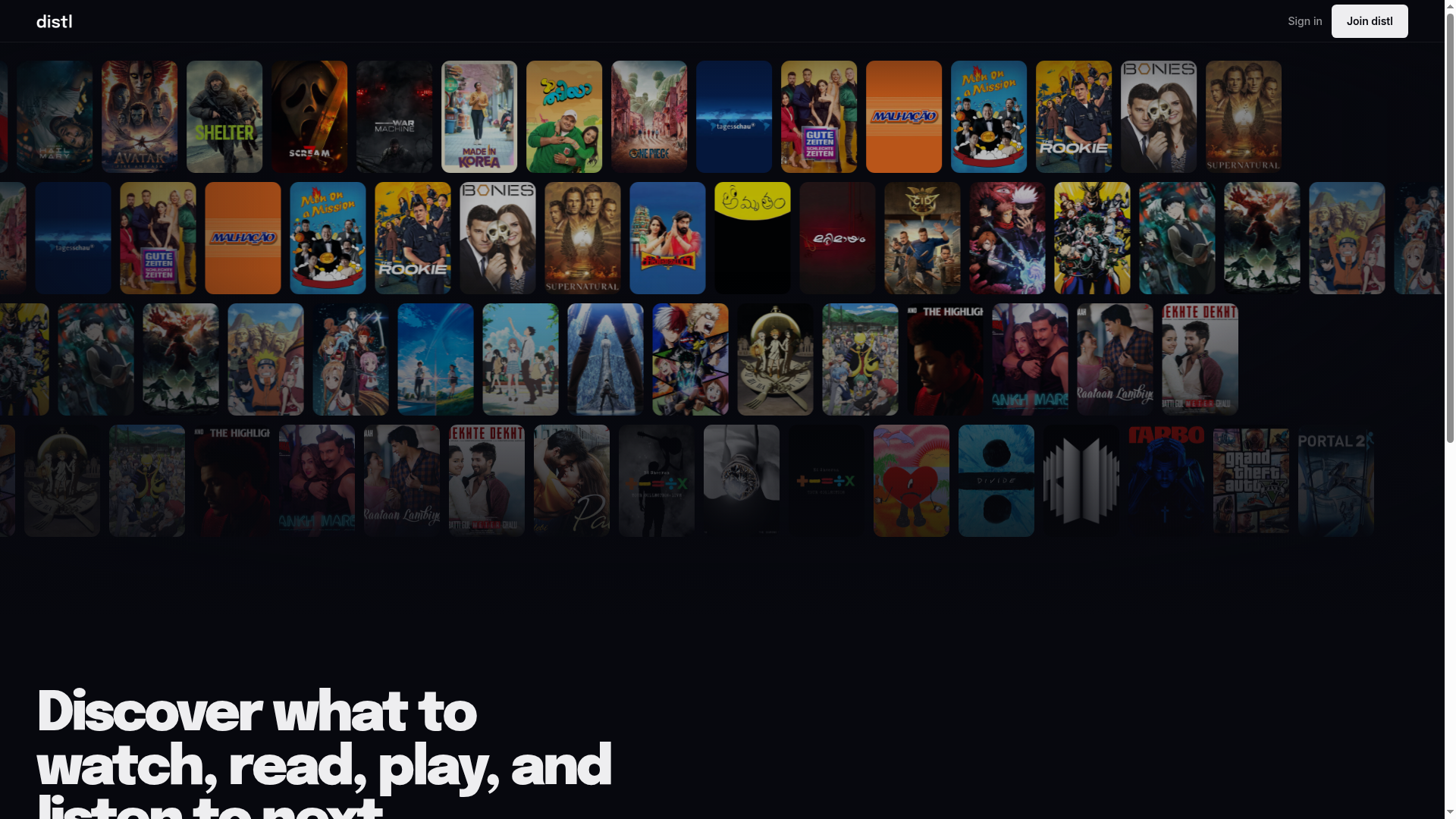
Most logging apps are vertical. Letterboxd handles movies, AniList handles anime, Goodreads handles books, and Backloggd handles games. If you're a serious consumer of multiple media types, you end up maintaining several profiles, each with its own rating scale, its own social graph, and its own algorithm. distl's pitch is that this is inefficient and, more importantly, that it prevents any platform from really knowing you. By aggregating movies, TV shows, anime, music, podcasts, audiobooks, games, books, comics, and manga into a single library, distl creates a unified record of your media life. The website's about page states: "Most platforms only cover one type of content. distl brings movies, TV, anime, music, podcasts, audiobooks, games, books, comics, and manga together in a single library." This is a bold claim, and it's the core of the product's value proposition.
The practical benefit is obvious: you no longer need to switch between apps to log what you've consumed. But the deeper advantage is data. Every rating you give a movie, every album you log, every manga you track becomes a data point in a single taste profile. That profile is what powers the recommendation engine, and the more you log, the sharper it gets. The site explicitly says: "Every rating teaches distl more about your taste. The more you log, the better it gets." This is a classic network effect, but instead of relying on other users, it relies on your own history.
Taste Match % as a trust signal
Most recommendation engines hide their reasoning. Netflix might say "Because you watched X," but it never tells you how confident it is. distl takes a different approach: it shows a "Taste Match %" on every recommendation, so you can see at a glance how well something aligns with your profile. The about page describes it as "a taste-match percentage so you know how well something fits your preferences." This is a clever trust signal. Instead of asking you to blindly trust the algorithm, distl gives you a number you can interpret. If a recommendation has a 90% match, you know it's strongly aligned with your taste; if it's 60%, you might be more cautious. This transparency could be a differentiator in a market where algorithms are often opaque.
The percentage also gamifies the logging process. The more you rate, the more accurate your match scores become, which encourages continued engagement. It's a virtuous cycle: you log more, the scores get better, you trust them more, and you log even more. This is a smart retention loop, and it's directly tied to the product's core mechanic.
Why cross-category data matters for discovery
A single-category platform can only recommend within that category. A movie app can't tell you that fans of the film Interstellar also enjoy the podcast Radiolab or the game Outer Wilds. But distl can, because it has data across all ten categories. This cross-category recommendation capability is the most interesting aspect of the product. It opens up discovery pathways that no single-medium platform can offer. For example, if you rate a dark, atmospheric anime, distl might recommend a similarly toned graphic novel or a moody soundtrack. This is a powerful idea, but it's also a technical challenge. The algorithm needs to understand not just genres, but themes, moods, pacing, and narrative structures across different media. The site doesn't explain how this works, but the promise is there.
The potential is significant. Cross-category recommendations could introduce users to new formats they wouldn't have considered. A book lover might discover a podcast that complements their reading, or a gamer might find a manga that captures the same aesthetic. This kind of serendipity is rare in single-platform ecosystems, and it could be distl's killer feature if executed well.
The cold-start challenge every logger faces
Every logging platform has a cold-start problem: the algorithm is useless until you've logged enough content. distl is no exception. The site says "The more you log, the better it gets," but that implies that initially, the recommendations will be rough. This is a classic chicken-and-egg problem. Users won't see value until they've invested time in logging, but they won't invest time until they see value. distl's solution is to encourage logging from the start, but the site doesn't mention any onboarding mechanism, like importing data from other platforms or starting with popular titles. This could be a barrier to adoption.
However, the multi-category nature might mitigate this. If you log just a few movies and a few albums, the system has more data to work with than a single-category platform would have. Still, the cold-start challenge is real, and distl's success will depend on how well it guides new users through the initial logging phase. The site's call-to-action is simply "Get started," which suggests a straightforward signup, but no details on import or onboarding are provided.
What distl's positioning leaves unsaid
For all its ambition, distl's public materials are thin on specifics. The site doesn't disclose how the recommendation algorithm works, what data sources it uses, or how it handles niche content. It also doesn't mention pricing or whether there's a premium tier. The tagline "Track everything you consume. Get recommendations that know you" is broad, and the about page is similarly high-level. This could be intentional—a lean launch focused on the core value proposition—but it leaves open questions about the product's maturity and long-term viability.
One notable omission is social features. Many logging platforms, like Letterboxd and Goodreads, have strong social components that drive engagement. distl's site doesn't mention following friends, sharing reviews, or community features. If distl is purely a personal logging tool, it might miss out on the network effects that make other platforms sticky. The blog page teaser says "powered by people who share your taste," which hints at some social element, but it's not elaborated. This could be a deliberate choice to focus on individual discovery first, but it's a risk in a space where community is often a key differentiator.
Ultimately, distl is an ambitious attempt to unify media logging and discovery. Its multi-category approach and taste-match percentage are genuinely different ideas that could resonate with power consumers. But the product is still young, and the site's lack of detail on algorithm, onboarding, and social features means it's hard to assess its execution. For now, distl is a promising concept with a clear value proposition, but its success will depend on how well it solves the cold-start problem and whether it can deliver on the cross-category recommendation promise.