EasyFace AI
AI hairstyle/look try-on for your face shape.
- Category
- AI & Machine Learning
- Launched
- October 15, 2026
- Stage
- Public
- Pricing
- freemium
- Website
- easyfaceai.com
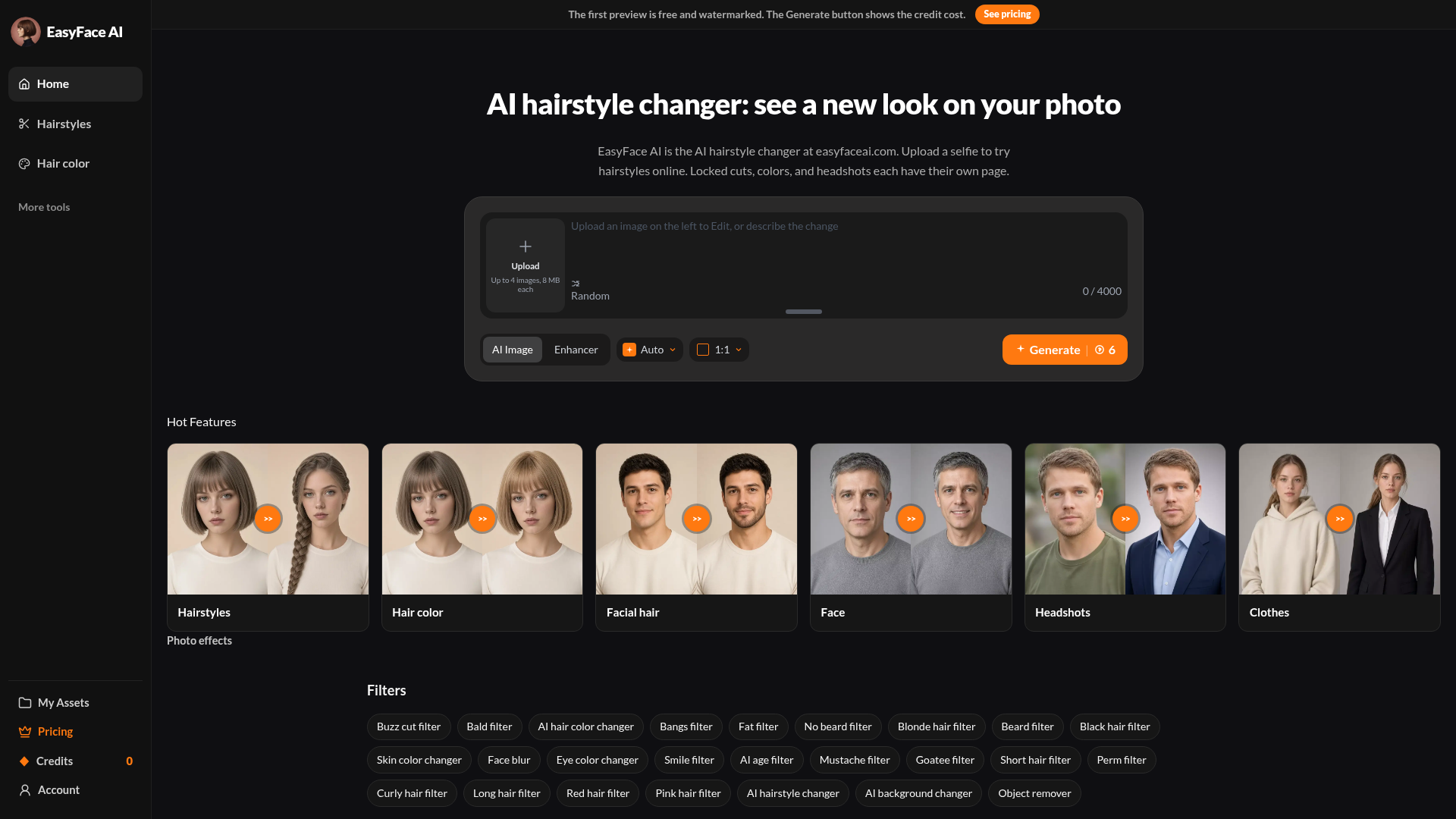
EasyFace AI turns the abstract advice of "find a haircut that suits your face shape" into a visual experiment on your own photo. Instead of browsing galleries of models whose bone structure, hairline, and lighting differ from yours, you upload a portrait and generate previews of specific cuts — pixie, lob, curtain bangs, layers, and more — mapped to six face shapes: oval, round, square, heart, long, and diamond. The product's wedge is not a new hairstyle database; it is the feedback loop between your face and a shortlist of cuts, with the first preview free and watermarked so you can judge the match before spending credits. The face shape shortlist as the core interaction The landing page is organized around a single table: each face shape links to four recommended cuts. That table is not decoration — it is the product's opinionated starting point. Oval faces get pixie, lob, curtain bangs, and slicked back; round faces get layers, side part, faux hawk, and high ponytail; square faces get soft waves, shag, curtain bangs, and crew cut. The links go to individual hairstyle pages, so the user can move from "what generally works for my shape" to "show me this specific cut on my photo" without leaving the site. How a generation actually runs The workflow is deliberately short: upload a clear portrait with good lighting and a visible face, pick a hairstyle or hair color, then generate and compare. The first preview is free but watermarked. The Generate button displays the credit cost before you commit, and a pricing link is always visible. That transparency matters because the product is selling a visual decision, not a subscription to a hairstyle encyclopedia. Where photo quality becomes a product constraint The FAQ is unusually direct about failure modes: heavily filtered or low resolution images do not work well, and lighting changes how a cut reads. This is not just support copy — it shapes the entire experience. A user who uploads a dim selfie may conclude a style looks bad when the real issue is the source photo. EasyFace AI's guidance to use clear, well lit portraits is effectively a quality control step that protects the perceived accuracy of every generated preview. Comparing multiple styles on one face The site explicitly supports generating several versions on the same photo and comparing them. That turns the tool into a personal lookbook rather than a one shot filter. For someone considering a dramatic change — a shag, a French crop, a high ponytail — the ability to see multiple candidates side by side on their own head reduces the risk of a costly salon mistake. The comparison loop is also what makes the credit model work: each additional style is another generation, but the first free preview lowers the barrier to trying. The economics of a free watermarked preview EasyFace AI uses a freemium credit model. The first preview is free and watermarked; subsequent generations consume credits, and the Generate button shows the cost. There is no unlimited free tier described on this page. The watermarked first preview functions as a trial that demonstrates the core value — seeing a cut on your own face — while the credit system monetizes users who want clean, downloadable comparisons. Pricing details live on a separate page, so the exact credit to dollar conversion is not visible here. Risks and open questions The biggest risk is expectation mismatch. Hairstyle try on is a visual promise, and if the generated preview does not account for hair texture, density, or growth pattern, the result can look like a sticker rather than a cut. The site acknowledges that face shape, hairline, and lighting all matter, but it does not claim to simulate hair physics. A second risk is photo quality dependence: users with poor lighting or filtered images may get misleading previews and blame the tool. Finally, the credit model depends on users wanting to compare multiple styles; if the first free preview is convincing enough, some users may never convert. The product's retention will likely hinge on whether the comparison workflow feels genuinely useful for real decisions — a haircut appointment, a color change, or a dramatic restyle.