Echo AI
Build autonomous agents that talk, act, and transact across every channel—while you stay in control.
NewName Editorial
Editorial Team


The first thing you notice about Echo AI is its ambition. It's not another chatbot builder that promises to answer FAQs a little better. The tagline—'Human-governed AI agents built to sell, support, and scale. For everyone.'—signals a different bet: that businesses want agents that don't just talk, but act. And the website doubles down on that with a list of channels that reads like a directory of every place a customer might type: web, WhatsApp, Instagram, Messenger, Telegram, Discord, Slack, and voice. That's a lot of surfaces to cover, and it's where Echo AI's story gets interesting.
The channel sprawl problem
Most customer-facing AI tools start with one channel—usually a website widget—and then bolt on others as an afterthought. Echo AI starts with the opposite assumption: your customers are already scattered across a dozen platforms, and you need an agent that can be everywhere at once. The site lists Discord, Reddit, Snapchat, Threads, TikTok, and even OnlyFans among its integrations, which is both a strength and a potential weakness. It's a strength because it acknowledges the messy reality of modern customer communication. It's a weakness because each channel has its own quirks, and an agent that works well on a website might feel out of place in a Discord server.
But Echo AI isn't just about being present on these channels; it's about being native to them. The platform claims to handle conversations 24/7 across all of them, with the same underlying agent. That's a hard technical problem, and the fact that they're attempting it suggests they're thinking about the problem from the customer's perspective, not the developer's.
From chatbot to checkout
The real differentiator, though, is that Echo AI agents don't just answer questions—they take actions. The description mentions booking meetings via Google Calendar, Outlook, and Calendly, and processing payments through Stripe, PayPal, Square, or even crypto. This moves Echo AI from the crowded 'chatbot' category into the more interesting 'agentic' territory, where the AI isn't just a front-end but a participant in the transaction.
For a small business, this could be transformative. Imagine a customer on Instagram asking about a product, and the agent not only answers but also sends a payment link. That's a closed loop that would otherwise require a human to be online at the right moment. Echo AI is essentially offering to be that always-on salesperson, and that's a compelling pitch.
However, there's a leap of faith here. Letting an AI process payments is a big trust ask. The 'human-governed' part of the tagline is meant to address that, but the site's description of 'full autonomy' might give some businesses pause. The balance between autonomy and control is the product's central tension.
The 'human-governed' promise
The phrase 'human-governed' is a smart piece of positioning. It acknowledges the fear that AI agents will run wild, while promising that the human owner stays in charge. But what does that mean in practice? The site mentions that you can customize agents with your own knowledge and even white-label them, but it doesn't go deep into the governance controls—like approval workflows or human handoff triggers. That's a gap in the evidence, but it's also an opportunity: if Echo AI can make 'human-governed' feel concrete, it could be a major trust signal in a market where many tools are either fully autonomous or fully manual.
The name itself, 'Echo AI,' reinforces this idea of a brand extension. An echo is a reflection of your voice, and Echo AI agents are meant to sound like you and act like you. The YouTube video title, 'Finally, AI that sounds like you. Because it is you,' captures that promise perfectly. It's a powerful emotional hook, but it also sets a high bar for personalization.
No-code meets RAG
The platform is no-code, which means it's aimed at creators and business owners who may not have a technical team. The site mentions RAG-based intelligence, which is a way of grounding the AI in your own knowledge base. That's a technical capability that's usually reserved for more developer-focused platforms, so its inclusion here is notable. It suggests that Echo AI is trying to offer enterprise-grade features with a consumer-friendly interface.
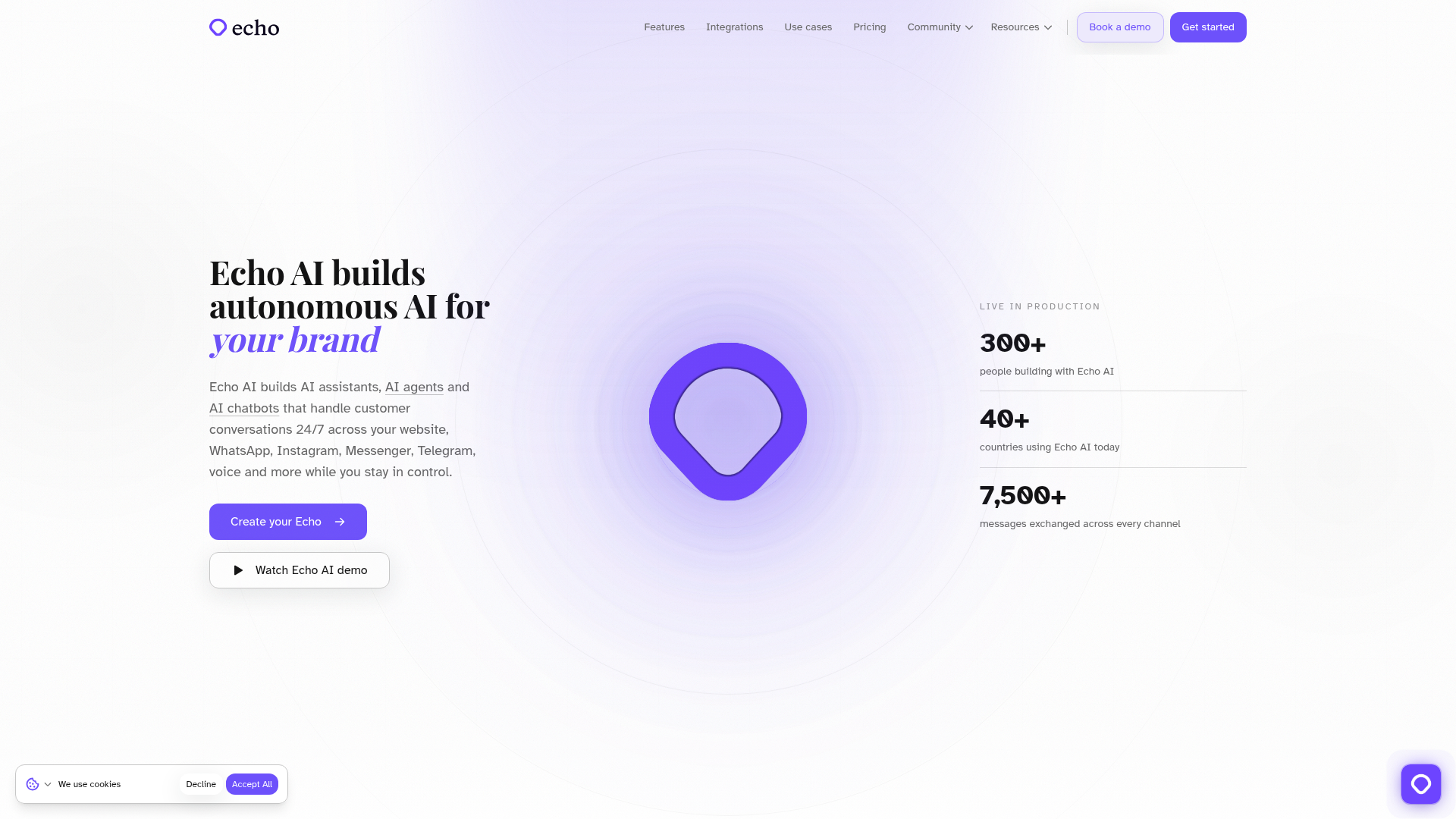
The combination of no-code and RAG is a strong one. It means a small business owner can upload their FAQs, policies, or product catalogs, and the agent will use that to answer questions accurately. That's a big step up from generic chatbots that hallucinate answers. But again, the evidence is thin on how well the RAG works in practice. The site claims 7,500+ messages exchanged, which is a modest number, suggesting early adoption.
The name as a promise and a risk
The name 'Echo AI' is a double-edged sword. On one hand, it's memorable and evokes the idea of reflecting your brand's voice. On the other hand, 'Echo' is a common word, and there are likely many other products with similar names. The domain, echoai.so, is a .so TLD, which is unusual and might be hard to remember or trust. For a product that wants to be 'for everyone,' a more conventional domain might be better. But the name does align with the core value proposition: creating an AI that echoes your brand's tone and knowledge.
Who should care (and who should wait)
Echo AI is most compelling for small-to-medium businesses and creators who are already active on multiple social channels and want to automate sales and support without hiring a team. The no-code approach and multi-channel support are a good fit for that audience. The transaction capabilities could be a game-changer for those who sell directly through social media.
However, businesses that require strict compliance or have complex workflows should wait for more evidence on governance and security. The site doesn't disclose much about data handling or compliance certifications, which is a red flag for regulated industries. Also, the 'forever free' promise, as mentioned in the video, is a bold claim that needs scrutiny—how does the company sustain itself? That's an open question.
Ultimately, Echo AI is a product to watch. It's aiming high, and if it can deliver on the 'human-governed' promise and make multi-channel autonomy feel reliable, it could carve out a meaningful niche. But the evidence is still early, and the proof will be in the execution.