Ekho Labs
Prescriptive intelligence for global freight: reroutes, alternatives, and booking windows before disruption hits.
NewName Editorial
Editorial Team
The supply chain software market is crowded with dashboards that tell you what you already know. Ekho Labs is trying something different: it wants to tell you what to do about it. The company's pitch, repeated across its site, is a sharp contrast to the typical visibility platform: "Your TMS shows the news. Ekho shows the reroute." That one line captures the entire thesis—not just surfacing that a disruption is happening, but prescribing the specific action to take, down to the purchase order level, and delivering it into the systems freight teams already use.
This is a decision engine, not a monitoring tool. And in a world where a single missed reroute can add 26 days to a voyage, the distinction matters.
From News to Reroute: The Shift Ekho Labs Is Selling
Most supply chain software is reactive by design. It tracks shipments, flags delays, and shows you a map of where things are stuck. But by the time a delay is visible, the cost is already accruing. Ekho Labs is built to operate on a different timeline: days before the disruption hits, not after.
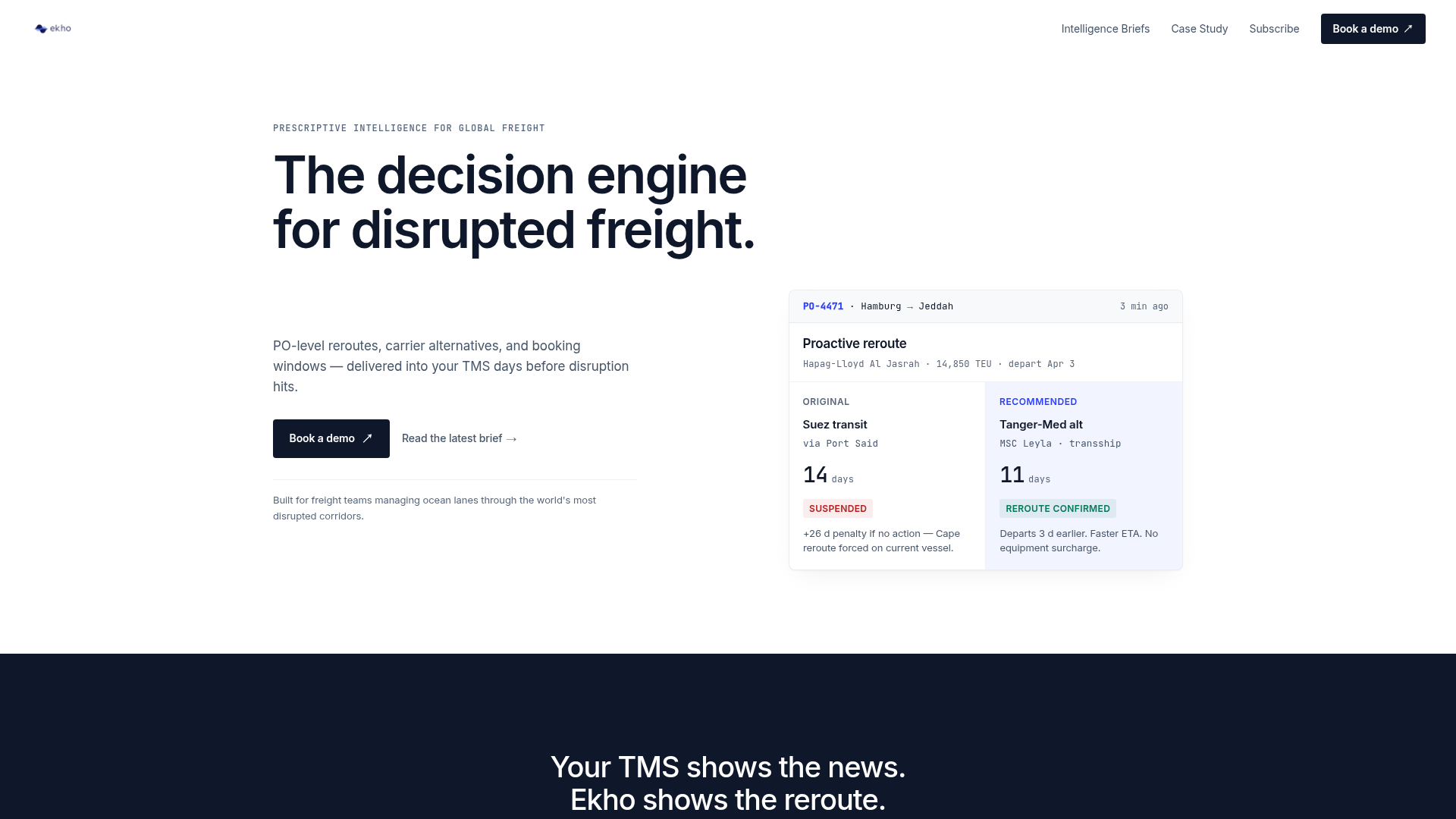
The company's homepage is explicit about this. It doesn't lead with a dashboard or a data visualization. It leads with a decision: "PO-4471 · Hamburg → Jeddah" and a recommended reroute via Tanger-Med, with a note that the original Suez transit is suspended and a Cape reroute would add 26 days. The message is clear: here's the problem, and here's the fix, already calculated and ready to execute.
That's a fundamentally different value proposition from "we give you real-time visibility." Visibility tells you a ship is stuck. Ekho tells you which alternative carrier to book, which port to use, and what the new ETA will be. It's prescriptive intelligence, not just descriptive analytics.
The Anatomy of a Disruption Call: Inside the Hormuz Brief
To understand how Ekho works, the Hormuz case study is the clearest window. The company published a detailed timeline of the March 2026 Suez closure, showing how it called the disruption 18 days before carriers officially filed reroutes.
The sequence is striking in its specificity. On February 28, US–Israeli strikes led carriers to suspend Suez transit. By March 1, the Gemini alliance reversed its return to Suez, and all carriers were heading to the Cape. March 2 saw Iran strike Ras Laffan, taking 20% of global LNG offline. By March 5, reinsurers exited and P&I clubs canceled, cutting traffic by 80%. On March 10, Iran mined the Strait of Hormuz.
Ekho's forecast, published on day 18 of the crisis, assigned probabilities: 15% fast resolution, 50% protracted standoff, 35% further escalation. It also prescribed a reroute for the Al Jasrah, recommending an MSC vessel via Tanger-Med that would depart three days earlier and avoid the equipment surcharge. The verification note says the call held: 25 days later, the transit penalty landed at +24 days, close to the predicted +26.
This is the kind of detail that makes the product tangible. It's not a vague prediction of "geopolitical risk." It's a specific, actionable recommendation with a confidence score and a source list—EIA, Lloyd's List, carrier filings, AIS, sanctions feeds.
Ten Thousand Sources, One Prescriptive Output
Ekho's methodology page describes a data engine that combines over 10,000 public and licensed sources: sanctions registries, AIS (Automatic Identification System) feeds, port authority data, carrier EDI, weather models, social signal networks, and even congressional and union communications. The claim is that this breadth allows the system to connect dots that a human analyst might miss.
For example, a congressional voting pattern might signal a shift in trade policy, which could affect port operations. A union communication might hint at a strike. A weather model might predict a typhoon that closes a transshipment hub. Ekho's model ingests all of this in real time and outputs a single, prioritized recommendation.
The median lead time is stated as 12 days. That's the gap between when Ekho flags a disruption and when it actually hits. For a freight team, 12 days is enough to reroute cargo, rebook capacity, and avoid the worst of the penalty costs.
Why Integration Depth Matters More Than Dashboard Polish
Ekho's integration strategy is deliberately unglamorous. The company emphasizes that it doesn't replace your TMS or ERP. It sits alongside them via a read-only API, delivering recommendations into systems like CargoWise, SAP TM, Oracle OTM, and Descartes. The setup is SaaS with SSO/SAML and role-based access, and the company claims it can be live in under 24 hours.
This is a smart positioning move. Freight teams are notoriously resistant to new software that requires changing their workflow. By plugging into existing systems, Ekho reduces friction and makes the recommendation part of the natural decision flow. The TMS still shows the news; Ekho just adds the reroute.
It also signals a focus on enterprise readiness. Security, compliance, and integration with legacy systems are the real barriers to adoption in this market, not the quality of the algorithm. Ekho seems to understand that.
The Economics of Acting Late: What Ekho Puts on the Table
Ekho's pricing page doesn't list prices, but it does lay out the cost structure of inaction. Detention and demurrage per container per day, equipment premiums, rebooking costs, downstream delays, and SLA penalties—these compound quickly. A single disruption can cascade through the entire supply chain.
The company's value proposition is simple: make the call earlier, avoid the compounding costs. The Hormuz case study quantifies this with a +26 day penalty if no action is taken. That's not a trivial number. For a shipment with a tight delivery window, 26 days can mean missed contracts, lost customers, and significant financial damage.
Ekho doesn't just predict the disruption; it calculates the cost of inaction and presents the alternative. That's the kind of concrete value that procurement and logistics executives can take to their CFOs.
Naming the Echo: What 'Ekho' Signals to a Risk-Averse Industry
The name "Ekho" is a deliberate choice. It evokes an echo—a sound that returns after a delay, a reflection of what's coming. In the context of supply chain, it suggests hearing the rumble of a disruption before it arrives, and having the foresight to act. It's short, memorable, and has a scientific ring to it, fitting for a company that sells itself on data and prediction.
The domain, ekholabs.com, is clean and professional. "Labs" implies research and rigor, which aligns with the methodology-heavy branding. The company also publishes "Intelligence Briefs" and a case study, reinforcing the idea that it's not just a software vendor but a source of analytical insight.
For a risk-averse industry like freight, the name signals competence and reliability. It doesn't sound like a flashy startup; it sounds like a firm you'd trust with your cargo. That's a subtle but important brand asset.
Ekho Labs is still early—there's no public funding information or customer list beyond the advisor quote from Renée Ure, former COO of Lenovo ISG. But the product logic is sound. In a market where visibility is table stakes, prescriptive intelligence is the next differentiator. And Ekho is positioning itself to lead that shift.