Epsilla
One API to route the world's best AI agents into your app — Epsilla's pivot from RAG to orchestration.
NewName Editorial
Editorial Team


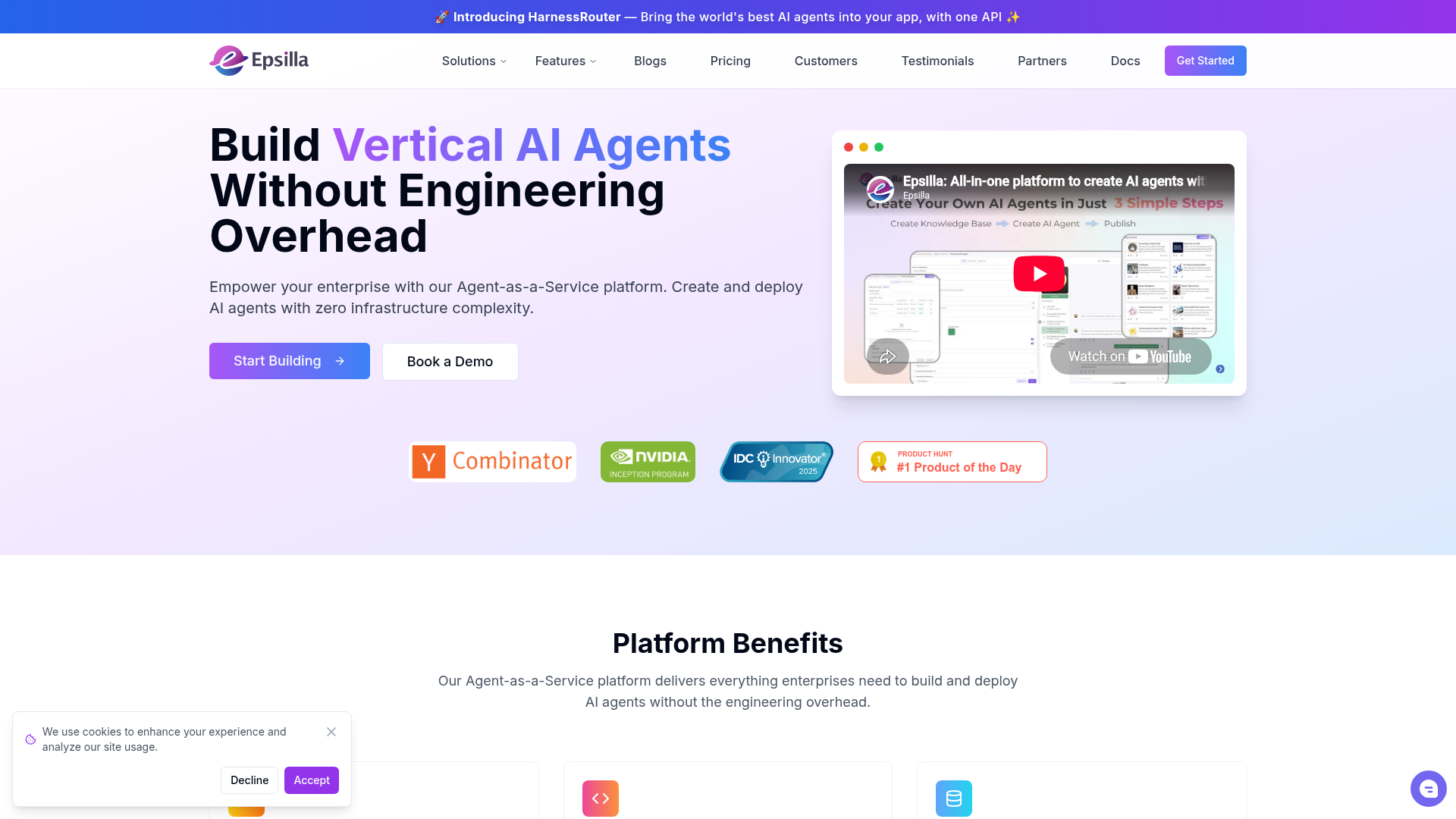
Epsilla's homepage now leads with a headline that would have been unthinkable a year ago: "Bring the World's Best AI Agents Into Your App, With One API." The company, which built its name on being an all-in-one platform for creating AI agents with your knowledge, is now positioning itself as a router—a thin layer that puts Codex, Claude Code, Hermes, and other frontier models behind a single integration. The shift is subtle but seismic. It's a bet that the future of enterprise AI isn't about building your own agents, but about orchestrating the best ones already in existence.
The Pivot Hidden in Plain Sight
Epsilla's public materials still describe it as an "Agent-as-a-Service platform" for building vertical AI agents without engineering overhead. But the new tagline—"One API that puts Codex, Claude Code, Hermes, and more behind your product"—signals a different ambition. Instead of asking enterprises to construct agents from scratch, Epsilla wants to be the switchboard that connects your app to the most capable agents available. The mention of specific agent names (Codex, Claude Code, Hermes) is a deliberate move to borrow credibility from the AI ecosystem's most recognizable tools. It's a classic aggregation play: rather than competing with the model makers, Epsilla positions itself as the indispensable intermediary.
From RAG Platform to Agent Router
Epsilla's history is rooted in RAG (Retrieval-Augmented Generation). The platform's features still emphasize RAG as a service, vector databases, and knowledge-base integration. Testimonials from customers like TigerGraph's Jonathan Herke praise the quality of knowledge retrieval and the ease of building RAG pipelines. But the new positioning suggests Epsilla is evolving beyond its core. The company is now selling the ability to "get real output: videos, games, code, documents"—not just answers to questions. This is a fundamental shift from being a knowledge-retrieval tool to being an agent-orchestration layer. The question is whether Epsilla can maintain its RAG credibility while convincing enterprises that it's also the go-to for routing agents that can take actions, not just answer queries.
Vertical Agents: The Enterprise Trojan Horse
Epsilla's website is organized around vertical solutions: manufacturing, healthcare, legal, financial services, construction, and more. This is a deliberate strategy to make AI agents palatable to risk-averse enterprises. Instead of selling a generic platform, Epsilla packages its capabilities into industry-specific stories. For example, the construction vertical promises "optimized construction planning and site management," while healthcare focuses on "enhancing patient care and streamlining clinical workflows." This vertical approach is a Trojan horse: it gets Epsilla in the door with a narrow use case, but the underlying platform is horizontal. The company's customer logos—Stanford Medicine, Samsung E&A, MTR—suggest it has already won trust in regulated industries. The vertical focus also helps Epsilla differentiate from generic AI infrastructure providers, even if the underlying tech is similar.
What the Name Says — and What It Hides
The name "Epsilla" evokes "epistemic" (knowledge) and "silla" (possibly a nod to 'silo' or 'scilla'), but it doesn't hint at agent routing or orchestration. The name is more aligned with the company's RAG heritage than its new direction. This creates a branding tension: the name suggests a knowledge platform, but the product is now an agent aggregator. The domain epsilla.com is clean and memorable, but it doesn't communicate the "one API" promise. Compare this to the new tagline, which is far more descriptive. The mismatch between name and positioning is a risk—enterprises searching for an "agent router" won't find Epsilla by name alone. The company may need to either evolve the brand or rely on its tagline and content marketing to bridge the gap.
The Integration Play: Partners Over Proprietary Models
Epsilla's partner page lists a who's who of AI infrastructure: Tavily (search), Jina AI (embeddings), Voyage AI, Nomic AI, Mixedbread AI, and PuppyGraph. This is a deliberate strategy to integrate with best-of-breed tools rather than building everything in-house. By partnering with these companies, Epsilla can offer a more complete solution without the R&D cost. The partner list also signals to enterprises that Epsilla is vendor-neutral—it's not tied to a single model provider. This is a key differentiator in an AI landscape where companies are wary of lock-in. However, it also means Epsilla's value proposition is dependent on the quality of its partners. If a partner's model or service degrades, Epsilla's reputation suffers.
Open Questions: Trust, Lock-in, and the Agent Economy
Epsilla's pivot raises several open questions. First, can it execute on the "one API" promise without becoming a bottleneck? Routing to multiple agents requires robust infrastructure and careful handling of context windows, tool calls, and output formats. Second, is there a risk of lock-in? If enterprises build on Epsilla's API, they may find it hard to switch to a competitor. Epsilla's SOC 2 Type 1 certification and multi-tenancy features are designed to address enterprise concerns, but the long-term commitment is still a leap of faith. Finally, the agent economy is still nascent. The names Epsilla mentions—Codex, Claude Code, Hermes—are evolving rapidly. Epsilla's value depends on staying ahead of these changes. For now, the company's strategy is clear: be the neutral layer that enterprises trust to route AI agents. Whether the name catches up to the ambition remains to be seen.