ESGAgent.ai
AI agents that turn months of ESG and safety reporting into hours for heavy industry.
NewName Editorial
Editorial Team
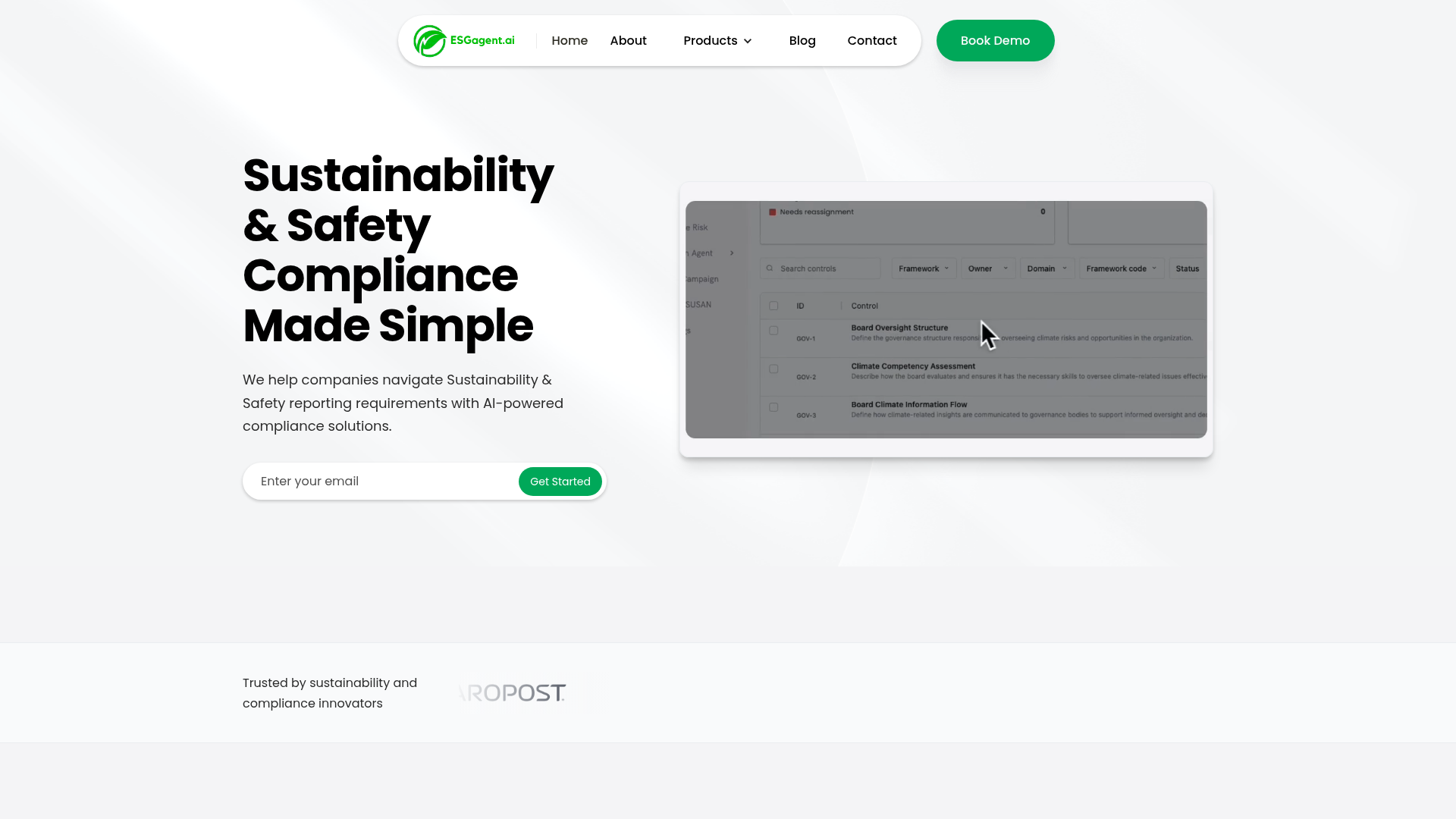


Heavy industry runs on spreadsheets, and that is precisely the problem. For companies managing coal mines, smelters, or large-scale manufacturing, ESG and safety compliance reporting is a manual, multi-month grind: pulling data from disparate systems, mapping it to frameworks like GRI, TCFD, or the Coal Mining Safety Health Act, and then praying that auditors find no gaps. Brisbane-based ESGAgent.ai has raised $450,000 in seed funding to replace that grind with AI agents that read documents, monitor risks in real time, and generate reports in minutes. The pitch is not just speed—it is the promise that two AI agents, named SUSAN and SAM, can carry the compliance load that once required a small army of consultants.
The startup's bet is that the pain in heavy industry is not a lack of tools, but a fragmentation of them. ESG reporting and safety compliance have historically lived in separate silos—different teams, different software, different regulatory bodies. ESGAgent.ai is deliberately building one platform that covers both, and that choice may be its sharpest insight or its biggest risk. This article examines how the company is positioning itself, what its AI agents actually do, and whether the trust barrier in safety-critical industries can be overcome.
The spreadsheet ceiling in heavy industry
For most heavy industry operators, compliance is a spreadsheet problem. Data lives in Excel files, PDFs, and legacy systems, and each reporting cycle requires manually aligning that data with an ever-growing list of frameworks: AASB S2, TCFD, GRI, SASB, CDP, ISO 14001, WHS Act, and more. The website's copy speaks directly to this: "Automated compliance reporting for GRI, SASB, TCFD, CDP, and global standards. Generate comprehensive reports in minutes, not weeks." That is a bold claim, but it targets a real bottleneck.
A typical mid-sized mining operator might spend months preparing annual sustainability disclosures, with teams of analysts cross-referencing incident logs, emissions data, and supplier records. The cost is not just time—it is the opportunity cost of having skilled professionals doing data entry instead of risk analysis. ESGAgent.ai's value proposition is to break that ceiling by automating the data collection and report generation, freeing humans to focus on interpretation and action.
Why ESG and safety belong under one roof
Most compliance software treats ESG and safety as separate markets. ESG tools focus on emissions, governance, and sustainability disclosures, while safety platforms handle incident tracking, OSHA compliance, and workplace hazards. ESGAgent.ai is unusual in bundling both into a single offering. The website lists "ESG Reporting" and "Safety Compliance" as twin pillars, with the latter including "incident tracking, and OSHA compliance reporting."
This bundling makes operational sense for heavy industry, where safety incidents often have ESG implications—a workplace fatality is both a safety failure and a governance red flag. By integrating the two, ESGAgent.ai can offer a more complete risk picture. For example, a real-time risk alert about a safety gap could also feed into the ESG report's governance section. The company's tagline—"Sustainability & Safety Compliance Made Simple"—reinforces this dual focus.
However, this approach also means competing with specialized incumbents in both categories. The seed funding of $450,000 is modest, and the company will need to prove that its unified platform can match the depth of purpose-built tools. The bet is that the integration itself is the differentiator: heavy industry buyers would rather have one system that covers both than two systems that don't talk to each other.
Meet SUSAN and SAM: agents, not chatbots
One of the most distinctive elements of ESGAgent.ai is its use of named AI agents: SUSAN and SAM. The website describes them as "your dedicated AI Agent to assist you on your compliance journey." They are part of the "Knowledge base" feature, which creates a comprehensive library of a company's existing resources, combined with best practices and up-to-date industry documentation.
Naming the agents is a deliberate move to make AI feel more approachable. SUSAN and SAM are not generic chatbots; they are positioned as virtual team members who can answer questions, flag compliance gaps, and provide recommendations. The website's "Real time risk analysis" section explains that the AI reads documents daily and gives instant alerts on compliance gaps. This is a step beyond static report generation—it implies continuous monitoring, which is critical for safety compliance where conditions change rapidly.
The choice of names is also interesting from a branding perspective. SUSAN and SAM are common, trustworthy names, evoking reliability rather than futuristic tech. This could help ease adoption among risk-averse safety officers, but it also risks feeling gimmicky if the agents fail to deliver on their promises. The company is betting that a human-like interface will increase engagement, but the real test is whether the underlying AI is accurate enough to be trusted.
From months to hours: what the AI actually automates
ESGAgent.ai's core promise is compressing reporting timelines. The Startup Daily article notes it aims to turn "months of reporting into hours." The website's ESG Reporting section says reports can be generated "in minutes, not weeks." While the exact time savings will vary by company, the mechanism is clear: AI ingests documents, extracts relevant data, maps it to chosen frameworks, and drafts the report.
The platform supports a wide range of frameworks, from AASB S2 and TCFD to GRI and ISO 14001, as well as safety-specific regulations like the Coal Mining Safety Health Act and WHS Act. This is a significant technical challenge, as each framework has its own data requirements and formatting rules. The company's approach appears to be framework-agnostic, letting users "pick your compliance frameworks" and then generating the appropriate reports.
Another key feature is "Smart Link Analysis," which uncovers hidden connections between people and businesses. This could be useful for supply chain due diligence or detecting conflicts of interest in governance reporting. The website also mentions "Deep Web Scanning" and "AI Fraud Detection," though these seem more aligned with the safety product page. These features suggest a broader ambition to be a risk intelligence platform, not just a reporting tool.
The trust gap: AI in a zero-tolerance environment
Heavy industry is a zero-tolerance environment when it comes to safety and compliance. A single missed incident report or an inaccurate emissions figure can lead to fines, legal action, or worse. This creates a high bar for AI adoption: will regulators and auditors accept AI-generated reports? ESGAgent.ai's website includes testimonials from an ESG specialist and a CEO, praising the platform's ability to "make complex regulations easy to navigate" and "significantly enhance sustainability reporting." These are early signals, but the company will need broader validation from industry bodies and audit firms.
The startup's modest seed round suggests it is still in the early stages of building that trust. The website lists several logos under "Trusted by sustainability and compliance innovators," including Xenco and Maropost, but the details of these partnerships are thin. The company's ability to win over heavy industry incumbents will depend on the accuracy of its AI and its ability to integrate with existing systems.
Ultimately, ESGAgent.ai is making a calculated bet that the convergence of ESG and safety compliance is an opportunity, and that AI agents can be trusted with the paperwork. If it succeeds, it could become a standard tool for heavy industry. If it fails, it will be another cautionary tale about AI overpromising in a risk-averse sector. The next 12 months, as the seed funding is put to work, will be telling.