Exclaim Robotics
Autonomous robots for AI data center maintenance, turning lights-out operations into reality.
NewName Editorial
Editorial Team


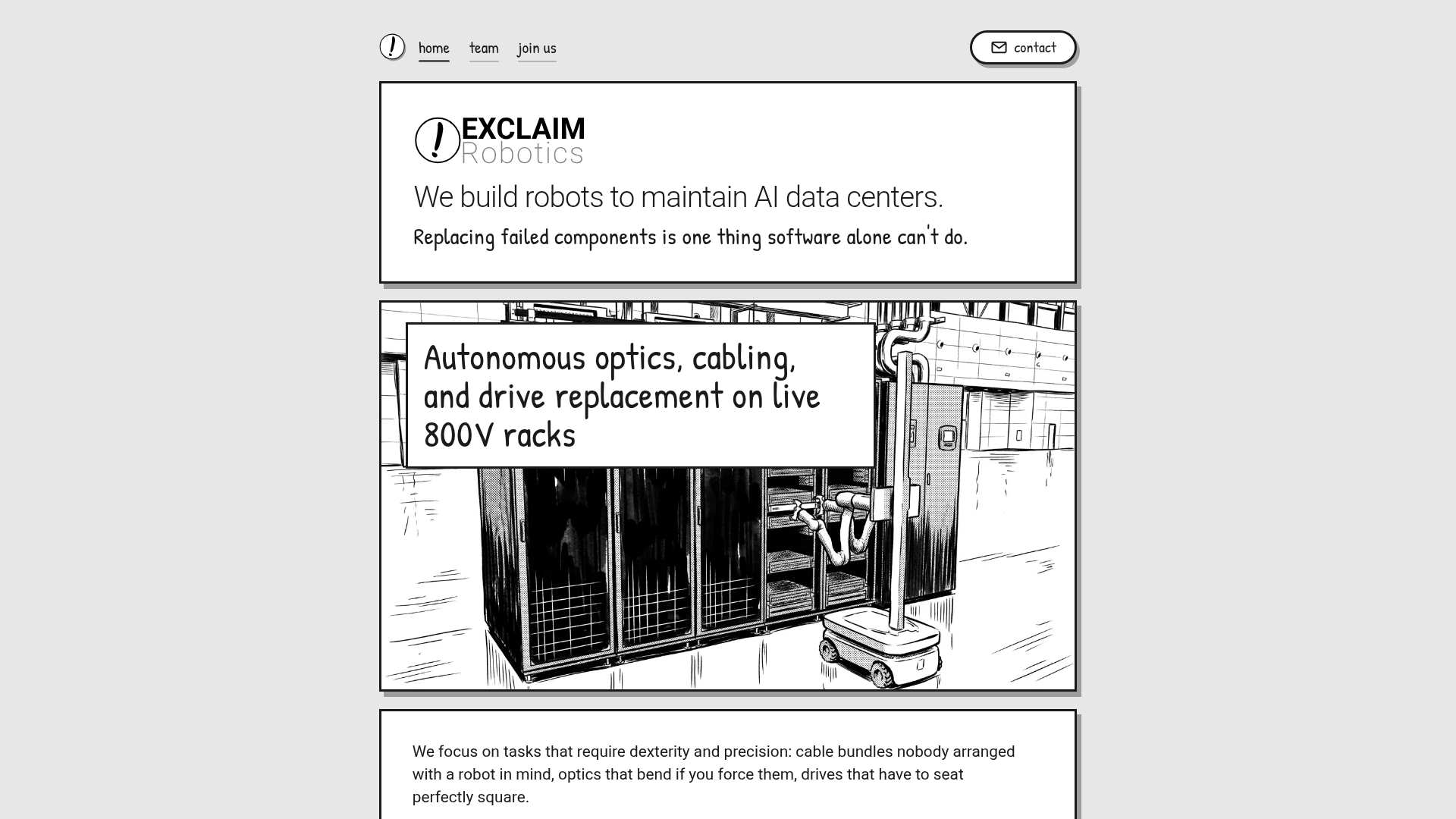
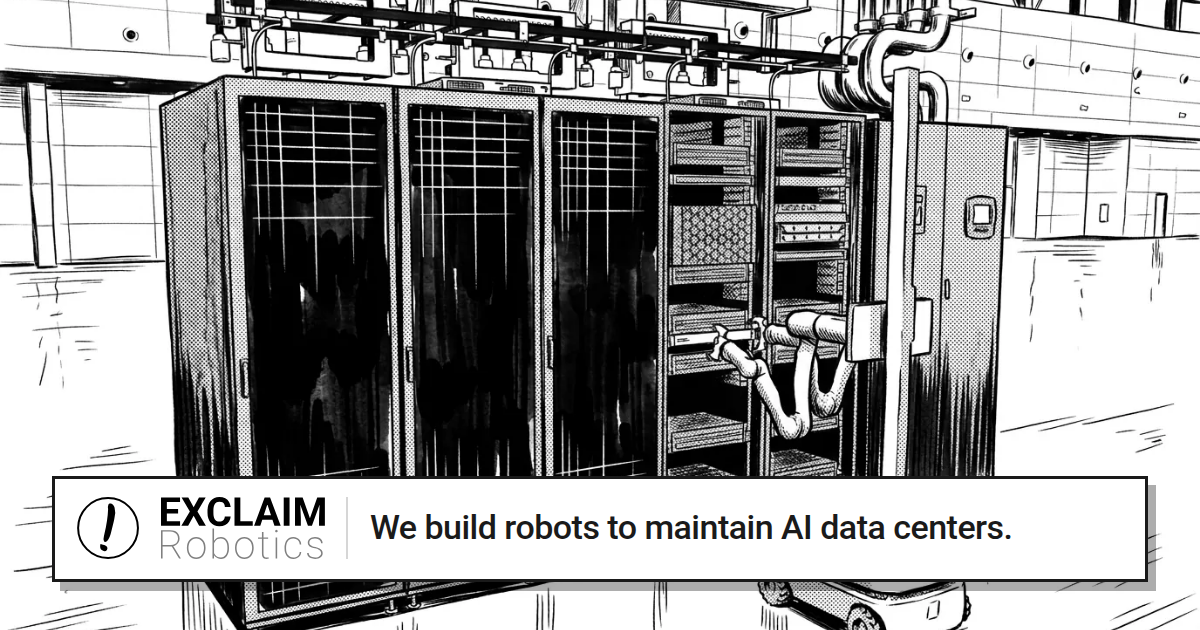
The AI data center is the most physically demanding environment in modern computing. While software-defined everything has automated networking, storage, and orchestration, the white space—the hall of racks—still relies on humans for the dirty, delicate work of replacing failed drives, re-seating optics, and managing cable bundles. Exclaim Robotics, a Zürich-based startup, has exited stealth with €4.29 million in pre-Seed funding to change that. Its thesis is simple and radical: if a robot can handle routine rack maintenance, the data center can run lights-out, unattended, and safer. This is not a story about another software copilot; it's about hardware that physically touches the infrastructure.
The lonely rack: why AI data centers need a robot, not a patch
AI data centers are not your grandfather's server rooms. They pack more compute density, more power, and more heat into every rack. But the fundamental problem remains: components fail. Drives die, optics degrade, cables loosen. Software can detect these failures, but it cannot replace a failed drive or reseat a bent optic. That requires dexterity, precision, and the ability to work in tight spaces—tasks that have always required a human technician.
Exclaim Robotics focuses on exactly these tasks. The company's website highlights "cable bundles nobody arranged with a robot in mind, optics that bend if you force them, drives that have to seat perfectly square." These are not abstract challenges; they are the daily realities of data center maintenance. The robot is designed to handle them with the precision that software alone cannot achieve.
800V DC: the safety argument that sells the robot
The next generation of AI data centers will run at 800V DC in the rack. That is a significant shift from traditional 48V or 240V systems, and it introduces a genuine safety risk for human operators. Working mere centimeters away from live 800V lines is dangerous, even with proper training and protective gear. Exclaim Robotics positions its robot as the answer to this risk: a machine that can work in these hazardous conditions without the same physical vulnerability.
This is not just a safety feature; it is a fundamental enabler. If you cannot safely have humans work on live racks, you have two options: shut down the rack for maintenance (costly downtime) or find a robot that can do the job. Exclaim Robotics is betting on the latter. The safety argument is compelling, and it is likely to be the primary driver for early adopters who are already planning 800V DC infrastructure.
Lights-out operations: the economic logic behind autonomy
Routine rack maintenance is the main reason the white space needs to be staffed at all. If a robot can handle these tasks, the hall can run unattended. This is the "lights-out" vision that Exclaim Robotics promotes. The economic logic is straightforward: fewer staff, lower cooling costs, and higher uptime.
The company points out that halls are currently cooled to keep humans comfortable, not hardware. A robot doesn't care about temperature, so the facility can run warmer, reducing cooling expenses. Maintenance can happen when the hardware needs it, not when a human shift is available. And physical access is a security surface—fewer people on the floor means a smaller attack surface. These are concrete, measurable benefits that go beyond the initial safety pitch.
Autonomy-first: skills, confidence, and the teleoperation safety net
Exclaim Robotics is not building a remote-controlled robot; it is building an autonomous one. The company trains "expert skills" for each task, so the robot can perform them precisely, reliably, and repeatably. But autonomy is not all-or-nothing. The robot is designed to understand its environment and reason about how to approach a job on its own. When its confidence in a skill is low, it asks for teleoperation rather than risking a critical incident. As skills mature, it asks less often.
This hybrid approach is pragmatic. It acknowledges that full autonomy is hard, especially in unstructured environments like data centers. By allowing teleoperation as a fallback, Exclaim Robotics can deploy its robots sooner and learn from human interventions to improve its skills. This is a sensible path to full autonomy, and it reduces the risk of catastrophic failures.
Beyond the data center: a roadmap for hazardous infrastructure
Exclaim Robotics' vision extends beyond data centers. The company states, "We won't stop at data centers: our vision is robots servicing any hazardous, remote, or hard-to-reach infrastructure." This is a bold ambition, but it is grounded in the same core competency: dexterous manipulation in dangerous environments. Oil rigs, power substations, and underwater facilities are all potential markets. The data center is the beachhead, but the long-term opportunity is much larger.
This roadmap also explains the name "Exclaim." It suggests a bold statement, a declaration that robots can do this work. It is a name that carries confidence, even arrogance. But it is also a risk: if the robots fail to deliver, the name becomes a punchline. The company is making a claim, and it needs to back it up.
The name 'Exclaim': a bold claim and a brand risk
The name "Exclaim" is short, memorable, and active. It evokes a sense of urgency and importance. But it is also generic—it does not immediately convey robotics or data centers. The company's wordmark and logo, which feature an exclamation mark, reinforce the name's meaning. In a category filled with names like "Robotics" or "Autonomous Systems," Exclaim stands out for its boldness.
However, the name is a double-edged sword. It makes a promise of significance, but it does not describe what the company does. This is a deliberate choice, likely intended to allow the brand to expand beyond data centers. But it also means the company must invest heavily in explaining what it does. The tagline "We build robots to maintain AI data centers" helps, but the name alone leaves room for ambiguity.
Despite this, the brand has a clear positioning: autonomous maintenance for critical infrastructure. The domain, exclaimrobotics.com, is straightforward and professional. The company's website is minimal but effective, with a hand-drawn aesthetic that suggests precision and craftsmanship. The team's background—NVIDIA, Microsoft, Google, ETH Zürich—adds credibility.
Exclaim Robotics is a startup to watch. It is tackling a real problem with a novel solution, and it has the funding and team to make progress. The road ahead is long, and the technical challenges are significant. But if the robots deliver, the name will be justified. And if they don't, the exclamation mark will become a question mark.