Executor
A single MCP gateway that connects any agent to every tool, with permissions you control.
NewName Editorial
Editorial Team


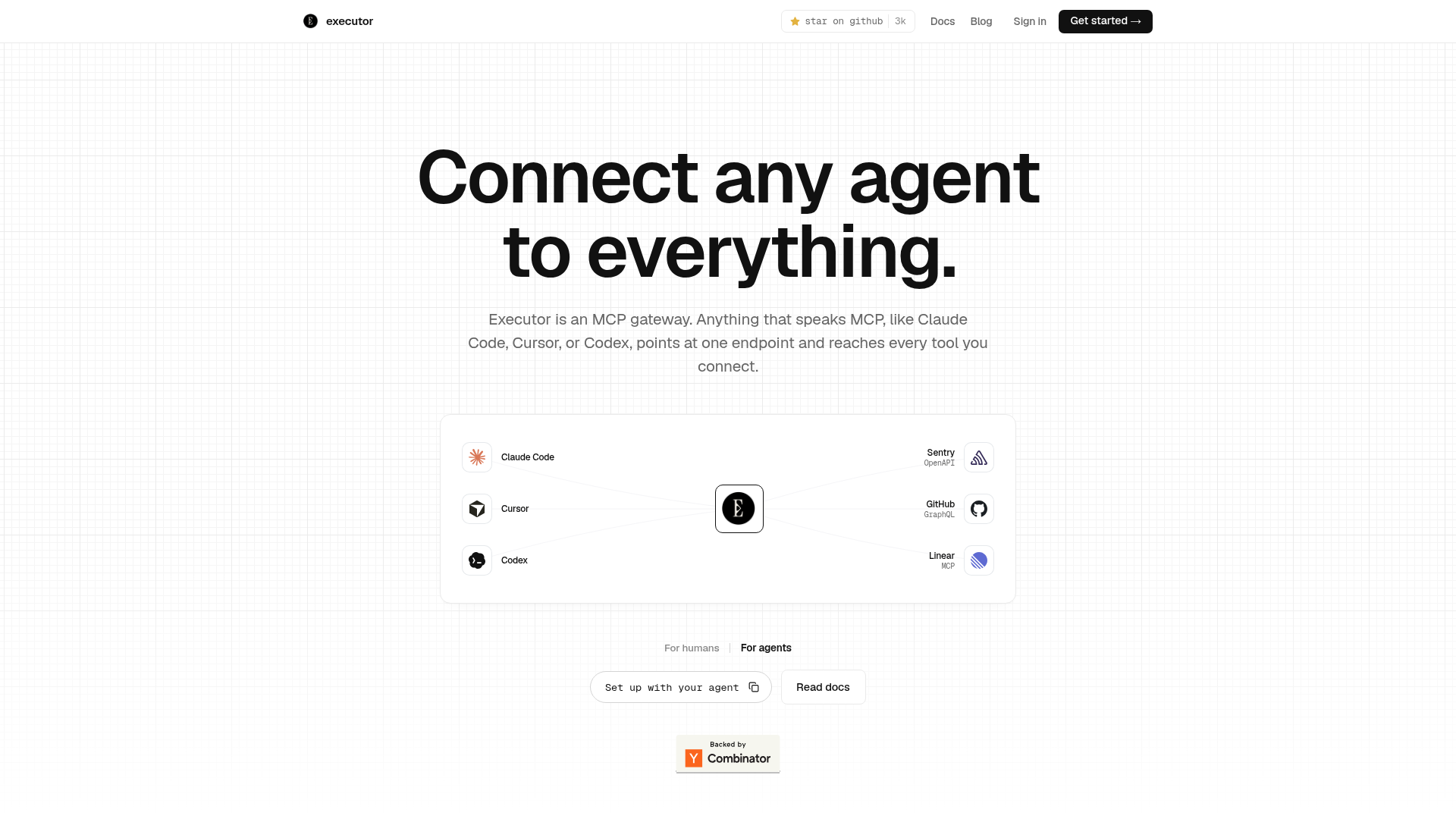
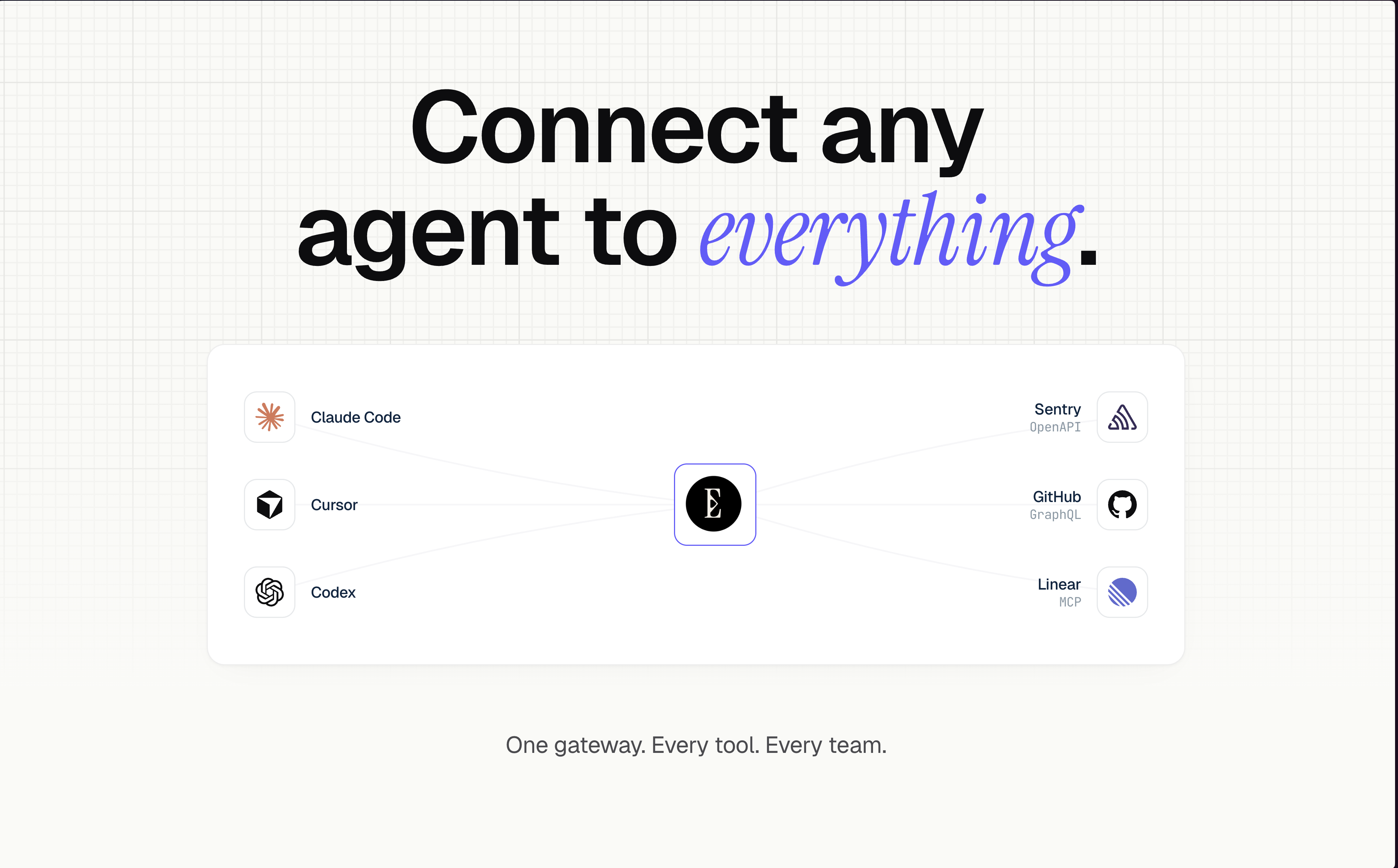
The AI agent stack is growing sideways. Every week, another coding assistant or autonomous worker appears, each with its own way of calling tools. The result is a tangle: point Claude Code at GitHub, give Cursor Stripe access, let Codex reach Sentry—and repeat for every new agent. Executor, a startup from Y Combinator, wants to be the single point where all of that wiring stops. It calls itself an MCP gateway: anything that speaks the Model Context Protocol—Claude Code, Cursor, Codex—points at one endpoint and reaches every tool you connect. The pitch is simple, but the implications are deeper than a convenience layer.
The MCP gateway: a new layer in the AI stack
MCP is the emerging standard for letting AI models call external tools. Instead of each agent building its own integrations, MCP defines a common way to expose tools. Executor sits on top of that protocol as a gateway. Think of it as a reverse proxy for agent tooling: the agent talks to Executor, and Executor talks to everything else. This is a distinct layer in the stack—not another tool, but the switchboard that routes tool calls. The website's hero line, "Connect any agent to everything," is deliberately broad. It positions Executor as infrastructure, not an application. That's an ambitious claim, and the execution will determine whether it's a layer or just another proxy.
Why tool overload breaks agent workflows
Without a gateway, connecting an agent to your stack means configuring each integration separately. The website lists the pain: "Wiring tools to agents is fiddly, per-client, and easy to get wrong." Each agent has its own configuration format, authentication, and error handling. When you have five agents and ten tools, that's fifty potential points of failure. Executor's answer is normalization: every tool, from any protocol, looks the same—one name, one input schema, one output schema. This is a classic abstraction play. The hard part is not the concept but the breadth of connectors and the reliability of the translation layer. The site mentions support for GitHub, Stripe, Jira, Sentry, Linear, Gmail, and OpenAPI—a solid starting set, but the long tail of enterprise tools remains an open question.
The context trick: one tool instead of 1,640
Here's the most concrete claim on the site: without Executor, connecting 1,640 tools would balloon the model's context to about 278,800 tokens. With Executor, the model sees just one tool, consuming about 1,044 tokens. That's a 99.6% reduction. The mechanism is lazy loading: Executor shows the model a single tool, and only when the code actually calls it does it fetch and load that tool's schema. This is a clever engineering solution to a real problem—context windows are finite, and tool schemas are verbose. By hiding the catalog until needed, Executor keeps prompts lean. The numbers are from the site's own comparison, so they're illustrative, but they point to a genuine advantage. For teams running large tool catalogs, this could be the difference between a usable agent and one that chokes on its own configuration.
Permissions: the quiet control plane
The tagline promises "permissions you control," and the site emphasizes that Executor centralizes access. Instead of giving each agent a separate API key with its own scope, you define permissions once in Executor. This is a security win: fewer keys floating around, and a single place to audit who (or what) can do what. The site's visual shows a toggle between "For humans" and "For agents," suggesting a clear separation of access. This is crucial as agents become more autonomous—you want them to act within bounds, not with unrestricted access. Executor's positioning here is smart: it's not just a convenience layer, but a governance layer. The question is how granular the permissions are—can you restrict an agent to read-only on GitHub but full access on Stripe? The site doesn't detail this, but the promise is there.
Naming as a promise: Executor's blunt ambition
The name "Executor" is a double-edged sword. On one hand, it's a strong, action-oriented word that suggests getting things done. On the other, it's generic—there are dozens of products called "Executor" in various categories. The domain executor.sh is clean and appropriate for a developer tool, with the .sh hinting at shell and scripting. The name works because it aligns with the product's function: it executes tool calls on behalf of agents. But it lacks the distinctiveness of, say, "Anthropic" or "Modal." The branding leans on the Y Combinator badge and the open-source GitHub repo (3k stars), which signals credibility. The risk is that "Executor" gets lost in search results, but for a dev tool, word-of-mouth and GitHub stars matter more than SEO. The name is a promise of action, and the product needs to deliver on that.
What's missing: the open questions
The site is light on specifics. There's no pricing page, no detailed documentation of supported protocols beyond MCP, and no mention of enterprise features like SSO or audit logs. The cloud offering is mentioned but not elaborated. For a product that aims to be infrastructure, these gaps matter. Teams evaluating Executor will want to know: How does it handle authentication for each tool? What's the latency overhead? Can it scale to thousands of concurrent agent sessions? The site's focus on the context efficiency win is compelling, but it's a single metric. The real test will be in production—whether Executor can reliably route calls across a messy, heterogeneous tool landscape. For now, it's a promising start, but the proof will be in the adoption.
Executor is a bet on a specific future: that agents will proliferate, and the bottleneck will be integration, not intelligence. By making every tool look the same, it aims to remove the friction that slows agent adoption. The context trick is clever, the permission model is timely, and the naming is bold. But the open questions around scalability and enterprise readiness are real. For developers tired of wiring tools to agents one by one, Executor is worth a look. For the rest, it's a signal of where the AI stack is heading—toward a world where the agent is the user, and the gateway is the gatekeeper.