Fernand
A calm, founder-first support tool with AI, priced at $29/month.
NewName Editorial
Editorial Team
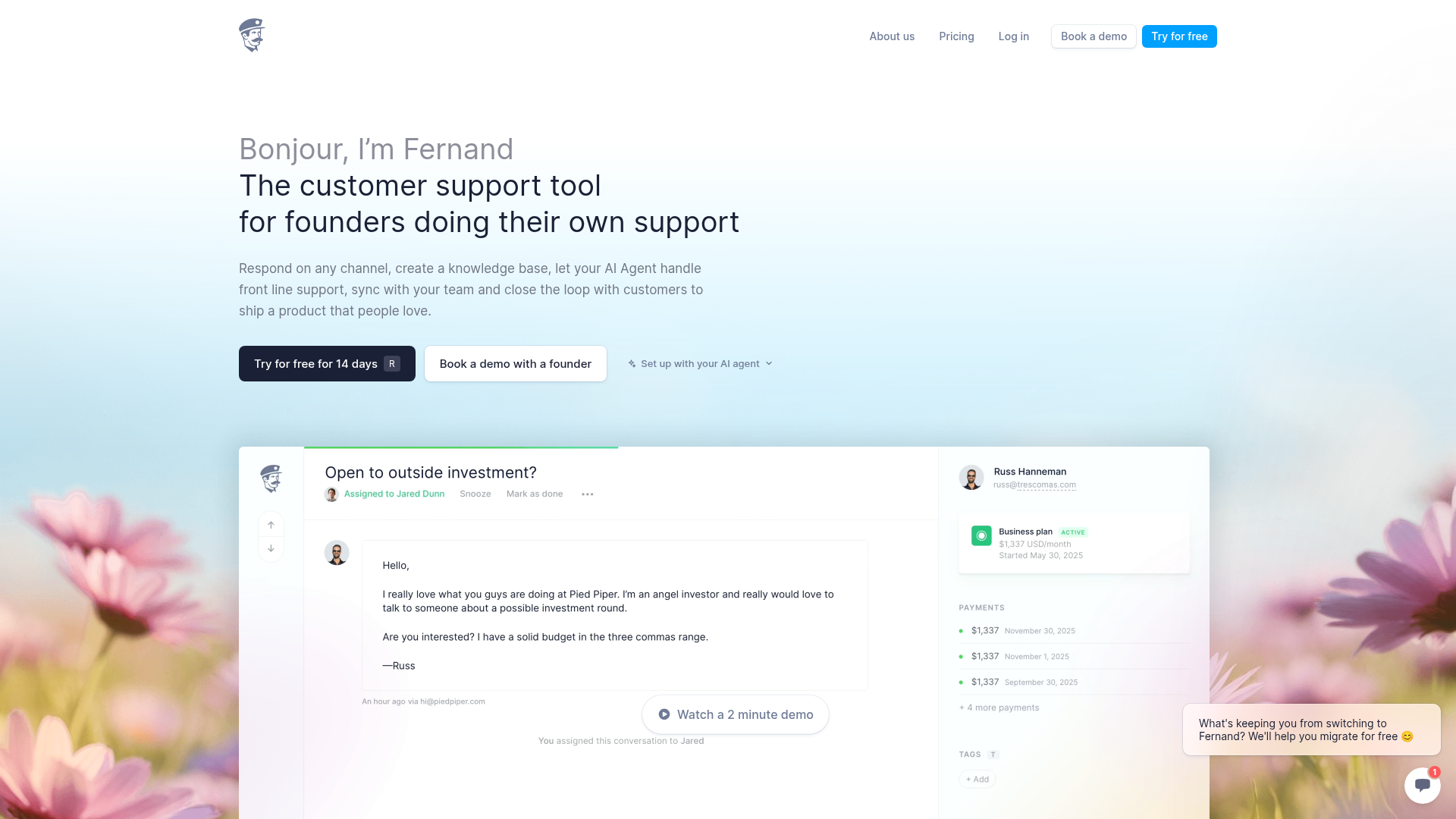
Most support tools greet you with a dashboard full of blinking badges, unassigned tickets, and a sales rep who wants to schedule a demo. Fernand greets you with "Bonjour." That single word—French for hello, delivered by a product named after a French fern—is the clearest signal of what this company is trying to do: make customer support feel less like a battlefield and more like a conversation.
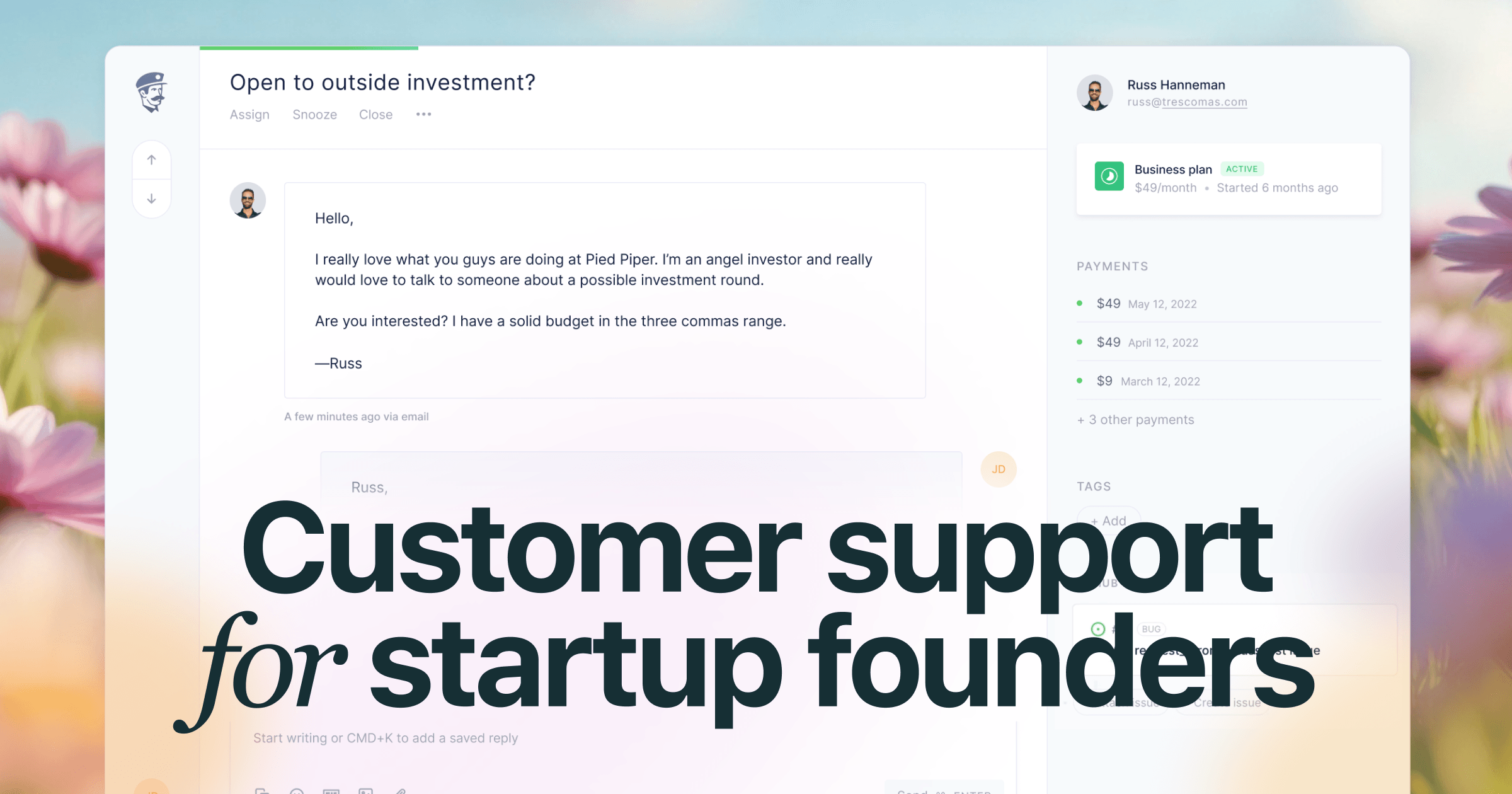
Fernand is a support widget, but that label undersells it. The product bundles a shared inbox, a knowledge base, an AI agent, and integrations with Stripe, GitHub, and Linear into a single tool aimed squarely at founders who are still doing their own support. The website opens with "The customer support tool for founders doing their own support," and every feature seems designed to reduce the cognitive load of that job. This is not a tool for enterprise support teams with SLAs and escalation matrices; it's for the solo founder who wakes up to 47 unread emails and needs a clear path to inbox zero.
The name itself is a strategic choice. "Fernand" is a French masculine given name, derived from the Germanic elements for "peace" and "dare." It's warm, slightly old-fashioned, and utterly unexpected in a category dominated by cold, technical names like Zendesk or Intercom. The "Bonjour" greeting, the French founders (Antoine and Cyril), and the fern imagery in the site's flowers all reinforce a brand personality that is calm, approachable, and human. In a market where every tool claims to be "AI-powered" and "enterprise-grade," Fernand's naming is a quiet rebellion: we're not a robot, we're your friendly neighbor.
The Bonjour Effect: A Name That Sets the Tone
The name "Fernand" does more than just sound pleasant. It sets expectations. When a customer sees a widget that says "Bonjour, I'm Fernand," they don't expect a corporate IVR; they expect a helpful human (or a very good AI impersonation). The name also makes the product memorable—try forgetting a support tool named after a French man. This is a deliberate contrast to the category's tendency toward abstract, techy names. Fernand's brand is built on approachability, and that extends to the product's design philosophy, which the site describes as "incredibly calm" and rooted in cognitive psychology.
The "Bonjour" welcome screen is a small touch, but it's indicative of the product's attention to emotional design. Instead of a stark list of tickets, users see a friendly greeting and a progress indicator toward inbox zero. This is not just decoration; it's a behavioral nudge. By framing support as a series of small, completable tasks, Fernand aims to reduce the overwhelm that leads to procrastination. The site even claims the design is "crafted to be incredibly calm" and "helps increase focus and reduce procrastination," citing principles from cognitive psychology and behavioral science.
Built for the Founder Who Is the Support Team
Fernand's target user is the founder who wears every hat, including support. The product is designed to consolidate all support channels—email, live chat, Slack DMs, contact forms, and even a headless API—into one shared inbox. This is a practical solution to a common problem: founders often have help@, sales@, and a Twitter DMs tab all open simultaneously, and things fall through the cracks. Fernand's promise is that you'll "never miss anything again," and the shared inbox is the mechanism.
The workflow is built around speed and context. Keyboard shortcuts for everything, a command palette (⌘K), and smart snippets that trigger templates, tags, and assignments with a single keystroke. The site claims the app loads in under 100ms, which is a bold claim but aligns with the "calm" ethos—no spinners, no waiting, just work. For a founder who is juggling product development, sales, and support, these micro-efficiencies add up.
But the real differentiator is the AI agent. Fernand's AI is not a generic chatbot; it's trained on your product's docs, past replies, and Q&As. It powers smart replies, automated drafts, conversation summaries, and even generates knowledge base articles. The AI can handle front-line support in the widget, escalating to a human only when it can't resolve the issue. This is a practical application of AI that saves founders hours each week, and it's included in the $29/month price.
The $29 Flat-Rate Bet: Pricing as a Positioning Statement
Fernand's pricing page is refreshingly simple: $29 per human per month, with AI agents riding free. No per-resolution fees, no hidden costs for API calls, and no credit card required for the 14-day trial. This is a direct contrast to competitors like Intercom or Zendesk, which often have complex pricing tiers based on seats, features, and support volume.
The flat rate is a bold bet. It signals that Fernand is confident in its AI's ability to handle a significant portion of support, and it positions the product as an accessible tool for early-stage founders who are sensitive to costs. The site's copy drives this home: "No setup maze. No annoying sales calls. No feature overload. Just something that works, priced transparently at $29/month."
This pricing strategy also aligns with the brand's anti-enterprise stance. By charging a flat rate, Fernand is saying: we're on the side of the founder, not the procurement department. It's a positioning statement that resonates with the target audience, even if it might limit the company's revenue per customer in the long run.
Calm by Design: Cognitive Psychology in a Helpdesk
The website's claim that Fernand is "crafted to be incredibly calm" is more than just marketing fluff. The product is designed around the idea of reducing cognitive load. Features like "one thing at a time" (a ticket flow that presents a single task), progress indicators toward inbox zero, and a "Bonjour" welcome screen are all intended to make support feel less overwhelming.
The site even references "proven principles from cognitive psychology and behavioral science" to justify these design choices. This is an unusual angle for a support tool, which typically focuses on efficiency metrics like first response time or resolution rate. Fernand is selling a feeling—calm, control, and clarity—which is a powerful differentiator in a category that often induces anxiety.
Of course, calm is subjective, and the proof is in the usage. The testimonials from founders like Jack Friks of Post Bridge and Thomas Sanlis of Uneed suggest that the product delivers on this promise. Jack says, "For the first time I'm not managing a mess of mailboxes but greeted every morning with a clear path to resolution." Thomas echoes this: "With Fernand, I finally feel calm again."
The AI Agent That Knows Your Product, Not Just Your Docs
Many support tools offer AI, but Fernand's approach is more integrated. The AI is trained on your specific product context—docs, past replies, Q&As, and files—and it uses that knowledge across all features. This means the AI can generate smart replies that sound like you, draft responses based on your tone, and even create knowledge base articles.
The AI agent in the widget is the front-line support. It answers customer questions instantly, drawing from your training data. If it can't resolve the issue, it escalates to a human with full context. This is a practical implementation of AI that reduces the founder's workload without sacrificing quality.
Fernand also allows you to bring in custom data from any HTTP endpoint, displayed in the conversation sidebar using Liquid templating. This is a powerful feature for founders who need to see customer-specific information, like account details or usage metrics, without switching tabs. The example on the site shows a customer's enterprise clients, NPS score, and QBRs, all pulled from an API.
Where Fernand Goes Next: Risks and Open Questions
Fernand is a well-designed product with a clear niche, but there are open questions. The $29 flat rate is attractive, but it may not be sustainable if AI costs scale with usage. The site says "unlimited API calls and agent actions included," which could be a risky promise if a customer's AI agent goes rogue and makes thousands of calls.
Another question is whether the "calm" design can scale to larger teams. The product is positioned for founders and small teams, but as a company grows, support becomes more complex, and the need for advanced routing, SLAs, and analytics increases. Fernand's simplicity is its strength, but it could become a limitation.
Finally, the name "Fernand" is a double-edged sword. It's memorable and distinctive, but it might not translate well in non-French-speaking markets, and it could be seen as gimmicky by enterprise buyers. However, for the target audience of indie founders, it's likely a plus.
Despite these uncertainties, Fernand has carved out a clear identity in a crowded market. It's a support tool that doesn't feel like a support tool—it feels like a calm, helpful companion. And in a world of bloated software, that's a refreshing proposition.