Fiber AI
Real-time change data on companies, people, and jobs for AI agents and GTM teams.
NewName Editorial
Editorial Team


Most data vendors sell you a snapshot. Fiber AI sells you the moment something changes — the instant a company hires, launches, switches jobs, raises, or posts. That's a different category of value, and it's why the company's pitch to developers and GTM teams is starting to resonate.
Fiber AI is an API-first platform that gives you access to a continuously updated database of 40M+ active companies, 850M+ professionals, and 30M+ jobs. But the headline isn't the volume; it's the freshness. The tagline — "Track any changes on companies, people, and jobs" — is a promise that your data won't be stale by the time you act on it.
The hidden value of change data
In sales and recruiting, timing is everything. A job posting that's two weeks old might already be filled. A funding announcement that's a month old means the company has already been flooded with pitches. Fiber AI's core thesis is that the signal isn't in the static profile; it's in the delta.
The website's primary use cases are telling: "Know the exact moment your ICP hires, launches, switches jobs, raises, or posts." That's not a feature list; it's a list of triggers. For a sales team, a company that just raised a Series B is a better prospect than one that raised last year. For a recruiter, a senior engineer who just updated their LinkedIn headline is a warmer lead than one who hasn't touched their profile in months.
Fiber AI's API endpoints are designed to surface these triggers programmatically. The company's documentation highlights endpoints like "live fetch" for real-time LinkedIn profile and company information, and "agentic search" that lets AI agents build comprehensive prospect lists from 100+ data sources. This is change data, packaged for machines.
API endpoints that go beyond the usual suspects
The API market is crowded. Crustdata, People Data Labs, Apollo, Brightdata, and Explorium all offer access to company and people data. Fiber AI's differentiation is in the exclusivity of its endpoints. The site claims: "We have API endpoints that you won't find on Crustdata, People Data Labs, or Apollo."
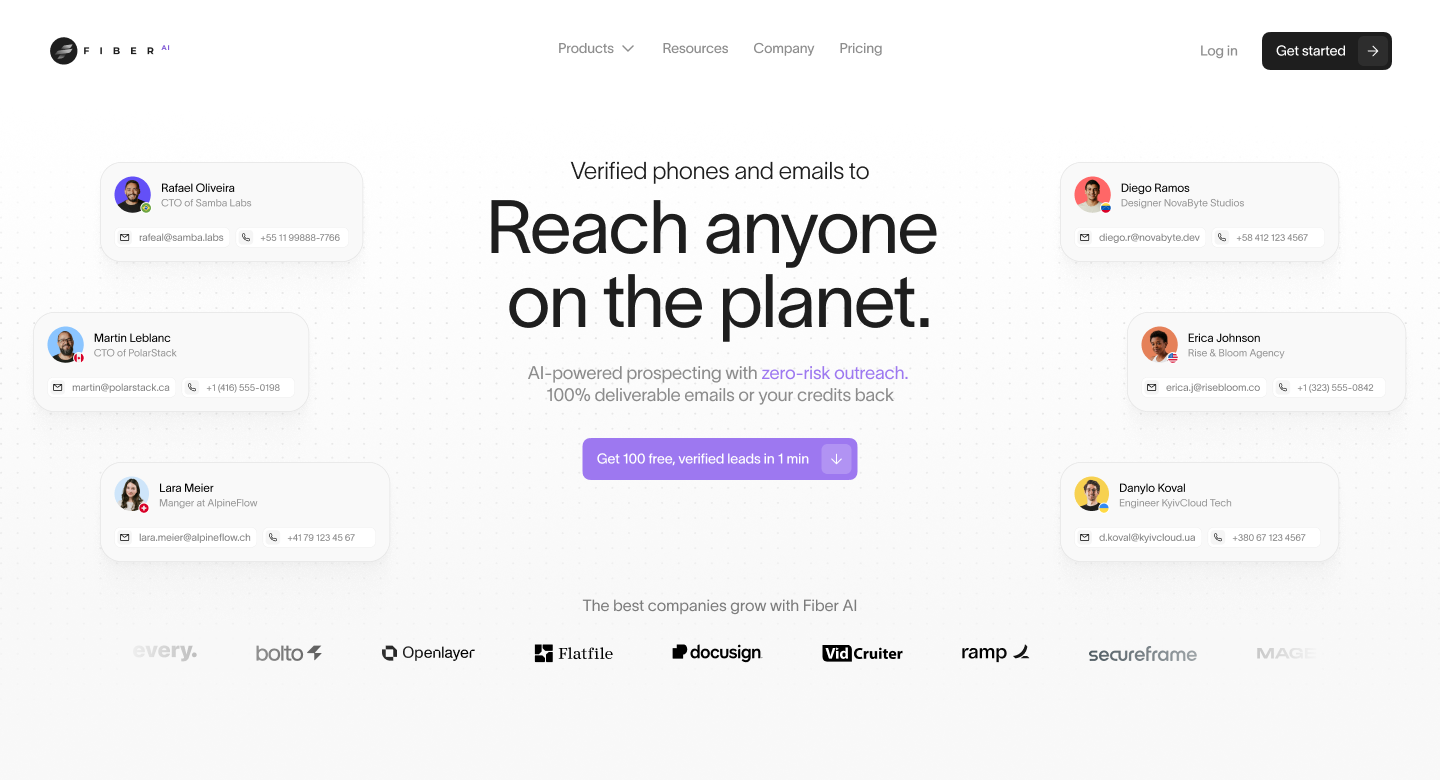
One such endpoint is the email-to-person reverse lookup. You feed it a work or personal email, and it returns the person's profile, current job, education, and skills. Docusign uses this to enrich accounts that sign up with personal emails, and it's also handy for CRM hygiene — old emails get enriched with the person's work history and contact info.
Another exclusive is the partial information search. You can search for a person or company with incomplete data — say, a first name and a city — and Fiber AI fills in the gaps. The site claims this is more granular than LinkedIn Recruiter, which is a bold statement for a seed-stage startup.
These endpoints are the moat. While competitors offer broad search, Fiber AI offers narrow, high-value queries that solve specific problems. The company is betting that these "nobody else has" capabilities will convince enterprises to switch.
Five surfaces, one data stream
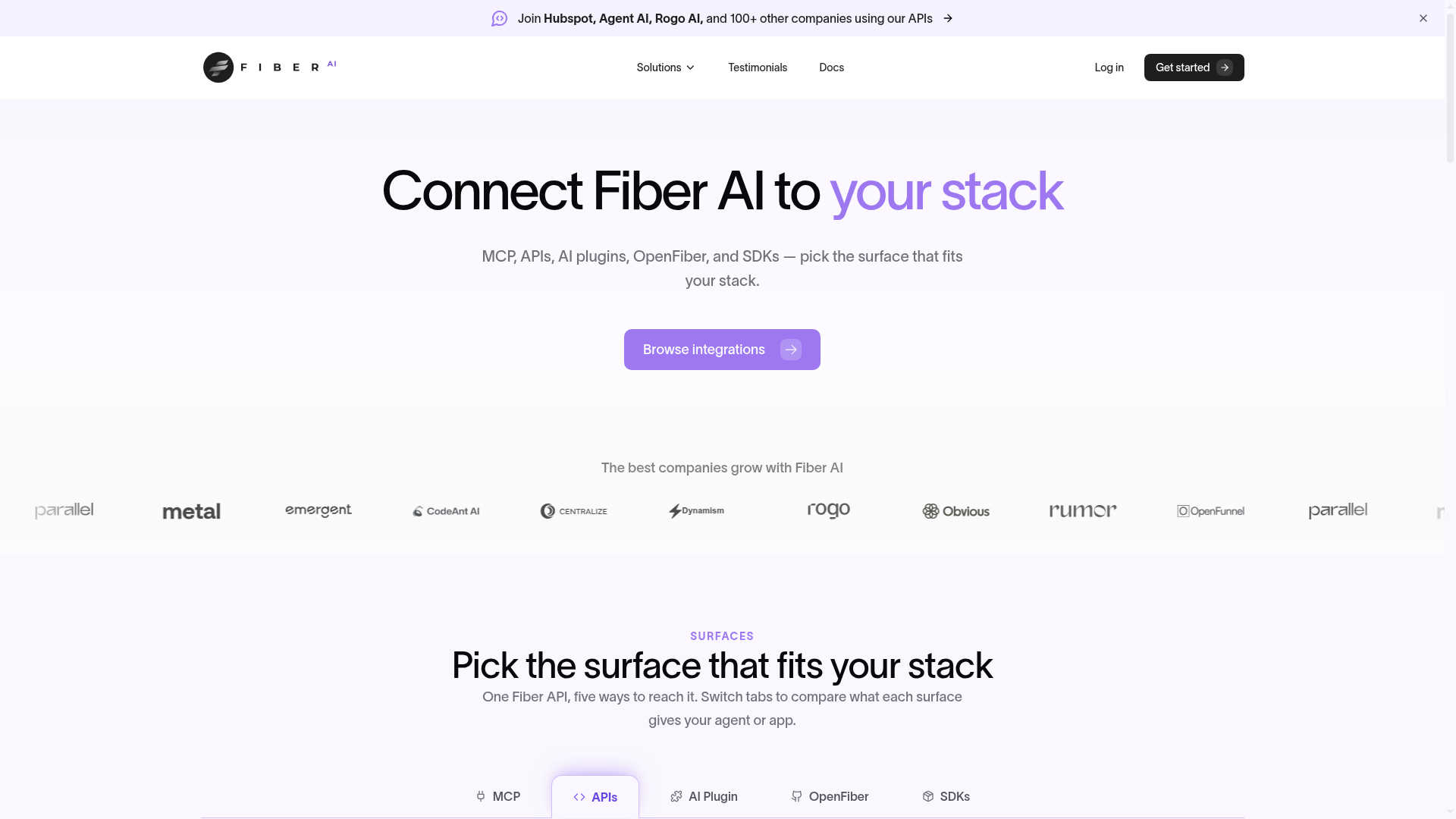
Fiber AI isn't just an API; it's a multi-surface platform. The website lists five ways to access the same data: MCP (Model Context Protocol), APIs, AI plugins, OpenFiber, and SDKs. This is a strategic move to embed itself into every possible workflow.
For developers, the API is the raw interface. For AI agents, the MCP and AI plugin surfaces make it trivial to plug Fiber AI into an agent's toolset. OpenFiber suggests an open standard, and SDKs lower the barrier for integration.
The tagline "Connect Fiber AI to your stack" reinforces this. The company wants to be the data layer that every GTM tool and AI agent runs on. The testimonials back this up: HubSpot uses Fiber AI to generate larger lead lists and enrich contacts; Ramp uses it to build targeted audiences for LinkedIn ads; Agent AI uses it to power its company and people search agents.
This multi-surface approach is smart. It means Fiber AI isn't competing for a single integration slot; it's competing to be the default data source across the entire stack.
From CRM enrichment to AI agent fuel
The customer stories on the site reveal two distinct use cases. The first is traditional GTM enrichment: sales and marketing teams using Fiber AI to clean up CRMs, build lead lists, and run targeted ads. The second is more forward-looking: AI agents using Fiber AI's data to make decisions.
Agent AI, for example, uses Fiber AI's "agentic search" APIs to power its own company and people search agents. This is a sign that Fiber AI is positioning itself as the data backbone for the agent economy. The site even mentions a "World's Largest Agentic AI Coding Platform" (under NDA) that uses Fiber AI to enrich profile data for its users.
This is a clever pivot. Instead of just selling data to humans, Fiber AI is selling data to machines. And machines are hungry for structured, real-time data. The company's API endpoints are designed to be called programmatically, with clear request/response formats and a focus on reliability.
The risk is that AI agents might eventually replace the need for human-facing GTM tools, but Fiber AI is hedging by serving both.
The name says it all: Fiber as the connective tissue
The name "Fiber AI" is a deliberate choice. Fiber is the connective tissue that carries signals — whether it's fiber optics or dietary fiber. The implication is that Fiber AI is the conduit for change data, carrying the signals that matter from the source to the user.
The brand is clean and modern, with a leaf logo that suggests growth and freshness. The domain, fiber.ai, is short and memorable, though it might be confused with other "Fiber" brands (like Google Fiber). But in the AI space, the name works: it's distinct, easy to say, and hints at the company's role as a data infrastructure layer.
For a seed-stage startup, the name is a statement of ambition. It's not "Fiber Data" or "Fiber API"; it's "Fiber AI," signaling that the company is AI-native from day one. That positioning is reinforced by the tagline and the emphasis on agentic search and MCP support.
What Fiber AI doesn't tell you
Fiber AI's website is impressive, but it's also selective. The company doesn't disclose pricing, which is common for enterprise-focused APIs but still a hurdle for small teams. There's no mention of data sources or how the database is built, which raises questions about accuracy and compliance.
The site claims "40M+ active, global companies, 850M+ professionals, and 30M+ jobs," but these numbers are self-reported and unverifiable. The testimonials are mostly anonymized (with NDAs), and specific metrics like ROAS increases are redacted.
There's also the question of sustainability. Building and maintaining a database of this scale is expensive. Fiber AI is at seed stage, and it's unclear how it will compete with well-funded incumbents like Apollo or People Data Labs. The "exclusive" endpoints are a differentiator, but they could be copied.
For now, Fiber AI is a promising player in the data API space, with a clear focus on change data and AI integration. The question is whether it can turn its early traction into a durable moat. If it can, the name "Fiber" will be fitting — the connective tissue of the AI economy.