FizzBee
Formal verification for your prompt, so your coding agent builds what you mean.
NewName Editorial
Editorial Team
The pitch for AI coding agents has always been the same: describe what you want, and the code appears. But anyone who has watched an agent confidently ship the wrong feature knows the real problem isn't the code generation—it's the specification. FizzBee, a new tool from the creator of fizzbee.io, takes the unusual position that the fix isn't a better agent or a longer prompt, but a formal verification pass over your requirements before the agent ever sees them.
It is a small, almost contrarian idea: instead of asking the coding agent to interpret your intent, FizzBee asks you a series of pointed questions, runs a formal check for contradictions and gaps, and produces a machine-readable specification that your agent can build from. The tagline on the site—"Your coding agent builds what you tell it. FizzBee helps you tell it what you mean."—captures the shift. This is not another AI planner or a document generator. It is a requirements engineer that treats your prompt as a set of logical claims to be verified, not a wish to be fulfilled.
The hidden decisions your coding agent makes for you
The core argument FizzBee makes is deceptively simple: every prompt leaves decisions unmade, and your agent will make them silently. The site's examples are concrete and vivid. Terminate a manager—who takes their team, and their pending leaves? Delete a wiki note—what happens to notes that linked to it? Remove someone from a shared expense when their balance isn't zero? These are not edge cases in a formal logic textbook; they are the mundane, messy decisions that every real product contains. FizzBee's claim is that it found these gaps before any code was written, using formal verification to systematically enumerate what your prompt did not say.
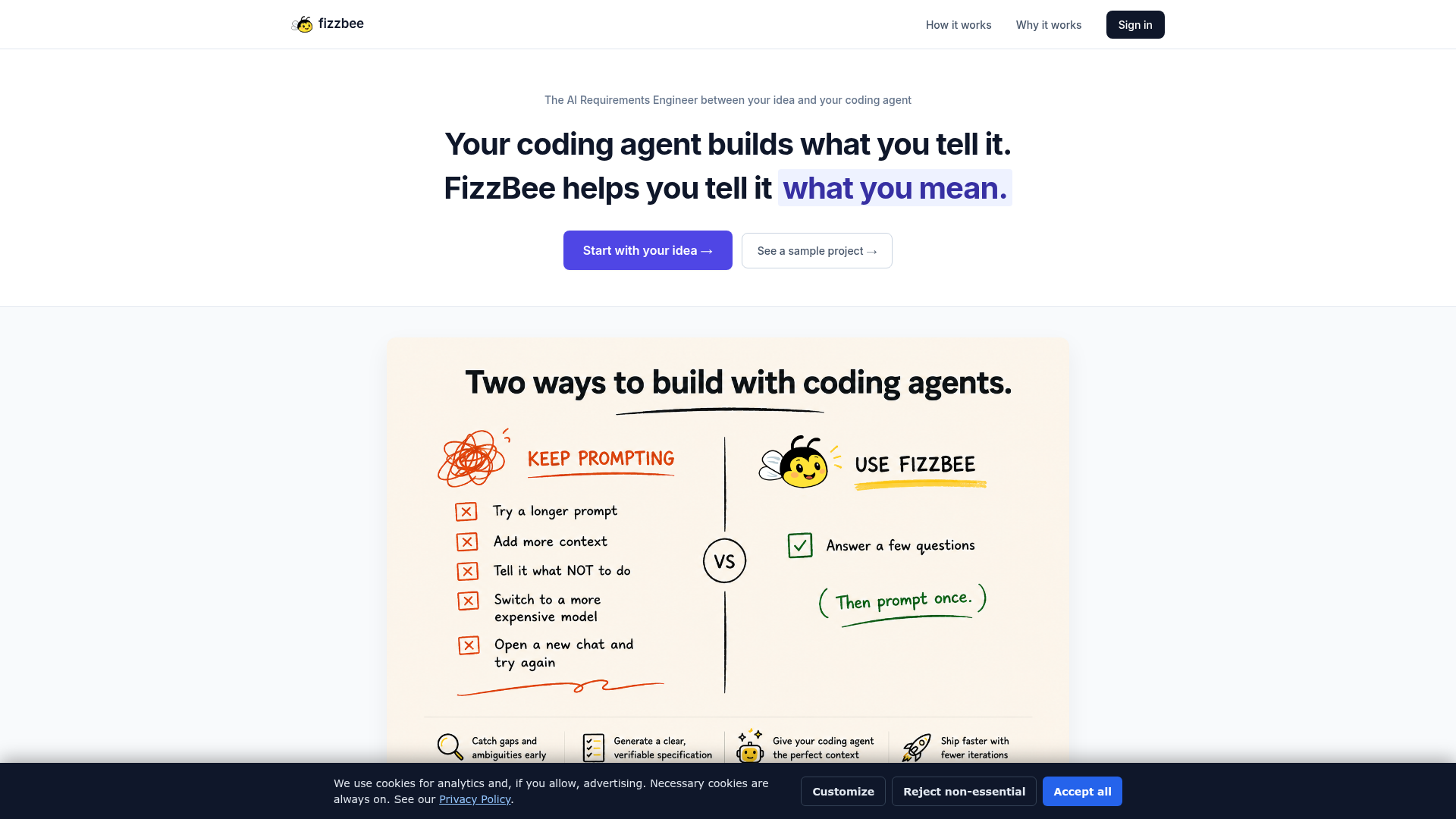
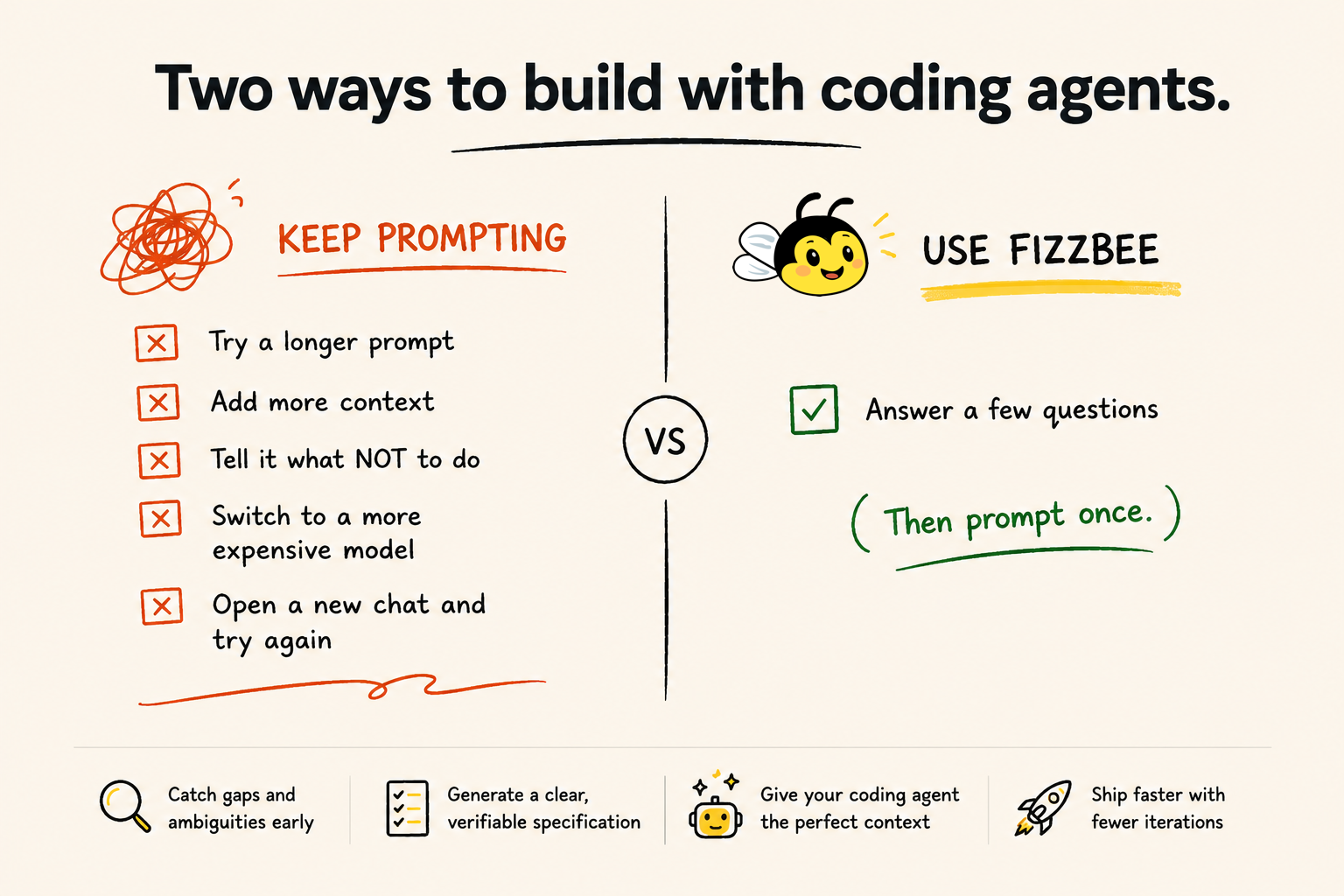
This is the strongest part of the pitch. It reframes the problem of AI development from "the agent is dumb" to "the specification is incomplete." The agent is not guessing maliciously; it is guessing because it has to. FizzBee's job is to make the guessing unnecessary by forcing you to answer the questions the agent would otherwise answer for you. The comparison graphic on the homepage makes the point visually: the left column is the current state—longer prompts, more context, telling it what NOT to do, switching to a more expensive model, opening a new chat and trying again. The right column is FizzBee: answer a few questions, then prompt once.
Formal verification as a prompt-engineering tool
FizzBee's mechanism is what sets it apart from the crowd of "AI planning" tools. It uses formal verification—the same technology behind fizzbee.io—to analyze your requirements for contradictions and gaps. This is not a fuzzy semantic similarity check; it is a logical analysis that can prove whether a set of requirements is consistent. The site's "How it works" section lays out three stages: elicitation (answer key questions), analysis (review contradictions and gaps), and validation (explore important scenarios). The output is a "Precise, Verified" specification.
The choice of formal verification is both the product's strength and its risk. On one hand, it offers a level of rigor that typical prompt-based tools do not. On the other, formal methods have a reputation for being heavy and academic. FizzBee's bet is that it can package this rigor into a lightweight, interactive experience—"You answer the questions; your agent reads the specification; you get the code." The site emphasizes that the spec is not a 30-page PRD for you to review; it is a machine-readable artifact for your agent. This is a deliberate inversion of traditional requirements engineering, where the spec is a human document. FizzBee's spec is for the machine, and the human interaction is the question-and-answer session.
The spec is for the machine, not for your boss
This is where FizzBee breaks from the standard Specification-Driven Development playbook. The site is explicit: "Most Specification-Driven Development tools generate documents for humans. FizzBee generates specifications for machines to analyze and coding agents to build from." That is a crucial distinction. A human-readable PRD is designed to align stakeholders, to be reviewed and signed off. A machine-readable spec is designed to be consumed by a coding agent, to reduce ambiguity in the instructions it receives. FizzBee is not trying to replace your product manager; it is trying to replace the guesswork in your prompt.
The implication is that the user is not a requirements analyst but a developer who wants to ship the right thing. The workflow is: start with an idea, answer a few questions, get a verified specification, then prompt your agent once. The promise is "Ship the right thing. First try." This is a bold claim, but it is grounded in the logic of the tool: if the specification is complete and consistent, the agent has less room to misinterpret.
Why the sample project is the real pitch
FizzBee's homepage includes a link to a sample project, described as "See how one prompt became a verified specification. Every question FizzBee asked. Every requirement gap it uncovered. Every decision the founder made." This is the most compelling evidence the site offers. Instead of abstract claims, it points to a concrete artifact: a live project that shows the elicitation process in action. The sample project is not just a screenshot; it is an interactive view of the questions, gaps, and decisions. For a product that is about surfacing hidden decisions, this transparency is the right marketing move.
However, the site does not disclose how many users, what the pricing is, or what the formal verification engine's limitations might be. There is no pricing page, no customer testimonials, no public roadmap. The product appears to be in an early stage, with a login flow that suggests a hosted service. The founder, jayaprabhakar, is also behind fizzbee.io, which the site references as the same formal verification technology. This gives some credibility to the technical claims, but the lack of public case studies means the reader must take the sample project at face value.
The line between requirements engineering and over-engineering
The biggest risk for FizzBee is the same one that has plagued formal methods for decades: it can feel like overkill. For a simple CRUD app, do you really need formal verification? The site's answer is yes, because even simple apps have hidden decisions—the expense example is a case in point. But there is a cost: the elicitation process takes time. The promise is that this time is less than the time you would spend debugging the wrong app, but that tradeoff is not quantified on the site.
Another risk is that FizzBee's output is a specification for a coding agent, but the quality of the final code still depends on the agent's ability to interpret a formal spec. The site does not address how the spec is translated into agent instructions, or whether it works with all coding agents. The user is left to assume that the spec can be fed into any agent, but the details are absent.
Despite these open questions, FizzBee's core thesis is compelling: the problem with AI development is not code generation, it is specification. By applying formal verification to the requirements stage, FizzBee offers a way to make the invisible visible, to force the hidden decisions into the open before they become bugs. Whether it succeeds will depend on how well it can balance rigor with usability, and whether developers are willing to answer a few questions before they prompt. The sample project suggests the questions are worth asking.