Flint
An idea engine that strikes unlike things together and grades the sparks honestly.
NewName Editorial
Editorial Team
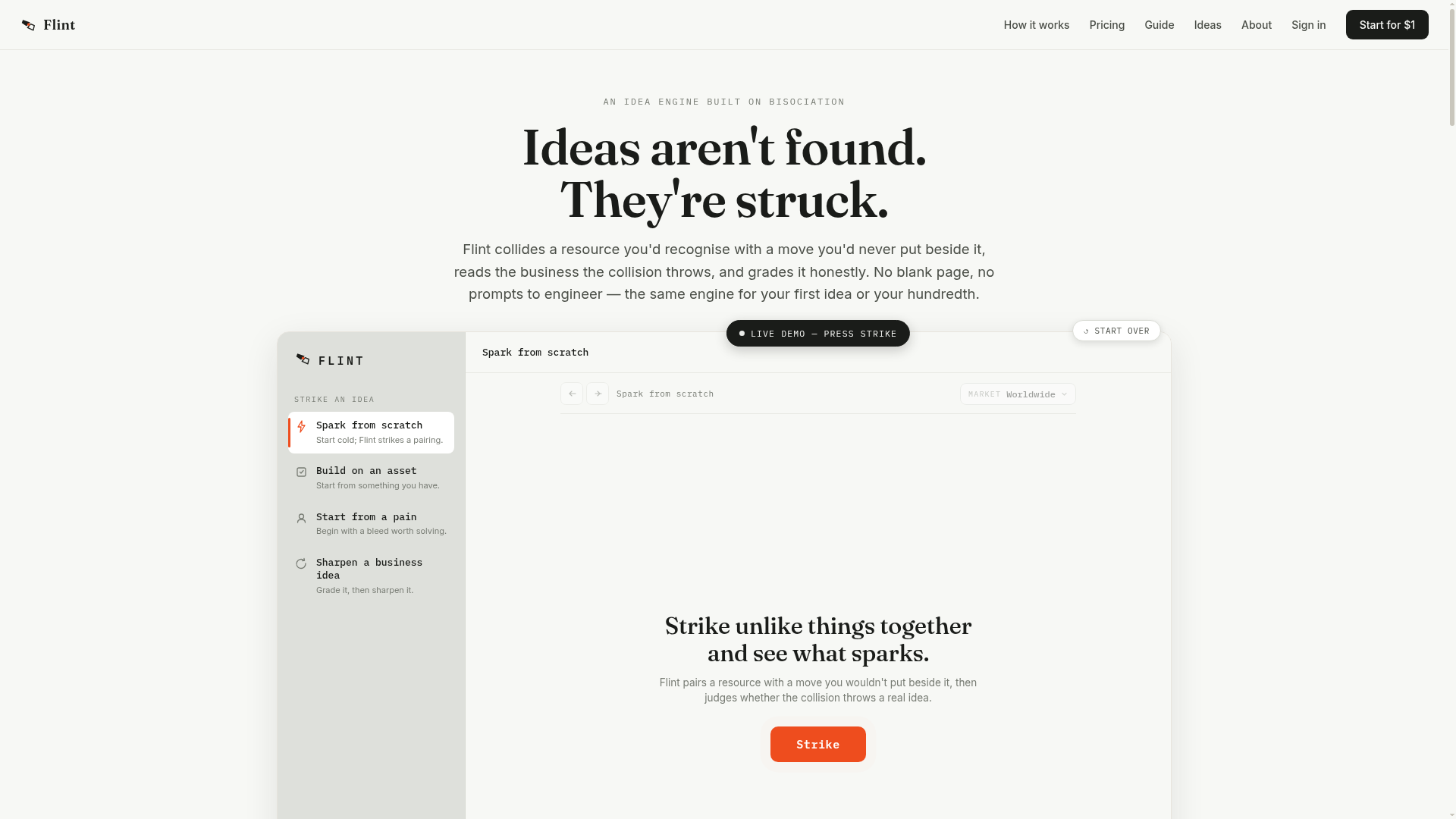
Most idea generators are prompt boxes with a hype filter. Flint is something else: a machine built on a specific theory of creativity — Arthur Koestler's bisociation — that deliberately collides a resource you recognize with a move you'd never put beside it, then reads the business the collision throws and grades it with a verdict that is often uncomfortable. The thesis is blunt: ideas aren't found, they're struck. And the ones worth building are the ones that surprise you.
Ideas aren't found. They're struck.
The homepage opens with a line that could be a manifesto: "Ideas aren't found. They're struck." It's not just rhetoric. Flint's entire interface is built around the strike — a single action that pairs, say, a concert film with the move "teach," or a parking lot with "underwrite." The engine picks the coordinates deliberately far apart because, as the site puts it, "distance is where surprise lives." You never face a blank page, and you never need to engineer a prompt. You press a button, and the collision happens.
This is a deliberate rejection of the free-association brainstorm, which the About page dismisses as reaching for "the nearest, most familiar combinations." Flint's answer is structural, not motivational: it builds the unfamiliar pairing into the architecture itself. The user steers with controls, not paragraphs — a design choice that levels the playing field between a first-timer and a seasoned founder.
The grid: every business ever built, and the empty cells
Underneath the engine sits a decomposition of business itself into load-bearing axes: six kinds of resources (matter, people, knowledge, time & space, claims, creative work) and a library of moves (pool, underwrite, reclaim, certify, monitor, broker, rent, localise, finance, host, plus eleven more). Flint claims that every business ever built decomposes onto this grid — and therefore the ones nobody has built yet are also on it, sitting in empty cells no one has read.
That's a bold claim, but it's testable. Decompose a hotel: it's a resource (time & space) plus a move (rent). A streaming service? Creative work plus host. The grid gives Flint a systematic way to walk the empty cells and interpret what it finds. It's not magic; it's a combinatorial search with a narrative layer.
The same decomposition runs in reverse. Bring a tangled idea, and Flint strips it to its axes, showing you which part carries the edge and which part is habit. This is the "sharpen" door, and it might be the most practical feature for anyone already nursing a concept.
A judge that won't flatter you
The most unusual thing about Flint is its grading system. Every reading ends in one of three verdicts: flicker (real, untaken edge), tame (sound but well-worn), or dud (no edge at all). The site is explicit that the grade measures surprise and untaken edge, not profit — a profitable but familiar idea grades tame on purpose.
This is where Flint earns its trust. Most AI tools flatter you because praise is cheap and pleasant. Flint's grader is walled off from the interpreter — it never sees how the idea was built, only the finished idea, so its verdict isn't quietly talking its own book. That separation is a clever piece of architecture, and it's the reason a dud that costs a dollar can be "the cheapest lesson in business."
The honesty is refreshing, but it's also a risk. Users who get a string of tames might feel the engine is broken, not that their ideas are derivative. Flint's answer is that tame and dud are working verdicts — if everything graded flicker, the grade would mean nothing.
Four doors in, one engine
Flint doesn't force a single workflow. It offers four entry points, each matching a different starting position:
- Spark from scratch — for when the well feels dry and the obvious ideas are taken.
- Build on an asset — for when you're sitting on a skill, savings, or a workshop and need an unobvious move.
- Start from a pain — for a problem no one fixes properly; Flint presses resources against it until an idea forms.
- Sharpen a business idea — for the idea you already have but don't trust; Flint grades it, then works to lift it.
All four doors end the same way: a graded idea and an honest verdict. This is smart product design because it meets users where they are, rather than demanding they fit a single creative ritual.
Pay per strike, not per month
Flint's pricing is as unconventional as its method. No subscription — you buy credits, and every action spends in proportion to the work it does. A typical hunt — strike, verdict, and the moves that evolve it — runs about a dollar. The starter pack is $1 for one credit, and larger packs (10, 33, 60 credits) come with bonus percentages.
This pay-per-strike model aligns cost with value: you pay for the engine's work, not for a seat you might not use. It also lowers the barrier to trying the tool — a dollar for a first hunt is nearly frictionless. The site is transparent that credits are valid for 12 months and that launch pricing may be tuned as engine costs settle.
What Flint won't tell you
The site is refreshingly honest about its limits. The About page includes a plain warning: "Flint's readings are AI-generated. They are sparks to investigate, not business, legal, or financial advice." And the grade is a lead, not an oracle — a flicker means talk to whoever the reading says bleeds, not that you've found a winner.
What Flint won't show you is how it chooses the collision. That part is the engine, and the secrecy is deliberate — it's the moat. But it also means users can't audit the logic behind a strike, which might matter for trust over time.
Flint is a product with a point of view. It believes surprise is the only justification for an idea, and it's built an entire machine around that conviction. Whether it finds you a flicker or a dud, it will tell you the truth — and in a category full of flattery, that's a rare and valuable thing.