Impact-Site-Verification: 41b53a0c-6d04-458b-a457-fe9e29acde1a

Fintech & Web3··5 min read

Florin

Florin: insurance bound in minutes, with zero underwriters and a full-stack AI core.

NN

NewName Editorial

Editorial Team

Florin product image 1
Florin product image 2

Insurance is a business built on human judgment. Underwriters spend decades learning to price risk, and their institutions are organized around that expertise. Florin, a Y Combinator-backed startup, is making a radical bet: that judgment can be fully automated. The company describes itself as "a full-stack insurance company with 0 underwriters," and claims to "autonomously place hard-to-price risks in seconds."

That is not a modest pitch. It is a direct challenge to the idea that insurance requires human intuition, and it raises a question: what happens when the last human in the underwriting loop is replaced by an algorithm?

The last human in the insurance loop

For most of insurance history, the underwriting process has been a bottleneck. A broker submits a risk, an underwriter reviews it, and the decision can take days or weeks. The underwriter's expertise is the product—their ability to assess a risk that no spreadsheet can fully capture. Florin's tagline, "Insurance, bound in minutes," is a direct attack on that bottleneck.

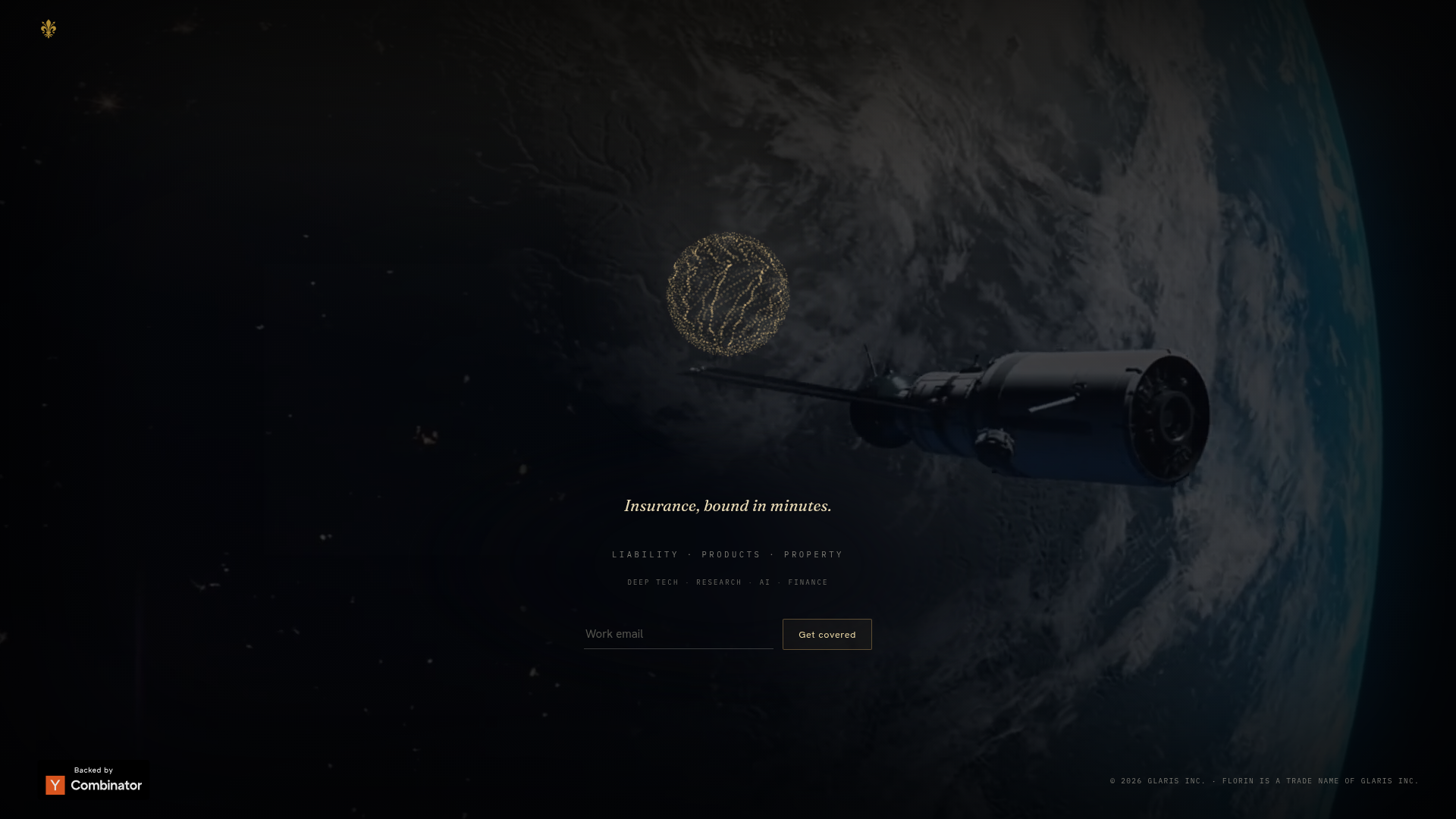
The company's website lists three lines of business: Liability, Products, and Property. These are broad categories, but the emphasis on "hard-to-price risks" suggests Florin is not going after standard auto or home policies. Instead, it is targeting the edges of the market—risks that are complex, novel, or lack historical data. These are the risks that underwriters often struggle with, and where automation could provide the most value.

By removing the underwriter, Florin is not just speeding up the process; it is changing the fundamental economics. An underwriting team is a fixed cost, and it scales poorly. An AI system, once built, can process an unlimited number of risks with marginal cost near zero. That is the promise of "full-stack" insurance: not just the technology, but the entire infrastructure—from risk assessment to policy issuance—is automated.

What '0 underwriters' actually means for risk

The phrase "0 underwriters" is deliberately provocative. It signals that Florin's risk assessment is not assisted by humans, but driven entirely by algorithms. The company says it "autonomously places" risks, which implies a system that can evaluate a risk, decide whether to accept it, and set a price—all without human intervention.

This is a significant departure from the typical insurtech model. Many startups use AI to augment human underwriters, providing recommendations that a human can override. Florin is removing the human entirely. That is a bold claim, and it carries risks. If the algorithm is wrong, there is no human to catch the error. The company's website does not disclose the specific techniques it uses, but the "Deep tech · Research · AI · Finance" tagline suggests a heavy investment in machine learning and data science.

The key question is whether the algorithm can handle the "hard-to-price" risks that Florin targets. These are risks that are difficult to model, often because they are unique or lack sufficient data. An AI system trained on historical data may struggle with a risk that has no precedent. Florin's claim to place these risks "in seconds" suggests it has developed a method to assess them quickly, but the details are not public.

Hard-to-price risks: the market Florin is chasing

Traditional insurers often avoid hard-to-price risks because they are unprofitable or too uncertain. This creates a gap in the market: businesses and individuals who need coverage but cannot get it. Florin is positioning itself to fill that gap. By using AI to assess these risks, it can offer coverage where others cannot.

This is a classic disruption play. Start with the underserved segment, build a technology that can serve it profitably, and then expand into the mainstream. Florin's focus on liability, products, and property suggests it is starting with commercial lines, where risks are often more complex and bespoke. A product manufacturer, for example, might need liability coverage for a new product that has no claims history. A traditional underwriter would struggle to price this, but an AI system might be able to analyze similar products and make a prediction.

The "seconds" part of the pitch is also important. In insurance, speed is a competitive advantage. A business that can get a quote in minutes, rather than weeks, is more likely to close a sale. Florin's automation makes this possible, and it could be a key differentiator in a market where speed is often lacking.

The name 'Florin' and the currency of trust

The name "Florin" is an interesting choice. It is not a typical tech startup name—it does not sound like a SaaS tool or a mobile app. Instead, it evokes a historical currency, the florin, which was a gold coin used in Europe for centuries. This is a deliberate branding move: Florin is signaling that it is in the business of trust and value, not just technology.

In insurance, trust is everything. Customers need to believe that the company will pay out when a claim is made. A name that sounds like a currency suggests stability and reliability, qualities that are essential for an insurance brand. It also has a classic, almost old-world feel, which could help differentiate Florin from the many insurtechs with generic, tech-sounding names.

The domain, florin.inc, is short and memorable, and the .inc TLD reinforces the corporate, established vibe. The website also notes that "Florin is a trade name of Glaris Inc.," which adds another layer of corporate structure. This is a subtle but important detail: it suggests that Florin is a brand, not the entire company, and that there may be more to come.

Open questions: regulation, tail risk, and the human fallback

Florin's model is ambitious, but it raises several open questions. The first is regulation. Insurance is heavily regulated, and regulators may be skeptical of a company with no human underwriters. They may require a human to be accountable for decisions, or they may demand that the algorithm be explainable. Florin will need to navigate this carefully.

The second is tail risk. Insurance is about rare, catastrophic events. An AI system trained on historical data may not anticipate a black swan event, and if it does not, the consequences could be severe. Florin will need to ensure that its models are robust to extreme scenarios.

The third is the human fallback. Even if Florin has no underwriters, it will likely need humans for other functions, such as claims handling and customer service. The company's website does not mention these roles, but they are essential for a full-stack insurer.

Despite these questions, Florin is a compelling experiment. It is betting that the future of insurance is algorithmic, and that the "0 underwriters" model can work. If it does, it could transform the industry. If it fails, it will be a cautionary tale about the limits of automation. Either way, it is a company worth watching.