Impact-Site-Verification: 41b53a0c-6d04-458b-a457-fe9e29acde1a

SaaS & Productivity··5 min read

Fomr

Unlimited forms, responses, and teammates for free — with a visual editor that edits the real thing.

NN

NewName Editorial

Editorial Team

Fomr product image 1
Fomr product image 2

Form builders have a pricing problem. You start on the free plan, your form works, and then you hit the wall: 10 responses a month, or 100, or your third teammate costs extra, or the one feature you actually need sits behind the paid tier. The tool is fine. The meter attached to it is not.

Fomr's bet is to remove the meter entirely. Unlimited forms, unlimited responses, unlimited team members, free. The paid tier exists, but it covers branding and custom domains; collecting and reading responses stays free at any volume. That's a bold move in a category where almost everyone else monetizes volume, and it shapes everything from the editor to the founder's letter.

The pricing meter is the real enemy

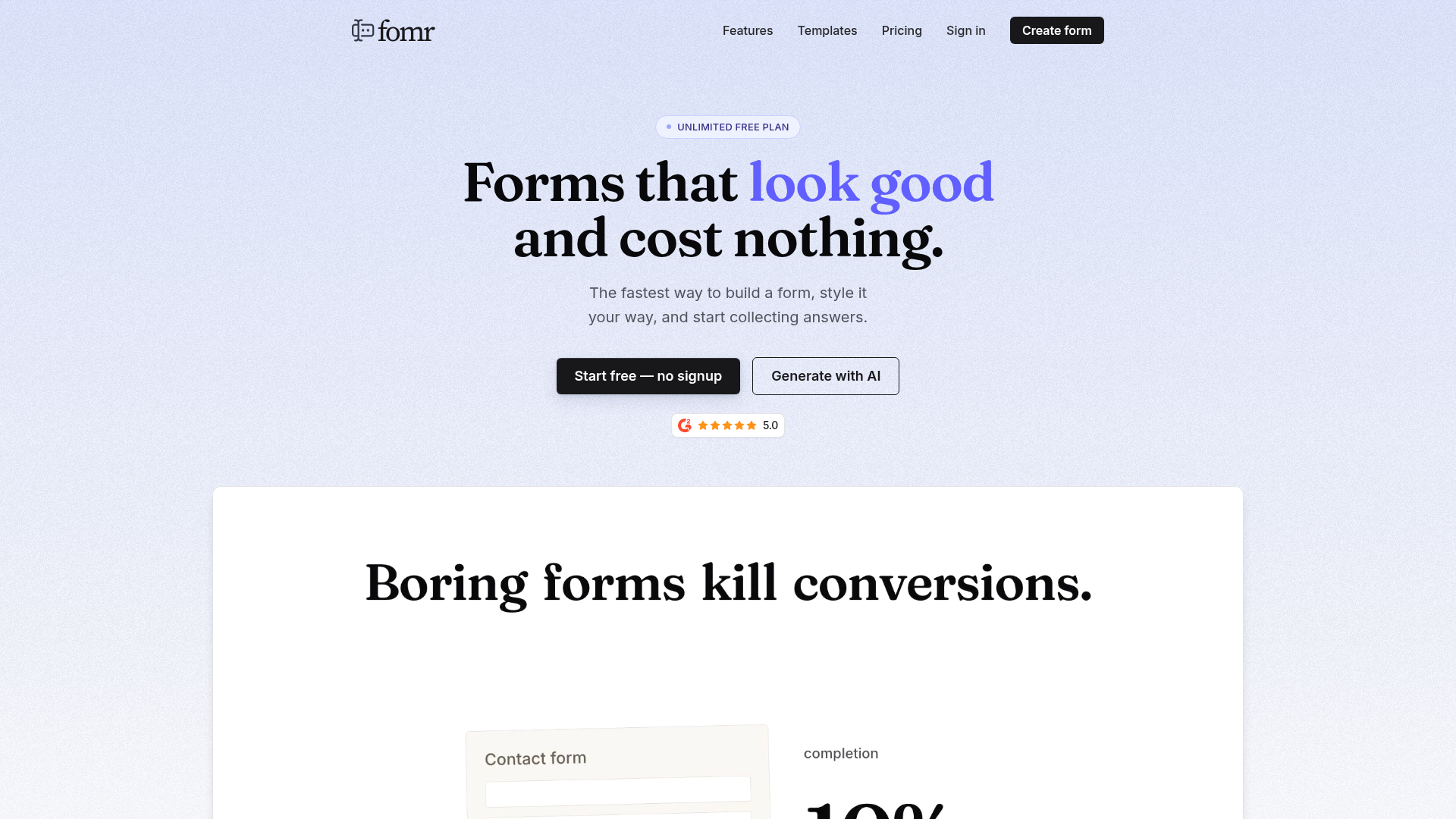
Fomr's homepage doesn't lead with features. It leads with a cost calculator that compares Fomr's $0 against a "typical paid form builder" as monthly responses scale from 10 to 10,000+. The site explicitly models this on Typeform's published plan pricing, a rare moment of naming a competitor directly. The message is clear: the value isn't in a new widget or a clever animation; it's in the absence of a paywall.

The free plan includes unlimited forms, unlimited responses, unlimited team members, 25+ form components, design customization, and email notifications. Features that other builders sell back to you—conditional logic, file uploads, email notifications, full design control—are listed as "Free here. Paywalled elsewhere." This is a direct appeal to the small team that has been burned by a form builder's tiering. It's also a strategic choice: Fomr is betting that the cost of serving responses is low enough that the free tier can be a permanent loss leader, with revenue coming from the minority who want to remove Fomr branding or use a custom domain.

An editor that edits the real form

The editor is where Fomr tries to differentiate beyond price. The pitch: "You edit the real form, not an abstract tree. What you see is exactly what your users get." Instead of a settings panel with a preview beside it, you manipulate the actual form on a canvas. Select any component and its options appear beside it. This is a subtle but meaningful UX philosophy—one that the founder, Bohdan, says came from years of building forms at a YC-backed startup and finding every tool either too old, too complex, or too rigid.

The editor offers 30+ components, including ratings, matrices, date ranges, and rankings, and design control that spans 50+ themes, 1,700+ fonts, and brand colors that adapt the whole form in one click. The site includes a playful example form that mimics a security verification flow, ending with "Monday will absolutely find out anyway." That tone—human, slightly irreverent—carries through the product copy and the founder's letter.

The founder's letter as a product decision

Most SaaS sites have an "About" page. Fomr has a "Letter from the founder" that reads like a product spec. Bohdan writes: "I've spent over a decade building for the web, most recently as the founding engineer at a YC-backed startup. We were always collecting something from customers. Onboarding details one week, a feedback survey the next. Every time, the form was supposed to be the quick part of the job. It almost never was."

He describes trying existing builders: some felt like paperwork, others required a week to learn, and the newer ones "looked good right up until I needed something they hadn't planned for." The letter ends with: "Most of my work goes into keeping it that boring." That's a rare and credible positioning—boring as a feature. It signals that Fomr is built by someone who has felt the pain, not by a growth team chasing a trend.

Google Sheets first, everything else later

Fomr's integration strategy is refreshingly honest. The integrations page lists Google Sheets as "Live," and everything else—Slack, Notion, Zapier, Airtable, HubSpot, Mailchimp, Salesforce—as "Soon." There's a roadmap where users can vote on what ships next. This is a deliberate focus: get the one integration that covers the majority of small-team workflows right, and let demand drive the rest.

The Google Sheets integration pushes every submission as a clean row, instantly. For a small team that lives in spreadsheets, that's the difference between a form that's a toy and a form that's part of a workflow. The "Soon" list is a promise, and the voting mechanism is a way to build community and prioritize without overcommitting.

The name 'Fomr': a small rebellion in a crowded category

The name "Fomr" is a deliberate misspelling of "form"—dropping the 'o' to create a four-letter, single-syllable brand. It's a common trick in the SaaS space (think Tumblr, Flickr), but here it does more than look cool. It signals a break from convention, a product that doesn't take itself too seriously. The domain fomr.io is short, memorable, and easy to type once you know it, though it may take a beat for first-time visitors to realize it's not a typo.

In a category dominated by names like Typeform, Jotform, and Google Forms, "Fomr" is a quiet rebellion. It's not descriptive in the traditional sense—it's a phonetic play that becomes a brand. The logo is a simple, clean wordmark, and the site's design language is modern and uncluttered, reinforcing the "forms that look good" promise. The name works because it's distinctive enough to be memorable, but not so abstract that it loses the category cue.

What Fomr doesn't tell you

Fomr's public materials are strong on vision and features, but thin on certain operational details. The site does not disclose the company's funding stage, team size, or specific security certifications beyond "SOC 2 data centers" and "GDPR-aligned safeguards." The G2 rating of 5.0 is cited, but there's no indication of how many reviews that's based on. The founder's letter is personal, but it doesn't mention how many users Fomr has or how long it's been live.

For a product that's betting on trust, these gaps are worth noting. The privacy policy and security page address data handling, but the absence of concrete numbers—like "10,000 teams use Fomr"—means potential users have to take the free tier's promise on faith. That's a reasonable ask for a free product, but it's a factor for teams evaluating Fomr for mission-critical workflows.

Fomr is a refreshing entry in a category that has grown bloated with paywalls and feature bloat. Its bet—that unlimited free is a stronger wedge than any single feature—is a bold one, and the editor's "edit the real form" philosophy is a genuine differentiator. The name and branding reinforce the message: this is a tool that wants to be simple, human, and quietly indispensable. For small teams tired of counting responses, Fomr might just be the easy part of the week.