Impact-Site-Verification: 41b53a0c-6d04-458b-a457-fe9e29acde1a

Developer Tools··6 min read

Fuse

A statically typed, purely functional language with approachable syntax and GRIN-powered native performance.

NN

NewName Editorial

Editorial Team

Fuse product image 1
Fuse product image 2

The programming language world is full of ambitious projects that promise to fix the shortcomings of existing tools, but few are as deliberately positioned as Fuse. Fuse is a statically typed, purely functional language that compiles to native code via the GRIN whole-program optimizer. Its pitch is not just about purity or type safety—it's about making functional programming feel familiar enough to attract developers who might otherwise shy away from Haskell or Scala.

What makes Fuse interesting is not a single feature, but the combination of choices: a type system based on System F, higher-kinded types, ad-hoc polymorphism, and a syntax that draws from Rust, Python, Scala, and Haskell. The language is designed to be readable, with indentation-based blocks and ML-like constructs, while still offering the power of higher-order types. And crucially, it compiles to GRIN, which then generates LLVM code, promising fast, small native binaries with zero-cost abstractions.

The functional language that wants to be approachable

Fuse's tagline is straightforward: "statically typed functional programming language." But the real story is in the details. The language is purely functional—every function is pure, and side effects are managed through constructs like IO[Unit]. This is a hard line that many languages blur, but Fuse commits fully. The challenge is that purely functional languages often have a steep learning curve, partly due to unfamiliar syntax and partly due to the mental model required to write code without mutable state.

Fuse attempts to lower that barrier by borrowing syntax from mainstream languages. For example, the fun keyword for function definitions, trait for type classes, and impl for implementations are reminiscent of Rust. Indentation-based blocks echo Python, and lambda expressions like (a, b) => a + b are familiar from Scala. This is a deliberate attempt to make the language feel less alien to developers coming from object-oriented or imperative backgrounds.

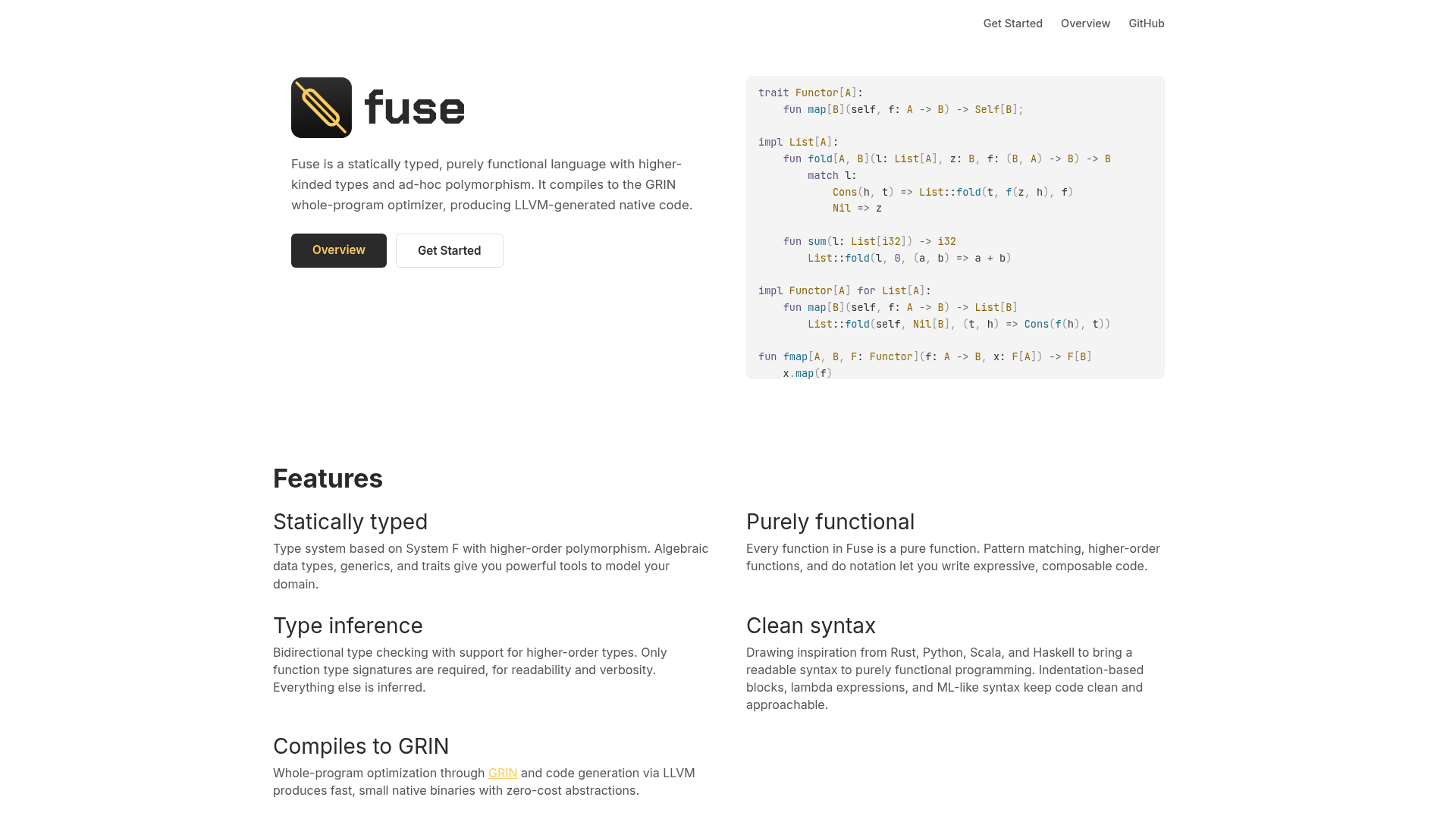
The example on the homepage shows a Functor trait, an implementation for List, and a generic fmap function that works over any Functor. The code is compact and readable, even for someone who has never seen Fuse before. The type signatures are explicit, but the rest is inferred, striking a balance between clarity and conciseness.

GRIN: The optimizer that makes purity fast

One of the most distinctive aspects of Fuse is its compilation strategy. Instead of going directly to LLVM or machine code, Fuse compiles to GRIN, a whole-program optimizer designed for functional languages. GRIN performs aggressive optimizations that are difficult to achieve in a traditional compiler, such as defunctionalization and specialization, which can eliminate the overhead of higher-order functions and algebraic data types.

The promise is "zero-cost abstractions": the high-level constructs of functional programming—pattern matching, higher-order functions, and type classes—should compile down to efficient native code without runtime costs. This is a bold claim, and while the project is still young, the choice of GRIN suggests a serious commitment to performance.

For developers, this means that Fuse could potentially offer the expressiveness of Haskell or Scala with performance closer to Rust or C. However, it's important to note that GRIN is still an evolving research project, and Fuse's integration with it is not yet battle-tested. The website does not provide benchmarks or performance comparisons, so it's unclear how well the compiler currently achieves its goals.

Type inference with a safety net: signatures only

Fuse's type system is based on System F, which supports higher-order polymorphism. This means you can write generic functions that work over any type that satisfies certain constraints, like the Functor trait. The language uses bidirectional type checking, which allows the compiler to infer most types, but requires explicit signatures for top-level functions.

The rationale is readability: "Only function type signatures are required, for readability and verbosity. Everything else is inferred." This is a pragmatic choice. In many functional languages, type inference is so powerful that you can write functions without any annotations, but this can lead to code that is hard to understand. By requiring signatures, Fuse ensures that the public interface of a function is always documented, while the implementation details remain inferred.

This approach is similar to what Scala and Rust do, and it strikes a balance between the flexibility of Haskell and the explicitness of Java. For developers who value type safety but also want to avoid boilerplate, this is an attractive feature.

Syntax as a bridge from Rust, Python, and Scala

The syntax of Fuse is one of its most distinctive selling points. The website explicitly states that it draws inspiration from Rust, Python, Scala, and Haskell. This is a smart move because it lowers the cognitive load for developers who are already familiar with these languages.

For example, the trait and impl keywords are straight from Rust, and the indentation-based blocks are reminiscent of Python. The lambda syntax (a, b) => a + b is common in Scala and modern JavaScript. Even the match expression for pattern matching is familiar to Rust and Scala developers.

By borrowing these elements, Fuse aims to make purely functional programming more accessible. It's a bet that the biggest barrier to functional programming is not the concepts, but the syntax. If that's true, Fuse could attract a wider audience than languages like Haskell, which has a notoriously steep learning curve.

The name 'Fuse': joining ideas, or burning out?

The name "Fuse" is evocative. A fuse joins two things together, and in the context of a programming language, it suggests the fusion of functional programming with mainstream syntax, or the fusion of high-level abstractions with low-level performance. The name is short, memorable, and easy to search for, which is a plus for a new project.

However, "Fuse" is also a common word in tech, used in various contexts (e.g., FUSE filesystem, Fuse.js, etc.). This could lead to confusion when searching for information about the language. The domain fuselang.org helps disambiguate, but the name itself is generic. That said, for a language that aims to be approachable, a simple name like Fuse might be a deliberate choice to avoid the intimidating names of some other functional languages.

The branding is minimal: the website uses a simple icon and a clean design, with no mention of a company or funding. It appears to be a solo or small open-source project, licensed under MIT. The lack of a blog or documentation beyond the overview suggests it's early days.

Who should try Fuse today (and who should wait)

Fuse is not yet a production-ready language. The website offers installation scripts for Linux and macOS, but there is no mention of Windows support, and the documentation is sparse. The project seems to be in an early stage, with only a few pages on the site and no detailed guides.

That said, for developers who are curious about functional programming and want to experiment with a language that combines familiar syntax with powerful type system features, Fuse is worth a look. It's also an interesting case study for compiler enthusiasts who want to see how GRIN can be used in a real language.

On the other hand, developers who need a stable, well-documented language for production use should wait. The lack of benchmarks, ecosystem, and tooling means that Fuse is not yet a viable alternative to Rust, Haskell, or Scala. The project's future depends on community adoption and the continued development of GRIN.

In summary, Fuse is a promising experiment that could make functional programming more accessible without sacrificing performance. Its unique combination of features—System F types, GRIN compilation, and familiar syntax—sets it apart from other languages. But it's still early days, and the real test will be whether it can build a community and deliver on its performance promises.