Impact-Site-Verification: 41b53a0c-6d04-458b-a457-fe9e29acde1a

SaaS & Productivity··7 min read

Get Map Leads

One platform to scrape, qualify, close, and deliver local web design clients.

NN

NewName Editorial

Editorial Team

Get Map Leads product image 1
Get Map Leads product image 2
Get Map Leads product image 3

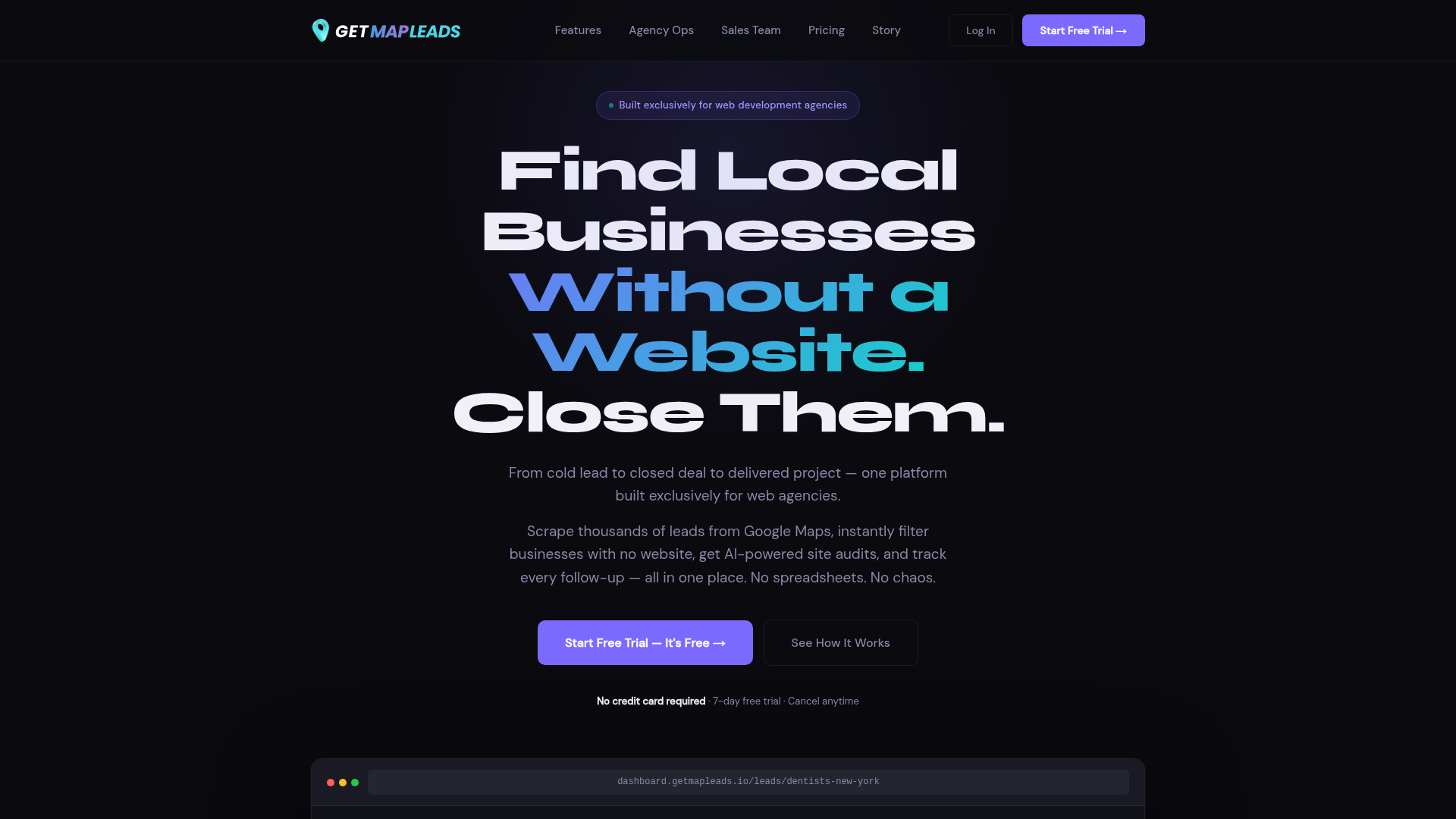
Web development agencies have a dirty secret: their best leads are sitting on Google Maps, and most of them don't have a website. For years, the playbook has been the same — scrape a list, dump it into a spreadsheet, try to remember who you called, and pray you follow up before the prospect forgets you exist. Get Map Leads, a new platform built exclusively for web agencies, wants to kill that spreadsheet chaos with one tool that takes you from cold lead to delivered project. It's a bold claim, but the product's design suggests it's not just another scraper with a CRM bolted on.

The pitch is direct: find local businesses without a website, close them, and deliver the project. The tagline is almost painfully literal, but that's the point. This is a tool for agencies that do cold outreach at volume, and it's built to solve one specific problem — the leads that fall through the cracks when you're juggling five different tools.

The 40% of leads that fall through the spreadsheet cracks

Get Map Leads' origin story is familiar to anyone who's run a web agency: you scrape leads from Google Maps, export a CSV, and then the chaos begins. You have a spreadsheet for leads, another for follow-ups, a CRM that's too generic to be useful, and a sticky note somewhere with a phone number you forgot to call. The website's own copy is blunt: "5 tools. 5 logins. Zero system." It claims that 40% of leads are forgotten in this mess, a figure that's not independently verified but feels painfully plausible to anyone who's worked in agency sales.

The platform's answer is to compress the entire pipeline into one interface. You scrape leads directly from Google Maps via a browser extension, they land in a tagged pipeline ("Dentists NY", "Restaurants LA"), and then you can filter for businesses with no website — the hottest prospects. Every lead has a status: Not Called, Interested, Call Back Friday. There's no more guessing who you've contacted. The dashboard even shows a leaderboard for sales teams, turning follow-up into a competitive sport.

A scraper that refuses to be just a scraper

Most Google Maps scrapers are dumb data exporters. They give you a CSV and walk away, leaving you to figure out what to do with 500 business names. Get Map Leads positions itself as the anti-scraper: "Every scraper on the market exports a CSV and leaves you to figure out the rest. We don't." Instead, it integrates the scraping with qualification and follow-up, so the data doesn't sit idle.

The browser extension routes leads directly into your pipeline, tagged by campaign. You can scrape dentists in New York, then restaurants in LA, and each lead is automatically organized. The no-website filter is one click, and it's the killer feature — it instantly surfaces businesses that literally need what you're selling. For leads that do have a website, you can trigger an AI audit right from the same screen, turning a raw list into a prioritized outreach list.

This is where the product's focus on web agencies becomes clear. A generic CRM might track leads, but it won't tell you which prospects have a broken mobile site or a missing H1 tag. Get Map Leads does, because it's built for people who sell website fixes.

The no-website filter: a wedge that sells itself

The "no website" filter is the core insight of Get Map Leads. For a web agency, a business without a website isn't just a lead — it's a prospect with an obvious, urgent need. The platform makes this the first thing you see, with a prominent "No Website" count at the top of the pipeline. It's a simple feature, but it changes the sales conversation. Instead of cold calling a dentist and trying to convince them they need a website, you're calling them because they don't have one. The pitch writes itself.

The website's example dashboard shows this in action: "Bright Smile Dental — No Website — Interested." It's a tiny detail, but it illustrates the entire value proposition. The tool doesn't just find leads; it qualifies them for you. For agencies that have been manually sorting through spreadsheets, this is a significant time saver.

AI audits as the new cold call opener

For businesses that do have a website, Get Map Leads offers an AI-powered audit that scores the site out of 100, checking speed, mobile responsiveness, SEO basics, and SSL status. The audit generates a plain-English summary of what's wrong and what fixing it would mean for the business. This is where the product gets clever: the audit becomes your cold call opener.

Instead of calling a prospect and saying, "Do you want a website?" (which they'll say no to), you call and say, "I ran an audit of your site, and it's losing you 40-60% of potential patients because it's not mobile-friendly." That's a reason to listen. The platform even lets you export the audit as a branded PDF with your agency's logo, so you can send it before the call. It's a credibility play that most agencies can't replicate without expensive tools.

The pricing comparison is aggressive: Get Map Leads claims to be "10x cheaper than Clay.com" for website audits. Clay, a popular data enrichment tool, charges $500-$700 per 1,000 website assessments. Get Map Leads' Agency plan at $249/month includes 300 AI audits plus the full lead management system. The math is compelling, though it's worth noting that Clay is a different kind of tool — it's not a CRM, and it's not built for web agencies specifically. Still, for the specific use case of auditing websites at scale, the cost difference is stark.

From close to delivery: the operations add-on gamble

The core platform covers the sales side: scrape, qualify, call, close. But Get Map Leads doesn't stop there. It offers an add-on called Agency Operations, which adds project management, developer assignment, daily progress tracking, and automated weekly client reports. The idea is to keep the entire agency — sales and production — on one platform, with one login.

This is an ambitious bet. Most tools stop at the close, assuming that once you've signed the client, you'll switch to a project management tool like Asana or Trello. Get Map Leads wants to be the single source of truth for the entire client journey. The pricing reflects this: the Agency + Operations plan costs $449/month, nearly double the Agency plan.

The risk is that this could be scope creep. Project management is a crowded field, and agencies already have tools they like. But the pitch is coherent: if you're a small agency, why pay for a separate CRM, a separate project manager, and a separate reporting tool when you could have one platform that does it all? It's a classic bundling strategy, and it might work for the solo operator who wants to avoid tool sprawl.

The name says it plainly — and that's the point

"Get Map Leads" is not a clever name. It's descriptive to the point of being almost generic. But for a tool aimed at busy agency owners who don't have time to decode metaphors, that's a feature, not a bug. The name tells you exactly what the product does: it gets leads from Google Maps. The domain, getmapleads.io, is straightforward and easy to remember. The branding is consistent across the site — clean, functional, with a focus on the workflow rather than flashy visuals.

The naming also sets expectations. This is not a tool for enterprise sales teams or B2B tech companies. It's for web agencies that do local cold outreach, and the name signals that. It's a niche play, and the name reinforces the niche. The risk is that the name might feel limiting if the company ever wants to expand beyond Google Maps scraping, but for now, it fits perfectly.

Get Map Leads is not a revolutionary product. It's a focused, well-executed tool that solves a specific problem for a specific audience. It won't be for everyone — if you're not a web agency doing local cold outreach, you'll probably pass. But for that audience, it could be the tool that finally replaces the spreadsheet chaos. The 7-day free trial with no credit card required makes it easy to test, and the founder-led demo offer suggests a team that's confident in its product. The real question is whether it can grow beyond the solo founder niche and become the default platform for web agencies. If it can, the name might become as synonymous with local lead generation as Google Maps itself.