Impact-Site-Verification: 41b53a0c-6d04-458b-a457-fe9e29acde1a

Marketing·Unknown··5 min read

Growth Stash

A founder-curated stash of growth tactics, searchable by category and ready to test.

NN

NewName Editorial

Editorial Team

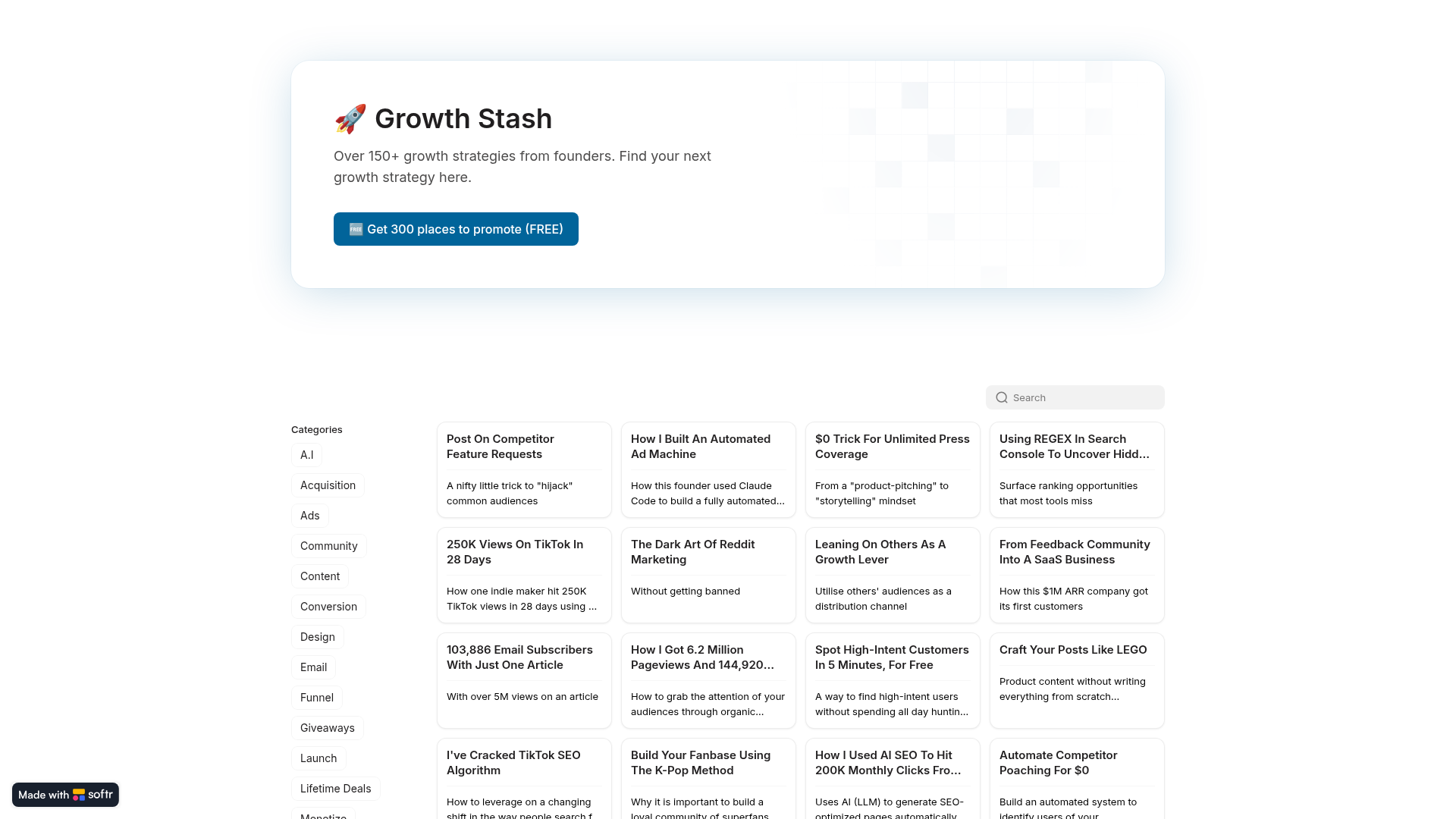
Growth Stash product image 1

Growth Stash is not another growth hacking blog or a SaaS tool promising automated virality. It's a free, searchable directory of over 150 growth strategies, each contributed by a founder who claims to have used it. The site's tagline — "The largest directory of growth strategies shared by founders and creators" — makes a specific promise: these are not theoretical playbooks from marketing gurus, but field-tested tactics from people who have been in the trenches. That positioning is both its strength and its limitation, and it's worth unpacking for anyone who has ever scrolled through a list of "growth hacks" and wondered which ones actually work.

The 'Stash' premise: curated growth hacks, not a growth platform

The name "Growth Stash" immediately sets expectations. It's not a "growth suite" or a "growth OS" — it's a stash, a collection of valuable odds and ends that you might dig through when you need a specific tool. The site delivers exactly that: a list of strategy cards, each with a catchy title and a one-line description, waiting to be opened. There's no login wall, no gated content, no dashboard. You land on the page, see a grid of cards like "Post On Competitor Feature Requests" or "How I Built an Automated Ad Machine," and you click to read the full tactic. The simplicity is refreshing, but it also means the site is more of a reference library than an active community or a tool. It's a stash you rummage through, not a platform you build on.

How the directory is organized: 24 categories and the 'bites' format

The directory is organized into 24 categories, from the obvious (SEO, Content, Email) to the specific (Reddit, X/Twitter, Lifetime Deals). This taxonomy is a key part of the value proposition: instead of a chaotic list of random tips, you can filter by the channel you're currently working on. For example, if you're trying to get your first users on Reddit, you can click the Reddit category and find tactics like "The dark art of Reddit marketing" or "480 emails waitlist for an app within 12 hours." Each entry is presented as a "bite" — a short, scannable card with a title and a brief description. The format is designed for quick browsing, not deep reading. It's the difference between a cookbook and a food blog: you get the recipe, not the life story.

The free lead magnet: '300 places to promote' and the newsletter funnel

One of the first things you see on the homepage is a prominent call-to-action: "Get 300 places to promote (FREE)." This links to a Substack newsletter, where Growth Stash likely delivers a list of promotion opportunities. This is a classic lead magnet strategy: give away a valuable resource to build an email list. The site itself is free, but the newsletter is the real product — a channel to keep users engaged and potentially monetize later. It's a smart move, and it aligns with the site's own ethos of sharing growth tactics. The newsletter is called "Growth Stash" as well, reinforcing the brand. This freebie also serves as a proof point: if you want more growth tactics, you can get a curated list of places to promote your product, which is a natural extension of the directory's value.

The founder voice: raw tactics, real numbers, and the absence of polish

The strategies themselves are notable for their specificity and their founder voice. Titles like "103,886 Email Subscribers With Just One Article" or "We Made $214,500 and Set a New Record on Appsumo Deals" are not vague platitudes; they are concrete claims with numbers. The descriptions are often just one line, but they hint at a story: "How this founder used Claude Code to build a fully automated ad machine" or "How to leverage on a changing shift in the way people search for stuff." This rawness is a double-edged sword. On one hand, it makes the content feel authentic and actionable — you can imagine a founder sharing this at a meetup. On the other hand, there's no validation. Anyone can submit a strategy, and there's no evidence that these tactics actually worked beyond the founder's word. The site doesn't include case studies, screenshots, or links to the original posts. It's a collection of claims, not proven results.

What the name 'Growth Stash' signals — and what it hides

The name "Growth Stash" is memorable and descriptive, but it also carries a connotation of something hidden or slightly illicit. A "stash" is often something you keep secret — a stash of cash, a stash of candy. This might appeal to founders who feel like growth tactics are insider knowledge, but it also suggests that the strategies might be a bit shady or at least not mainstream. The site leans into this with titles like "The dark art of Reddit marketing" and "Automate competitor poaching for $0." This edgy framing can be engaging, but it might also turn off more conservative marketers. The domain, growthstash.io, is clean and brandable, though the .io TLD is more common among tech startups than traditional directories. Overall, the name does its job: it tells you exactly what to expect — a stash of growth strategies.

The risks of unverified tactics and the burden on the reader

Perhaps the biggest issue with Growth Stash is the lack of curation quality control. There's no indication of how strategies are vetted, if at all. The site says "shared by founders," but it doesn't say "verified by experts." This means readers must take every tactic with a grain of salt. Some strategies might be outdated, some might be one-off successes that don't replicate, and some might even be harmful if followed blindly. The burden is on the reader to test and adapt. This is not necessarily a flaw — it's a trade-off. Growth Stash offers breadth and authenticity, but it sacrifices depth and reliability. For a founder who wants to quickly scan a variety of ideas and then do their own research, it's a useful starting point. For someone looking for a step-by-step playbook, it will be frustrating.

Growth Stash is a free resource that fills a niche: it's a searchable index of growth tactics from the founder community. It's not a substitute for a growth consultant or a data-driven experimentation platform, but it's a valuable source of inspiration and ideas. The site's success will depend on whether it can maintain a steady stream of new strategies and whether it can build trust with its audience. For now, it's a promising stash worth digging through.