Handler
Spy the outlier TikToks, dupe the winners with AI creators.
NewName Editorial
Editorial Team
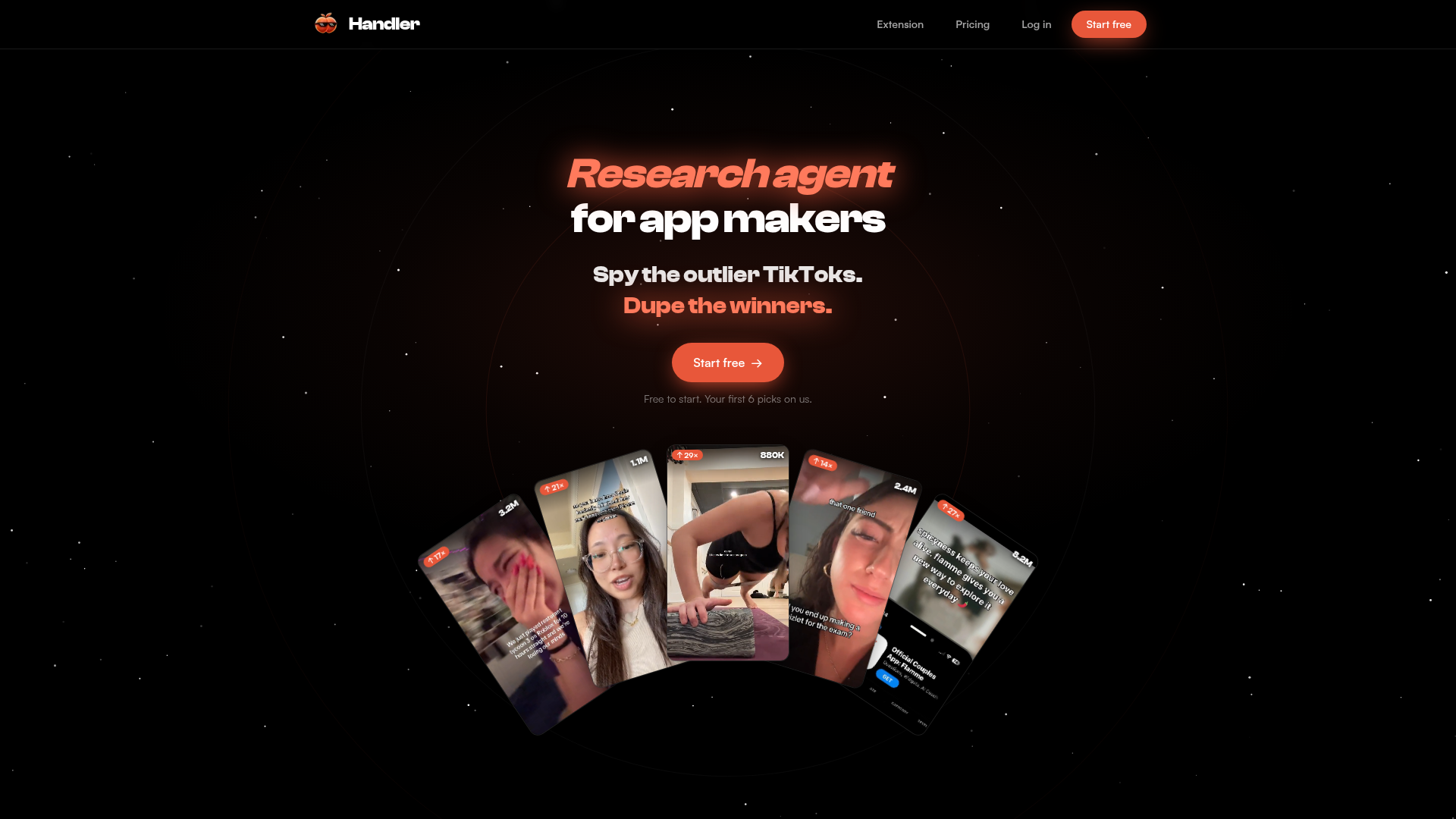
Every app marketer has been there: four hours deep into TikTok's For You page, screenshotting videos that might work, trying to reverse-engineer why one blew up and another flatlined. The scrolling is the job, and it is a terrible one. Handler, a new AI agent from the team behind Agniverse, argues that the real bottleneck isn't making content — it's deciding what to copy. Its pitch, delivered in the blunt language of a growth hacker's notebook: "Spy the outlier TikToks. Dupe the winners."
The product is built for app makers, a niche that faces a specific misery. UGC (user-generated content) creators charge $25–$200 per video, and most of that spend goes to videos that never convert. The alternative — scrolling manually, guessing at what will work — burns hours and still leaves you with a hunch, not a strategy. Handler wants to replace the hunch with a pipeline: find the outlier, understand why it popped, and hand you a finished dupe.
The 4-hour scroll that should be a product
Handler's origin story, as told on its site, is a complaint about manual labor. The problem section lists three pains: 4+ hours wasted scrolling daily, an inability to tell what content will convert views to users until it's too late, and UGC costs that don't scale. The site doesn't cite a study for the four-hour figure — it's a persona, not a statistic — but the pain is real enough for anyone who has tried to grow an app on TikTok.
The insight is that the research phase, not the creation phase, is where the value is lost. Most tools in the AI content space focus on generation: type a prompt, get a video. Handler's bet is that generation is the easy part. The hard part is knowing what to generate. So it built a research agent that watches TikTok for you, scores what it finds, and only then offers to make something.
Outlier and Pull: a vocabulary for what to copy
Handler's core innovation is a scoring system with two numbers. The first, Outlier, measures how far a video beat its own account's average performance. A video with 1.7 million views from an account that usually gets 100,000 is a 17× outlier. The second, Pull, measures how hard the video moved viewers — engagement rate, comments, shares, the signals that suggest it might convert views into app installs.
This is a meaningful distinction. Most "trending" tools show you what's popular globally, which is useless for a niche app. Handler's Outlier score normalizes for account size, so a small creator's viral hit surfaces alongside a mega-influencer's. The Pull score adds the conversion layer: a video with high views but low engagement might be entertaining, but a video with high Pull is one that makes people act.
The public library at gethandler.ai/research shows the system in action. Each entry lists the Outlier multiplier, view count, and a star rating for format — Education, Health & Fitness, Finance, Games, and so on. It's a live, filterable board of what's working in your niche, updated weekly. For a solo founder, this is the kind of intelligence that would normally require a social listening agency.
TikSpy: reading the comments before you dupe
Scoring is only half the job. A number tells you that a video worked; it doesn't tell you why. That's where TikSpy comes in. The site describes it as a tool that "reads the hook, the payoff, and what the comments actually want." The hook is the first three seconds, the payoff is the resolution, and the comments are the unfiltered focus group.
This is the part that feels genuinely new. Most AI marketing tools will tell you a video is trending; few will tell you that the comments are full of people asking "how do I get this app?" or "is this real?" — signals that a dupe could convert. TikSpy's job is to surface those signals before you spend a credit on regeneration.
The output is a "dupe kit": the exact regeneration prompt, a brand-voice overlay, and the sound to add. It's not a vague suggestion; it's a recipe. The site's example shows a real outlier — a creator talking in front of an ivy wall, 1.7 million views — and the resulting dupe, shot by an AI creator named James. The kit is the bridge between research and production.
DupeFarm: AI creators that reshoot, not just rewrite
DupeFarm is where the content actually gets made. It's a roster of AI creators you build once and reuse. The process is simple: seed the look with a reference image or a description ("male, 18-24, brunette, athletic"), pick one of six generated samples, and you have a creator. The site shows six ready-made faces — Nayal, James, Aisha, Amber, Jade, Melia — each with a personality tag like "founder-serious" or "bright / UGC."
What's notable is that DupeFarm generates finished videos, not prompts. The site is explicit: "The dupe itself, not a prompt to run somewhere else." This is a deliberate contrast with the wave of AI video tools that hand you a text prompt and expect you to go run it through another service. Handler wants to be the whole loop.
The workflow is designed for speed. You find an outlier, TikSpy explains it, you pick a creator, and DupeFarm reshoots the winner — "clean, on brand, yours to post." The site claims a dupe can be ready in minutes, though it doesn't publish a specific benchmark. The emphasis is on iteration: build a creator once, then dupe winners forever.
What 'vibe marketing' means for app makers
The phrase "vibe marketing" is a deliberate echo of "vibe coding" — the practice of building software with AI assistance, iterating quickly, and accepting that you don't understand every line. Handler's founder, who goes by @consumerxai on X, puts it directly: "You vibe-coded the app. Now vibe-market it."
The analogy is apt. Vibe coding tools like Cursor or Replit made it possible for non-engineers to ship software. Handler wants to do the same for marketing: give app makers an agent that runs the whole loop, from finding winners to duping them, with the human in an approval role. "It proposes, you approve" is the workflow.
This positioning is smart because it targets a specific pain: app makers who can build a product but can't market it. The pricing reflects that — a free tier with 6 outlier picks and 3 dupe kits, then $29/month for Starter, $49 for Growth, and $119 for Pro, with credits for dupe generations. The free tier is a taste, not a trial: "Full library locked past that."