Handwritten Blogging Platform
A blogging platform where your words are written by hand, not typed by algorithm.
NewName Editorial
Editorial Team


The case for slowing down, one page at a time
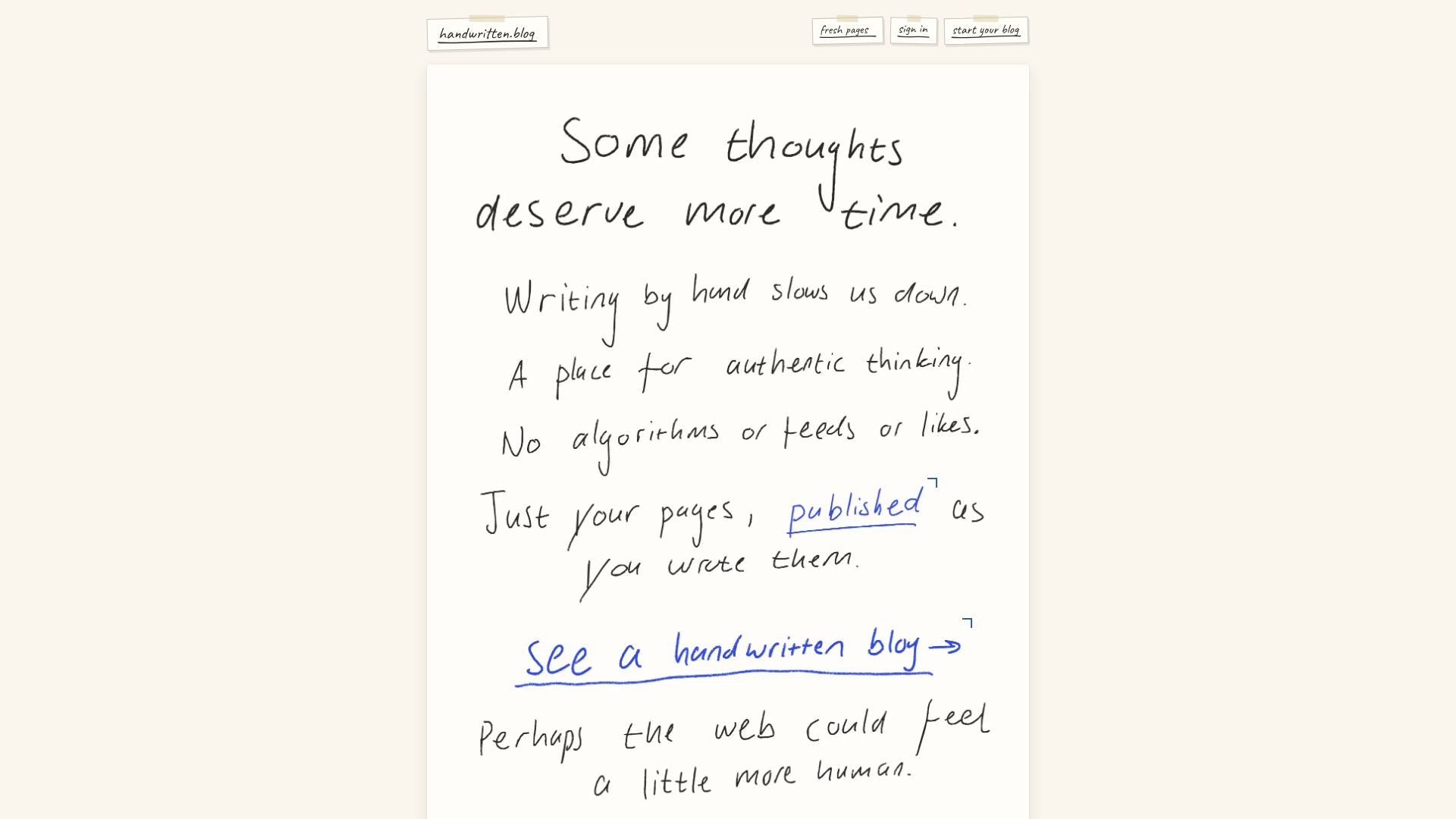
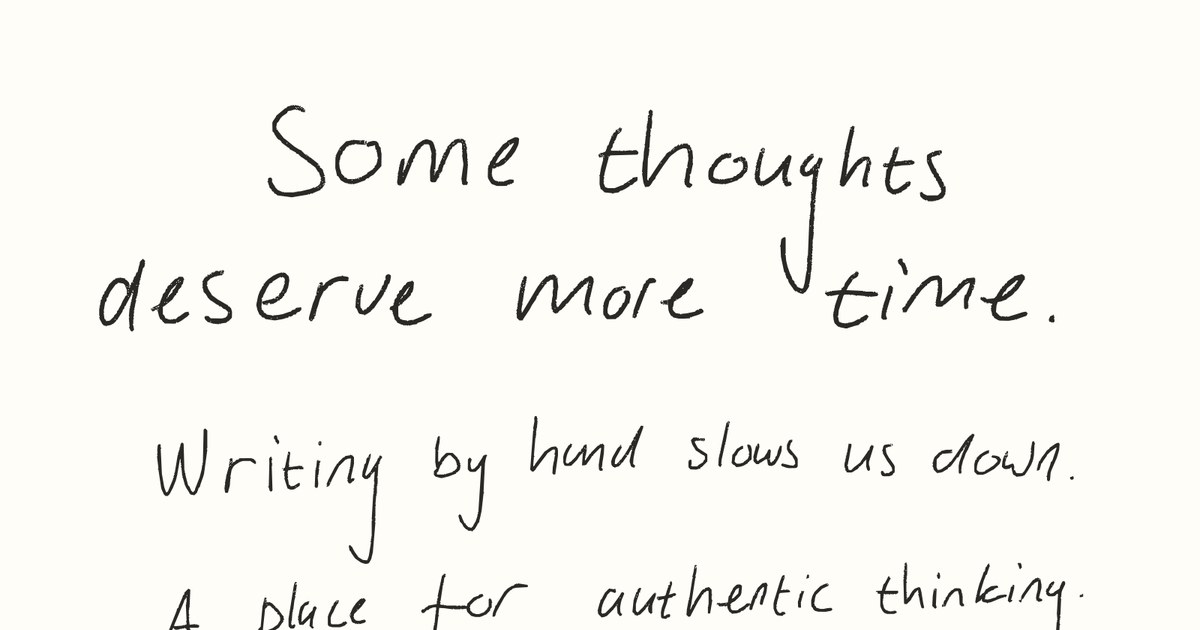
The modern web is built on speed. Faster loading, faster scrolling, faster content churn. Every platform optimizes for engagement, which usually means more posts, more likes, more time on site. handwritten.blog takes the opposite stance. Its homepage doesn't say "publish your thoughts," it says "some thoughts deserve more time." The entire product is a bet that the act of writing by hand—slow, deliberate, physical—can be a feature, not a limitation.
This is not a novelty gimmick. It's a deliberate design philosophy. The platform's about page explains that "in a world where machines are doing more and more of our thinking, we need a place to slow down." That's the thesis. And it's backed by concrete choices: no algorithms, no feeds, no likes, no tracking. Just your pages, published as you wrote them.
How a page gets written: handwriting as the interface
The core mechanic of handwritten.blog is that you write your posts by hand—literally, with a pen and paper—and then upload images of those pages. The platform publishes them as images, preserving your handwriting exactly as it is. There's no OCR, no conversion to text, no editing in a rich text editor. The interface is the page itself.
This is a radical departure from every other blogging platform. On Medium, Substack, or WordPress, you type into a box, format with buttons, and hit publish. Here, you write with a physical tool, photograph or scan the result, and upload it. The platform then presents it as a page in a notebook, complete with the texture of your handwriting.
The implications are profound. Your typos are permanent. Your crossed-out words remain visible. The rhythm of your handwriting—the pressure, the slant, the spacing—becomes part of the content. It's the opposite of the sanitized, uniform text that dominates the web. It's personal in a way that fonts can't replicate.
What the platform refuses to be: no feeds, no likes, no tracking
Most blogging platforms are built on a social layer. They have feeds to keep you scrolling, like buttons to validate your worth, and analytics to tell you how you're performing. handwritten.blog strips all of that away. The homepage explicitly states: "No algorithms or feeds or likes. Just your pages, published as you wrote them."
This is not just a marketing line. The about page makes a series of promises that back it up: no ads, no cross-site tracking, and cookie-free analytics only on public marketing pages, never on your blog or account. There's also no lock-in—you can export your content at any time.
These are strong commitments, especially in an era where data collection is the default business model. By refusing to track users or run ads, handwritten.blog is positioning itself as a safe haven for writers who are tired of being the product. It's a conscious rejection of the attention economy.
The origin story: a hyperlink essay that became a domain
The platform's origin is as unusual as its concept. The idea came from a guy named Daniel, who wrote a post about creating hyperlinks in handwriting. Emile Silvis, the founder, read that post, fell in love with the idea, and bought the handwritten.blog domain from Daniel. He's now developing the platform by himself in the Netherlands.
This origin story is baked into the product's identity. The about page links to Daniel's original essay, and the platform is essentially a tribute to that idea. It's rare to see a product so directly traceable to a single intellectual spark. It also explains why the platform feels so focused: it's one person's passion project, not a corporate strategy.
Who this is for: the quiet corners of the internet
handwritten.blog is not for everyone. It's for a specific kind of writer: one who values authenticity over polish, and who wants to share thoughts that are more meditative than viral. The platform's "fresh pages" section suggests a community of early adopters, but the design doesn't encourage mass adoption. There are no social features, no sharing buttons, no way to follow other writers. It's a place to publish, not to network.
This will appeal to a niche audience: journalers, poets, essayists, and anyone who finds typing to be a barrier to genuine expression. It might also attract people who are disillusioned with the performative nature of social media and want a more intimate, human corner of the web. The platform's tagline, "Perhaps the web could feel a little more human," captures this aspiration.
The name as a promise: handwritten.blog and the value of literal domains
The name "handwritten.blog" is remarkably literal. It tells you exactly what the platform is about: handwriting, and blogging. There's no metaphor to decode, no clever portmanteau. This is both a strength and a risk.
On the one hand, the name is instantly memorable and self-explanatory. It's a perfect description of the product, which is rare in a world of abstract brand names like Medium or Substack. The .blog TLD is also fitting, and the domain is short and easy to type.
On the other hand, the name is so descriptive that it might limit the platform's potential to expand beyond handwriting. If the founder ever wants to add typed posts or other formats, the name would become a constraint. But for now, it's a perfect fit for the product's philosophy. The name is the promise, and the platform delivers on it.
Open questions: scale, sustainability, and the cost of slowness
The biggest question for handwritten.blog is whether it can sustain itself. The platform is free to use, with a promise that core features will remain free. Advanced features, like custom domains, may cost money in the future, but there's no pricing page yet. The founder is developing it alone, which raises questions about long-term maintenance and support.
There's also the question of scale. Handwriting is inherently slow, and the platform's audience is likely to be small. But that might be the point. handwritten.blog isn't trying to compete with Medium or Substack. It's carving out a tiny, deliberate niche. Whether that's enough to keep the servers running remains to be seen, but for now, it's a refreshing reminder that the web can still be a place for slow, authentic expression.
For writers who are tired of the algorithm's demands, handwritten.blog offers a quiet alternative. It's not a platform for building an audience; it's a platform for building a notebook. And that might be exactly what some thoughts deserve.