Hanji
Document AI that cites every field and refuses to guess when it's unsure.
NewName Editorial
Editorial Team
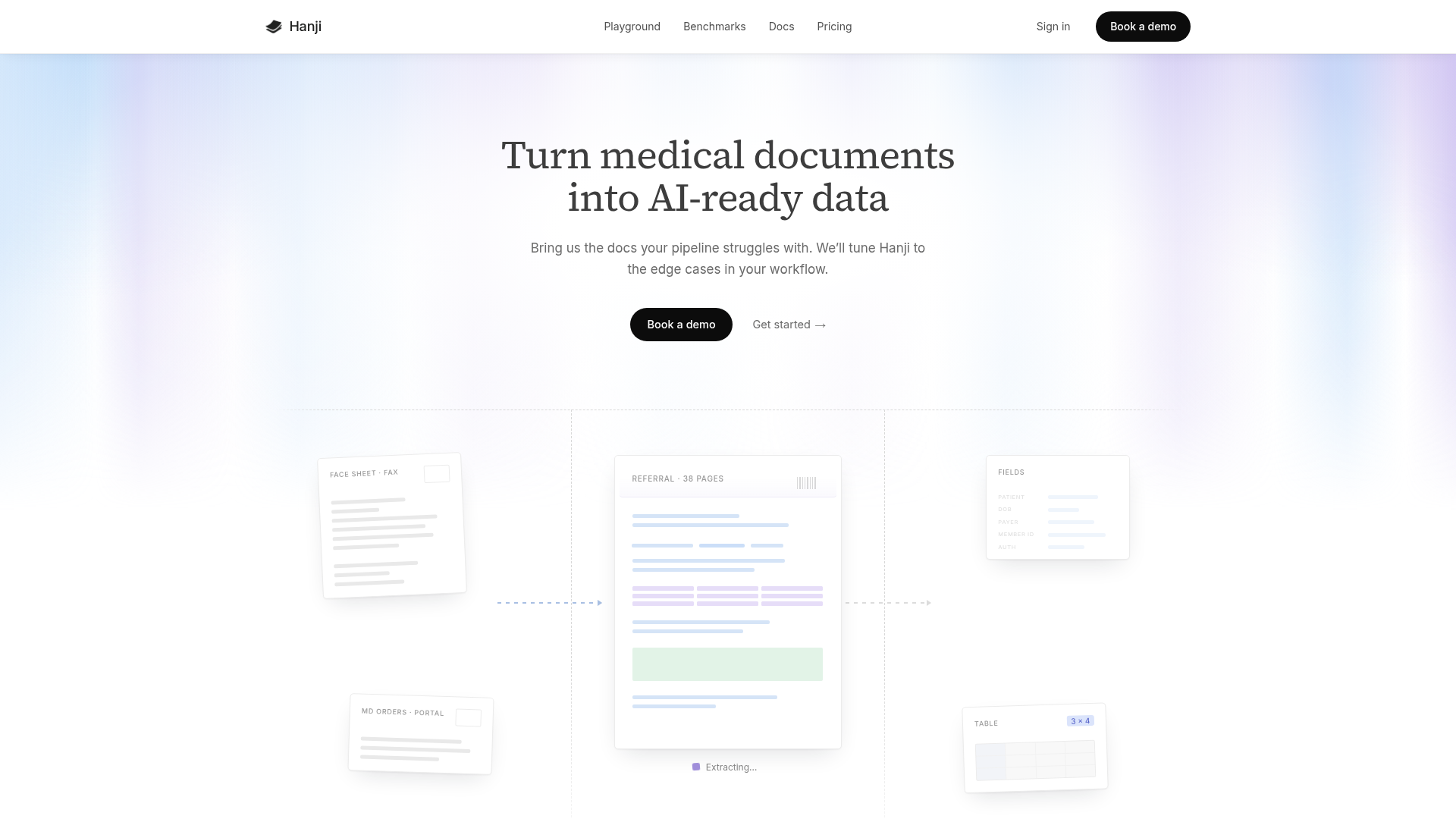

The hardest documents in the economy are not PDFs generated by software. They are faxed referral packets, handwritten face sheets, and 38-page prior-authorization bundles that arrive smudged, rotated, and full of checkboxes. Most document AI tools treat these as a parsing problem. Hanji treats them as a trust problem.
The company, spun out of a pipeline that has processed over 70 million pages, sells a two-stage API: Parse turns any document into grounded structure, and Extract maps that structure to your schema with every value cited back to its source. But the real product is the refusal to guess. When Hanji cannot verify a field, it returns null and flags it for review—a design choice that sets it apart in a market where confident wrong answers are the norm.
The hallucination tax on faxed documents
A wrong insurance member ID or a misread diagnosis code is not a minor inconvenience. It can delay a claim, trigger a denial, or cost a provider real money. Yet most extraction tools, including raw LLMs, will happily return a plausible-looking value even when the source is illegible. The site puts it bluntly: a confident wrong value looks exactly like a right one, with no flag to catch it.
Hanji's answer is to make uncertainty visible. The API returns null for ungrounded fields, and every extracted value comes with a verbatim quote, page number, and bounding box. This is not alignment-after-the-fact; the company says grounding happens at read time, with vision models reading text, tables, and layout in parallel. The result is a system designed for documents where a hallucination carries a financial cost.
The benchmark page backs this up with a concrete number: on 400 human-verified pages across seven document types, Hanji leads on text accuracy at 87.5%, ahead of Pulse (82.7%), Reducto (75.2%), and AWS Textract (74.1%). It also leads on word-overlap F1 at 90.2%. These are not vanity metrics; they are the kind of numbers a biller or a claims processor would care about.
Grounding as a product, not a promise
Most document AI vendors mention citations as a feature. Hanji makes them the core of the API. Every field returned by Extract includes the exact quote, page, and bounding box it came from. If a value cannot be verified, it is nulled and flagged—never passed through as clean data.
This is a subtle but important shift. It means Hanji is not just an extraction engine; it is an audit trail generator. For a developer building a claims pipeline, this turns the API into a compliance tool. You can show a regulator or an auditor exactly where each data point came from, without building a separate verification layer.
The company also catches bad reads internally. If a page is blank, truncated, or garbled, Hanji re-reads it with a heavier model, and if it still fails, the result is withheld. This is the kind of engineering detail that rarely makes it into marketing copy, but it is exactly what separates a production-grade pipeline from a demo.
The benchmark that names its rivals
Hanji's benchmark page is unusually transparent. It compares itself against seven named providers—Pulse, Reducto, AWS Textract, Docling, LlamaParse, and Unstructured—and publishes the methodology: 400 human-verified pages, seven document types, 95% confidence intervals. It even shows where it loses: on grounded accuracy, it trails the best by 0.3%, and on layout IoU, it is 7.9 points behind.
This is a bold move for a seed-stage company. Most vendors publish cherry-picked numbers or vague claims. Hanji instead invites you to see the gaps. The site also offers a free proof batch: send 20-50 representative documents, and Hanji will run the eval live and show field-level results before you commit. This is a go-to-market strategy built on evidence, not hype.
The benchmark also includes a latency figure: on 156 business PDFs and 13,671 pages, median latency was 10.7 seconds per document, fastest among eight measured providers. Speed matters when you are processing a million-page batch, and Hanji's autoscaling is sized for intake bursts.
Tuning as a service, not a feature
Hanji's tagline is "Turn your hardest documents into reliable data," and the company takes that literally. For enterprise customers, it offers customer-specific tuning for edge cases. The site cites a concrete example: one customer improved from 71% to 92% text accuracy in under a week, at the same speed and cost.
This is not a self-serve fine-tuning knob. It is a service where Hanji's engineers benchmark your documents, identify failure modes, and adjust the pipeline. The pricing page lists "customer-specific tuning for edge cases" as an enterprise feature, alongside custom data retention and production SLAs. This is a high-touch model that may not scale, but it is exactly what a hospital or insurer needs when their faxes are uniquely messy.
The company also offers a playground where you can test on your own documents, and a benchmark call where they run the eval live. This lowers the risk for a skeptical buyer who has been burned by overpromising AI vendors.
A pricing model that prices trust per page
Hanji's pricing is refreshingly simple: 1 credit per page for Parse, 4 credits per page for Parse + Extract, at a flat $0.003 per credit. That works out to $0.003 per page for parsing and $0.012 per page for extraction. There are no seat fees, no token costs, and no complexity surcharges for tables, handwriting, or OCR.
This is a deliberate contrast to raw LLM APIs, which price by token and can surprise you with a large bill on a dense 38-page referral. Hanji's flat per-page rate makes cost predictable, which is a feature for a CFO approving a six-figure processing contract.
The free tier gives 1,000 credits, enough to process roughly 1,000 pages of parsing or 250 pages of extraction. That is a generous trial for a developer who wants to test the API without a sales call.
Compliance as a quiet moat
Hanji is built for regulated documents: PHI under BAA, claims packets, public records. The site states that PHI runs in production under a signed BAA today, with SOC 2 Type II audit in progress. It also promises zero training on customer data, with sync documents processed in memory and never stored, and async uploads deleted after 3 days.
For a healthcare or government buyer, these are not nice-to-haves; they are table stakes. Hanji's enterprise tier adds customer-managed encryption, configurable retention, and dedicated regions. This is a moat that pure-play AI models like Gemini or GPT cannot easily cross, because they are not built for HIPAA from day one.
The company also offers uptime SLAs and a public status page, which signals production maturity. For a seed-stage startup, this level of compliance posture is unusual and suggests the team has deep experience in the space.
What Hanji still has to prove
Hanji's pitch is strong, but it faces open questions. The benchmark is self-published, and while the methodology is transparent, it has not been independently verified. The 70 million pages processed claim comes from the site, but it is unclear how much of that was through the predecessor pipeline versus Hanji itself. The tuning service is promising but may not scale beyond a few dozen enterprise customers.
There is also the question of category. Hanji competes with AWS Textract, a hyperscaler service, and with open-source tools like Docling. Its differentiation is groundedness and null-on-doubt, but that is a feature that can be copied. The company's real defense may be its compliance posture and its willingness to tune per customer, which is harder to replicate.
For now, Hanji is a compelling option for teams that process messy, regulated documents and cannot afford a hallucination. The free tier and proof batch make it easy to test, and the benchmark page gives you a realistic picture of where it stands. If you are a developer building a claims pipeline or a government intake system, Hanji is worth a look—not because it is perfect, but because it is honest about where it fails.