Impact-Site-Verification: 41b53a0c-6d04-458b-a457-fe9e29acde1a

AI & Machine Learning··5 min read

Heidi

AI scribe that turns documentation into relief, with a side of ROI.

NN

NewName Editorial

Editorial Team

Heidi product image 1
Heidi product image 2
Heidi product image 3

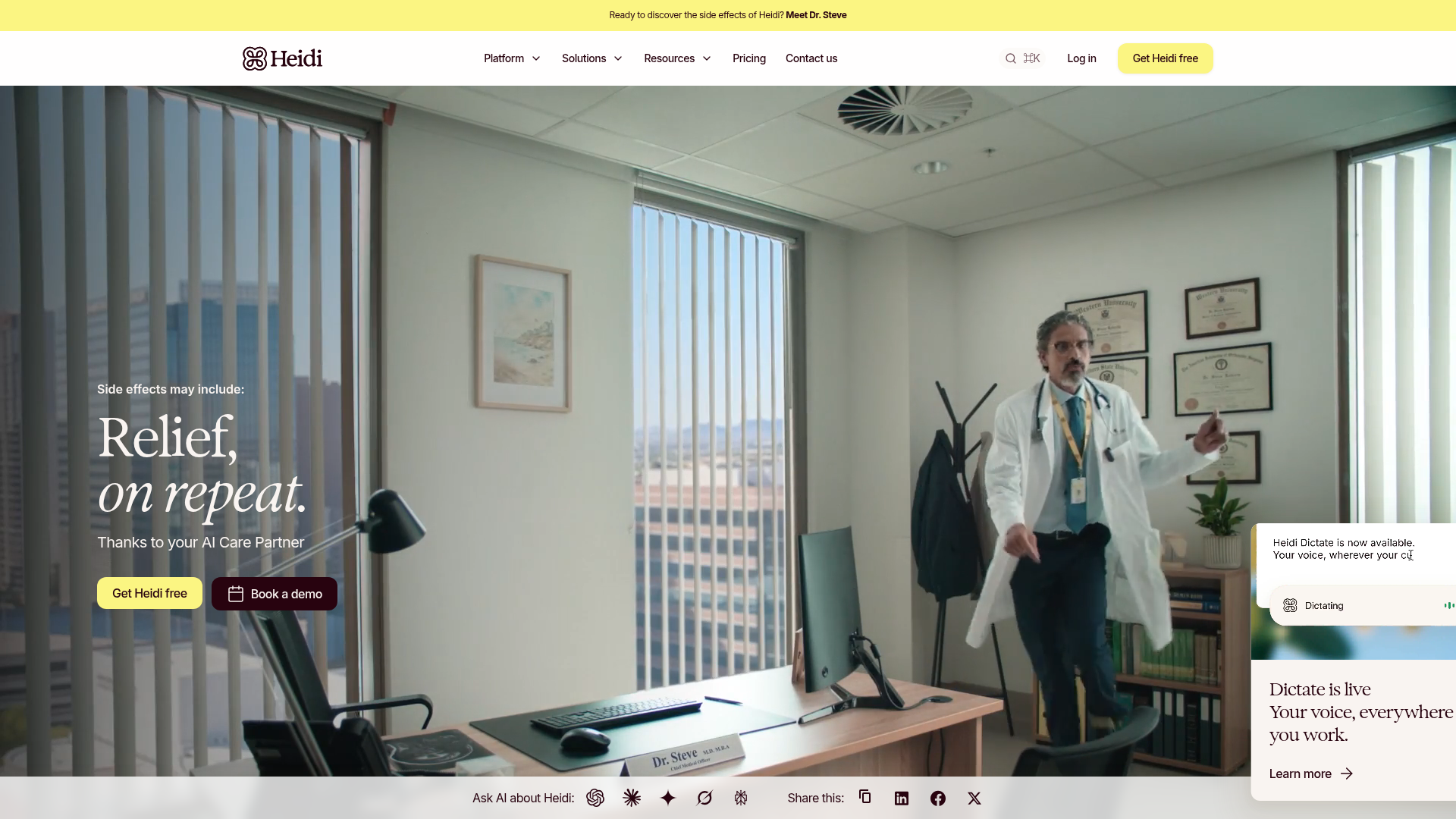
The first thing you notice about Heidi is not the product—it's the marketing. The homepage greets you with a mock pharmaceutical ad: "Side effects may include: Relief, on repeat." It's a clever twist on the tired "AI saves you time" pitch, and it signals something deeper about how this Australian-born AI scribe is trying to win over clinicians. In a category crowded with ambient documentation tools, Heidi is betting that a memorable brand and a clinician-first approach can cut through the noise.

Founded by Dr. Tom Kelly, Heidi has grown from a simple dictation tool into an "AI Care Partner" that handles notes, codes, and follow-up tasks. The website lists an impressive roster of health systems—Beth Israel Lahey Health, Ohio State University, MaineGeneral Health, and Bupa, among others—and claims to have enabled care for a staggering number of patient visits (the exact figure is obscured by a placeholder in the source, but the counter suggests millions). This is not a side project; it's a serious player in the AI scribe space.

The 'Side Effects' of an AI Scribe

Heidi's brand campaign is a masterclass in category differentiation. The "Side Effects May Include..." video series plays on the pharmaceutical trope, but instead of listing dry mouth or nausea, it promises "elevated ROI" and "being awesome." It's a bold move for a healthcare product, where marketing tends to be conservative. But it works because it speaks directly to the emotional pain point: burnout. The testimonial from Dr. Theresa Colina—"I go to lunch on time, I go home on time"—is more relatable than any feature list.

The campaign also extends to a character named "Dr. Steve," who appears in a banner ad inviting you to "discover the side effects of Heidi." This humanizes the product and creates a narrative hook. In a market where most AI scribes are marketed as faceless utilities, Heidi is building a personality. That's a strategic choice: it makes the product memorable and shareable, which is crucial for word-of-mouth adoption in clinical settings.

From Dictation to Ambient Scribe: The Workflow Shift

Heidi's core functionality is ambient scribing—it listens to patient-clinician conversations and generates structured notes. But the product has evolved beyond that. The website outlines a broader workflow: "Patient notes, handled. Let Heidi handle the note, codes, and every task that follows." This includes care gap identification, patient communications, guideline adherence monitoring, coding and CDI, revenue leakage identification, specialty pharmacy refills, and more. It's a full administrative assistant, not just a note-taker.

This aligns with the industry trend of AI scribes expanding into "autonomous medical coding" and "pre-charting." Heidi's enterprise pitch emphasizes "tailored to your workforce," suggesting customization for different specialties and roles. The site lists solutions for primary care, specialists, nurses, mental health, allied health, dentists, veterinarians, and trainees—a wide net that shows ambition.

The Hardware Bet: A Clip-On Mic for Rounds

One of Heidi's most distinctive moves is its hardware product: a clip-on microphone called "Remote." The pitch: "A clip-on mic that moves with you so your notes don't depend on a desk." This is a practical answer to a real problem—clinicians are often on their feet, moving between exam rooms, and a phone or desktop mic doesn't capture the conversation well. By offering a dedicated device, Heidi ensures audio quality and signal consistency, which are critical for accurate transcription.

The hardware bet is risky—it adds manufacturing and supply chain complexity—but it also creates a moat. Competitors like Nuance's DAX rely on ambient listening via existing devices, but a clip-on mic can be optimized for the clinical environment. It also reinforces the "care partner" brand: Heidi is not just software; it's a tool you wear.

Evidence at the Point of Care: Beyond Notes

Heidi's "Evidence" feature is another differentiator. The website claims: "Heidi has unlimited clinical evidence on tap, just ask." This suggests an integration with medical knowledge bases, allowing clinicians to ask questions during or after a visit and get evidence-based answers. This moves Heidi from documentation to clinical decision support, a significant expansion of scope.

If executed well, this could be a powerful tool for reducing errors and improving care. But it also raises the stakes: clinical evidence must be accurate and up-to-date, and any mistakes could have serious consequences. Heidi's safety page lists a litany of compliance certifications—HIPAA, SOC 2, GDPR, ISO 42001, and more—which signals a commitment to security and regulatory standards. This is table stakes for enterprise health systems, and Heidi seems to be checking the boxes.

Naming and Branding: Heidi as a Care Partner

The name "Heidi" is a deliberate choice. It's friendly, approachable, and human—a stark contrast to the clinical jargon of competitors like "Nuance DAX" or "Abridge." The tagline "By your side" reinforces the companion metaphor. The brand is built around the idea of an "AI Care Partner," which positions the product as an ally rather than a tool. This is smart marketing, but it also carries a risk: if the AI makes an error, the trust built by the brand could be shattered. The "side effects" campaign cleverly acknowledges this by framing the product as something with potential benefits and risks, much like a medication.

The domain, heidihealth.com, is clean and memorable, though it doesn't include "AI" or "scribe," which might hurt SEO. However, the brand is strong enough that direct navigation is likely. The name also has a global appeal, avoiding cultural pitfalls.

What's Missing: The Open Questions

Despite the polish, there are gaps. The website's "patient visits this week" counter appears to be a placeholder with random digits—a minor credibility issue. More importantly, the site does not disclose pricing (it offers a free tier and enterprise plans, but specifics are behind a contact form). This is common for enterprise SaaS, but it limits transparency.

Another open question is the actual accuracy and safety of the AI. The site lists compliance certifications but does not provide clinical validation data. In a field where errors can be harmful, independent studies would strengthen trust. The "Evidence" feature is promising, but its scope and limitations are unclear.

Finally, the competitive landscape is fierce. Players like Abridge, Ambience, and Nuance have significant market presence. Heidi's differentiation lies in its brand and hardware, but it will need to prove sustained value to win over large health systems.

Overall, Heidi is a compelling product with a strong brand and a clear vision. It's not just an AI scribe; it's a movement to bring relief to clinicians. If it can deliver on its promises, it could become a category leader. But the road ahead is long, and the side effects of AI in healthcare are still being written.