HeyNews
AI newsletter automation that learns your voice and ships in five minutes
NewName Editorial
Editorial Team


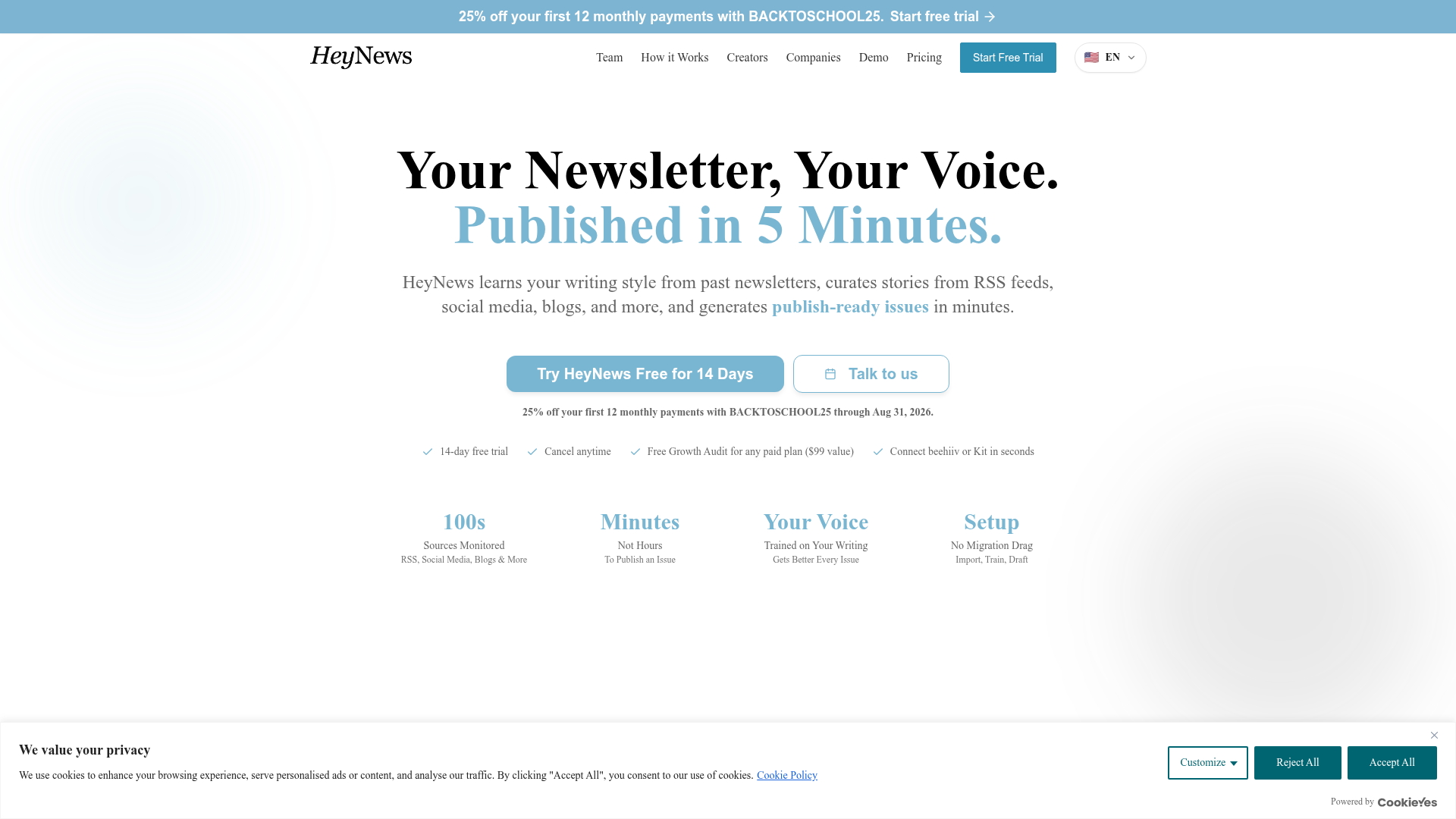
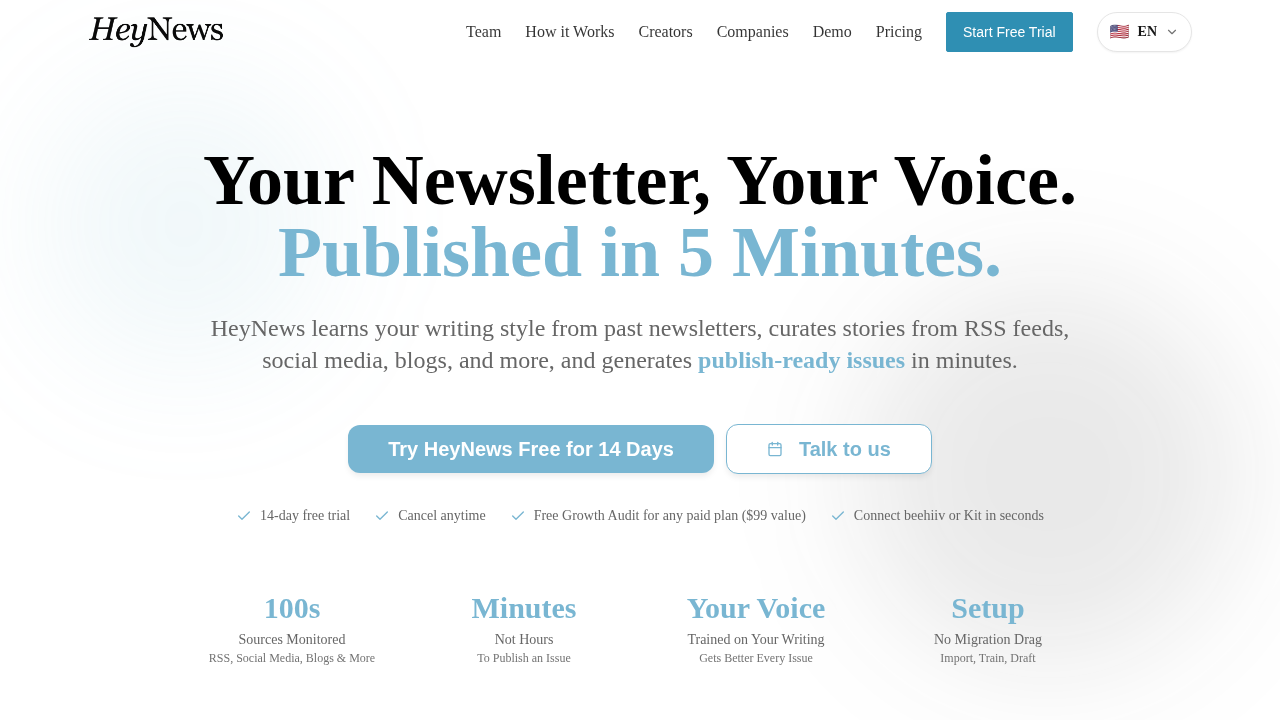
The pitch is a familiar one: AI saves you time. But HeyNews is making a more specific promise — that it can learn your writing voice from your past newsletters and produce drafts that sound like you on your best day. The tagline says it plainly: "Your Newsletter, Your Voice. Published in 5 Minutes." That's a bold claim, because the hardest part of newsletter publishing isn't finding stories — it's producing something that doesn't read like a generic AI roundup. HeyNews is betting that the way to win newsletter creators is not with a better template or a smarter autopilot, but with a system that trains on your archive and then hands you a draft that sounds like you. It's a bet on voice as the differentiator, and it's worth examining closely.
The 10-hour workflow that burns out newsletter operators
Newsletter burnout is real, and HeyNews's marketing speaks directly to it. The site describes the weekly grind: "Content research eats your week" and "Your voice fades as you scale." These are the two pain points that HeyNews is designed to solve. The first is time — finding stories, reading sources, writing it all up takes hours every week. The second is quality — when you publish more often, your writing starts sounding rushed and generic. Readers notice, and you know something is off but don't have time to fix it.
HeyNews's answer is to automate the research and drafting phase. It monitors RSS feeds, Reddit, blogs, and social media around the clock, ranks stories by relevance, and has the best ones waiting when you sit down to write. The claim is that you can go from a curated list to a publish-ready draft in one click. The case studies support this: one user says they went from 1 hour per day to 5 minutes per day on content creation and ad insertion. Another says HeyNews saved them 2-3 hours per newsletter just through layout and sourcing tools. These are concrete numbers, though they come from HeyNews's own case studies, so they should be taken with that caveat.
The workflow HeyNews targets is the one that newsletter operators know all too well: research, draft, edit, format, send. It's repetitive, but it requires judgment. HeyNews's approach is to keep the judgment with the human but automate the grunt work. The result is a draft that you can refine, not a finished product that you merely approve.
What 'your voice' actually means when an AI trains on your archive
The core feature of HeyNews is "AI Voice Training." The site explains: "HeyNews reads your past newsletters and picks up your phrases, your tone, how you put ideas together." This is more than just a generic prompt like "write in the style of a newsletter." It's a system that analyzes your actual writing archive and builds a profile of your style. You can even create separate AI Writers for different editions — a Monday deep dive vs. a Friday link roundup — each with its own voice profile.
The idea is that the AI gets better every issue as you refine drafts and build each edition. This is a feedback loop: you edit the AI's draft, and the AI learns from your edits. It's a clever mechanism because it turns the AI from a one-shot generator into a collaborator that improves over time. The risk, of course, is that the AI might pick up your bad habits too, or that it might flatten your voice into a generic version of itself. But HeyNews's approach of separating AI Writers for different editions suggests they've thought about this — they're not trying to create one monolithic voice, but a set of voices that match your different formats.
This is a differentiator from generic AI writing tools that don't have access to your archive or that don't let you train on your own content. The site claims that "0 readers flagged AI" across 600+ issues published. That's a strong claim, but it's from their own marketing materials, so it's worth verifying independently.
Curation is the real moat, not generation
While voice training is the flashy feature, the more durable value might be in the curation engine. HeyNews monitors "100s" of sources daily — RSS, Reddit, blogs, social media — and gives every story a relevance score. This is the part that saves you hours of reading and tab-switching. The site says you can configure sync frequency (up to 6+ hours) and choose from 4+ source types.
For a newsletter operator, curation is often the most time-consuming part. You have to keep up with your niche, find the stories your readers expect, and decide what's worth including. HeyNews automates the discovery and ranking, so you start with a shortlist of relevant stories rather than a blank page. This is where the tool becomes a true workflow companion, not just a writing assistant.
The integration with beehiiv and Kit is a smart move, as these are popular ESPs for newsletter creators. For other platforms, HeyNews works via a public archive URL — you share your Substack, Ghost, or Mailchimp archive, and it starts learning your voice. This lowers the barrier to entry: you don't need to migrate your entire operation to try HeyNews.
From draft to send: where HeyNews sits in the workflow
HeyNews positions itself as a full editorial workspace, not just a draft generator. The site describes an "Editorial Workflow" where you move from curated stories to a finished issue in one place. You can review the draft, rewrite sections, adjust subject lines, add images, and hand off the final issue to your ESP without rebuilding the workflow every week.
This is a key point: HeyNews is not trying to replace your email service provider; it's trying to replace the messy middle of your content creation process. It integrates with beehiiv and Kit via API, and for other platforms, you can export your final issue and paste it into your ESP. The Chrome extension lets you save articles from any webpage, which is a nice touch for capturing ideas on the fly.
The workspace also supports up to 10 publications from one account, each with its own AI Writers, sources, timezone, and language. This is aimed at agencies or operators who manage multiple newsletters. It's a feature that suggests HeyNews is thinking beyond the solo creator, even though its marketing focuses on the individual voice.
The brand promise: 'Your Newsletter, Your Voice' and the trust it asks for
The name "HeyNews" is simple and direct. It's conversational — "Hey, here's the news" — and it's easy to remember. The domain, heynews.co, is clean and matches the name. The brand positioning is clear: it's a tool for newsletter creators who want to maintain their voice while scaling their output. The tagline "Your Newsletter, Your Voice" is a promise that resonates with the fear of becoming generic.
But there's a tension in the brand. "HeyNews" sounds like a news aggregator, not a writing tool. It could be mistaken for a consumer news app. The company is aware of this, as they've added the subtitle "AI-powered newsletter automation + human editing" to clarify. The name is friendly, but it doesn't immediately convey the sophistication of the voice-training technology. That's a risk: the name might attract the wrong audience (people looking for a news reader) and miss the right one (newsletter operators).
Still, the brand's focus on "your voice" is a smart counter to the fear of AI-generated content. By emphasizing that the AI learns from you, HeyNews positions itself as a tool that enhances your creativity, not replaces it. This is a trust-building message in an era where readers are wary of AI-written newsletters.
What HeyNews doesn't tell you yet
HeyNews's marketing is strong on benefits but light on specifics. The site doesn't disclose pricing on the homepage, though there's a 14-day free trial and a coupon code for 25% off the first 12 months. It also doesn't list detailed technical specifications, like which AI models it uses or how the voice training works under the hood. For a product that claims to replicate your voice, that's a notable omission. Users will have to try it to see if the magic works.
There's also the question of scalability. The case studies feature newsletters with small to medium audiences. Can HeyNews handle a newsletter with 100,000 subscribers? The site doesn't say. And while the "0 readers flagged AI" claim is impressive, it's based on a small sample of 600+ issues. As the tool is adopted more widely, that number could change.
Finally, the company itself is young. It launched in November 2025 according to its Uneed profile, and its team consists of a growth engineer and a novelist. They have 15+ years of experience in the industry, which is a good sign, but they're still a small team. The product is evolving, and early adopters will be part of that evolution.
Despite these open questions, HeyNews has a clear thesis: newsletter operators are burning out, and AI can help if it's trained on their voice. The combination of voice training, smart curation, and a streamlined workflow is compelling. It's not a magic bullet — you still have to edit and add your own insights — but it could be the tool that turns a 10-hour workflow into a 5-minute one. For anyone who publishes a newsletter and wants to keep their voice, HeyNews is worth a look.