HyperProbe
Read-only AI probes that capture the exact variable state your logs miss.
NewName Editorial
Editorial Team

Every incident postmortem ends the same way: "We didn't have the data." The stack trace pointed to line 82, but the variable that caused the failure was set several frames up, in a different file. No log captured it there. So your best engineer adds a log line, redeploys, waits for the condition to reproduce, and repeats—two or three times, over the course of a night. The fix takes ten minutes. Finding it takes hours.
HyperProbe, a YC S26 startup, is built on a simple but radical premise: the bottleneck in incident response is not reasoning, it's evidence. Every other AI debugging tool reasons hard over the data you already have—logs, traces, metrics. HyperProbe instead captures the exact evidence that is missing, by dropping a read-only, non-blocking probe on the exact line where the problem occurred in production. No redeploy. No restart. No user impact. Just the variable state at the moment of failure.
The company's pitch is deliberately narrow: agents that do read-only debugging in prod. That constraint is not a limitation; it is the product's spine. It is what makes the tool safe enough to run on live traffic, and what makes its root-cause confirmations trustworthy enough to act on.
The 3 a.m. evidence gap
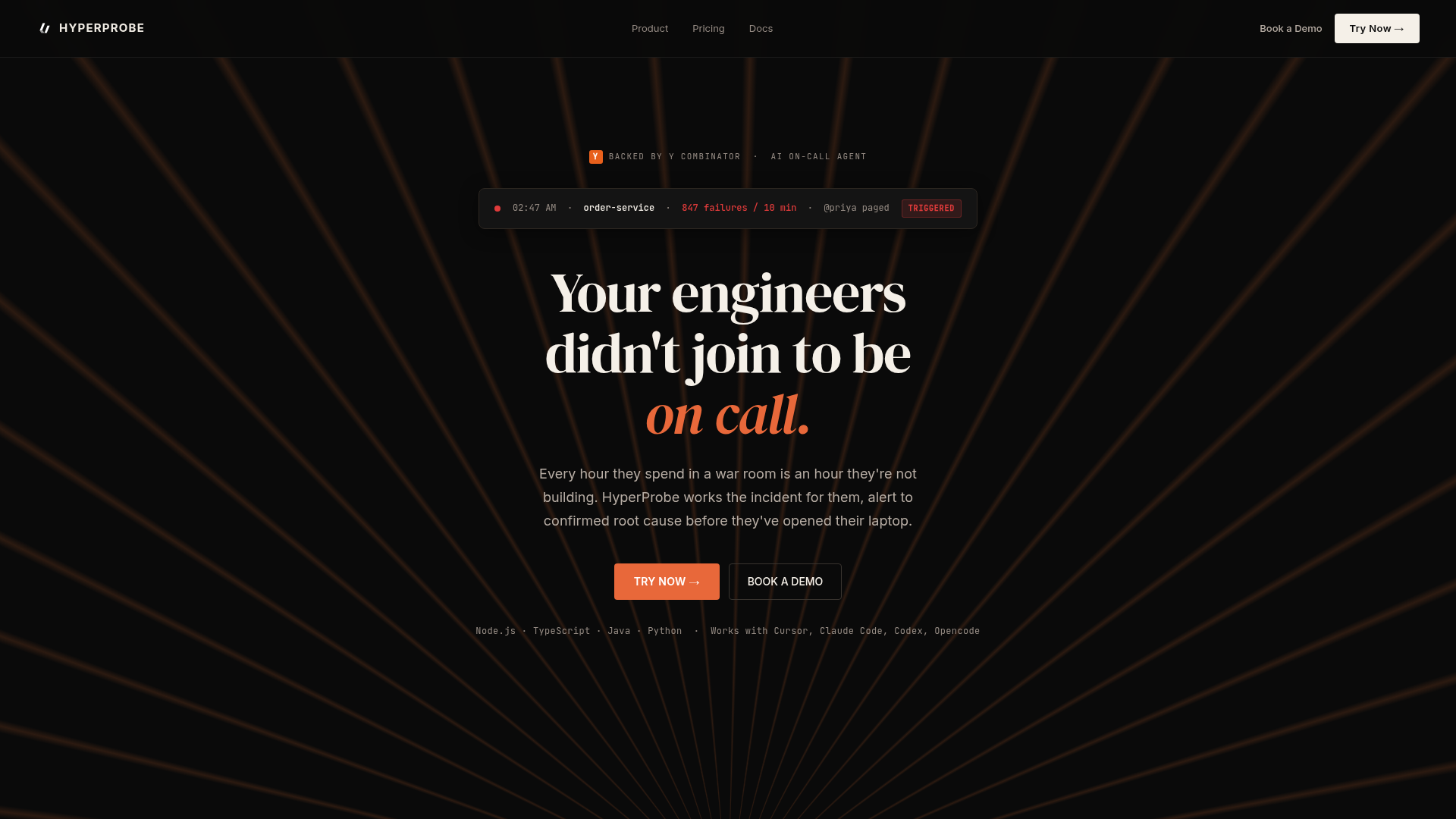
The problem HyperProbe targets is familiar to anyone who has been paged at 2:47 a.m. The alert fires: high error rate on order-status endpoint, 23% of requests failing, 847 failures in the last ten minutes. No exception in the logs. The trace shows a 404 from a downstream payment service, but the payment gateway says the payment exists. Somewhere upstream, a write failed silently.
The public materials walk through exactly this scenario. The stack trace points to line 82, but the variable that caused the failure was set several frames up, in a different file. No log captures it there. The engineer adds a log line, redeploys, waits for the condition to reproduce, and repeats—two or three times, over the course of a night. The fix takes ten minutes. Finding it takes hours.
HyperProbe's answer is to capture the exact variable state at the suspect line, on live traffic, without redeploying. It is a virtual breakpoint that fires asynchronously, captures the values, and disappears. The company claims less than 1% overhead at 3,000 RPS, and zero thread pause. That is the core mechanism, and it is what separates HyperProbe from every tool that merely analyzes existing logs.
A probe, not a patch: how the read-only constraint works
The word "probe" is carefully chosen. A probe is not a patch; it is a diagnostic instrument. HyperProbe's agent places a read-only, non-blocking snapshot of the live variable state at a specific line. It cannot write memory or execute code. Every probe is logged in an immutable audit trail, and on Enterprise plans, approval gates can be required before a probe arms.
This constraint is what makes the product viable in production. Because the probe is read-only, it cannot cause side effects. Because it is non-blocking, it does not slow down requests. Because it is ephemeral, it does not linger. The company's security page emphasizes that PII is redacted at the agent before capture, and that the tool runs inside your infra—self-hosted or private VPC—so nothing leaves your environment.
But the read-only constraint is also a limitation. HyperProbe can tell you what the variable was, but it cannot change it. It can confirm a root cause, but it cannot fix the bug. The company is explicit about this: the agent captures state, it does not write memory or execute code. That is a deliberate trade-off, and it is the right one for a tool that touches production. But it means HyperProbe is an investigation tool, not a remediation tool. The fix still belongs to your engineers.
From alert to root cause in nine minutes: the incident walkthrough
The website includes a detailed, minute-by-minute walkthrough of a real incident. It is worth reading in full, because it shows exactly how the product behaves in practice.
At 02:47, PagerDuty fires: high error rate on order-status endpoint. HyperProbe picks it up. At 02:48, it reads the distributed traces and follows the failure chain. Order service is healthy; payment service downstream is returning 404. Payments exist in the gateway but not in the system. A write failed silently somewhere upstream.
At 02:49, HyperProbe identifies that payments are recorded when the gateway calls a webhook, and places a virtual breakpoint on the webhook handler at line 78. No redeploy. Service keeps running.
At 02:50, the breakpoint fires on live traffic. The snapshot shows the gateway is sending a status of "PENDING," and the code has no case for it. The idempotency check marks the payment as processed before confirming the state, so the payment is never written to the database. No exception fires.
At 02:52, the root cause is confirmed and a fix is suggested. Five minutes from alert.
The contrast with the without-HyperProbe timeline is stark: 2 hours 33 minutes, two to three redeploy cycles, and a fix that was an educated guess. HyperProbe's claim is that it compresses that to nine minutes, with evidence-backed diagnosis. The walkthrough is a strong piece of marketing because it is concrete and plausible, not a vague promise.
The silent failures that never page you
The most interesting part of HyperProbe's positioning is its focus on failures that never trigger an alert. No exception. No error. The trace is green. The business metric just moves.
The company lists six such cases: silent failures where the API returns 200 with the wrong body; exceptions far from the cause; wrong behavior with nothing thrown; race conditions and duplicate processing; third-party contract drift; and business metric drops with no exception anywhere in the stack. These are the incidents that are hardest to debug because there is no obvious signal to follow. HyperProbe's probe can be placed on a specific line and capture the state at the moment of failure, even when nothing is logged.
This is where the product's value is most compelling. A tool that reasons over logs is useless when the logs are silent. A tool that can capture the exact variable state at the moment of failure is exactly what you need. The company's own example—the payment gateway sending PENDING, a status the code never handled—is a perfect illustration of a silent failure that no log would reveal.
Priced per service, not per engineer: a pricing philosophy
HyperProbe's pricing page is refreshingly clear: $0 for one service on managed cloud, $99 per service per month (or $79 annually) for unlimited services, and custom enterprise pricing. Probes and captures are unlimited on every plan. The company's rationale: "You should never hit a wall in the middle of an incident."
This is a deliberate departure from per-seat pricing, which is common in developer tools. HyperProbe bills for how much of your stack is instrumented, not how many engineers use it. That aligns with the product's purpose: it is an on-call agent that works for the team, not a tool that each engineer must license. It also signals confidence—if the tool works, teams will instrument more services, and the cost scales with value.
The pricing page also emphasizes control: every probe has a TTL, a rate limit, and a hit expiry, so nothing runs forever. Enterprise plans add org-level ceilings on these controls, so security teams can set the maximum allowed probe behavior. This is a thoughtful way to address the inherent risk of letting an AI agent touch production.
Naming the category: what 'probe' signals to engineers
The name HyperProbe is a compound of "hyper" and "probe." "Probe" is the key word. In engineering, a probe is a diagnostic instrument—something you insert to measure, not to change. It evokes the read-only, non-blocking snapshot that is the product's core mechanism. "Hyper" suggests speed and intensity, which fits the promise of compressing hours into minutes.
The name is not flashy, but it is precise. It tells an engineer exactly what the tool does: it probes, and it does so at hyperspeed. The domain hyperprobe.co is clean and memorable, and the brand consistently uses the term "probe" throughout the site—"virtual breakpoint," "read-only snapshot," "capture." The naming is a small but important part of the positioning: it frames the product as a diagnostic tool, not a fixer. That is honest, and it builds trust.
The risk is that "probe" is a generic term, and "hyper" is overused in tech. But in context, the name works. It is specific enough to be memorable, and it aligns with the product's safety-first architecture.
Open questions: trust, scope, and the limits of read-only
HyperProbe is a young product—YC S26, launched on Hacker News—and public materials are limited. There are no disclosed funding amounts, customer counts, or revenue figures. The testimonials on the site are from named individuals at CheQ Digital and Housing.com, but there is no independent verification.
The biggest open question is trust. Will security teams approve an AI agent that places breakpoints in production, even if they are read-only? The company has anticipated this with approval gates, immutable audit logs, and PII redaction, but the cultural hurdle remains. Engineers are trained to be cautious about anything that touches prod, and an AI agent that can place probes is a new kind of risk.
The second question is scope. HyperProbe currently supports Node.js, TypeScript, Java, and Python, and works with coding agents like Cursor, Claude Code, Codex, and opencode. It is shipping memory leak diagnosis, OOM root cause, CPU spike isolation, and latency spike tracing this month. But the read-only constraint means it cannot fix anything, only diagnose. That is a deliberate choice, but it limits the value proposition to investigation. Teams that want automated remediation will need to look elsewhere.
Finally, there is the question of whether the probe mechanism will work at scale. The site claims less than 1% overhead at 3,000 RPS, but that is a single data point. Real-world performance at high traffic, with many concurrent probes, remains to be seen.
Despite these open questions, HyperProbe's core idea is compelling. The evidence gap is real, and the read-only probe is a clever, safe way to fill it. If the product works as described, it could become a standard tool for incident response—not by replacing engineers, but by giving them the evidence they need to fix things fast. The name, the pricing, and the architecture all point in the same direction: a tool that is safe enough to trust, and sharp enough to find the bug.