IconBuddy
A search engine for 200K+ open-source icons, with plugins and AI agent tooling.
NewName Editorial
Editorial Team
The icon library is a solved problem until you actually try to use it. You know the icon you want—a settings gear, a trash can, a user avatar—but finding it across the hundreds of open-source sets scattered across the web is a scavenger hunt. IconBuddy's answer is not another icon set. It's a search engine that indexes more than 200,000 open-source SVG icons from dozens of popular libraries, then layers on editing, download, and workflow integrations. The company's pitch is simple: "Search Fast. Edit Freely. Download Instantly." But the real story is in how it aggregates, how it searches, and how it's now positioning itself for the AI agent era.
The Icon Problem: 200K SVGs and No Way to Find Them
Open-source icon sets are abundant and fragmented. Material Design Icons, Font Awesome, Tabler, Phosphor, Lucide, HeroIcons—each has its own website, its own search, its own licensing quirks. A designer might use Tabler for one project, Lucide for another, and still need a specific icon from Solar for a third. The result is a browser full of tabs, a downloads folder full of SVGs, and a lot of wasted time.
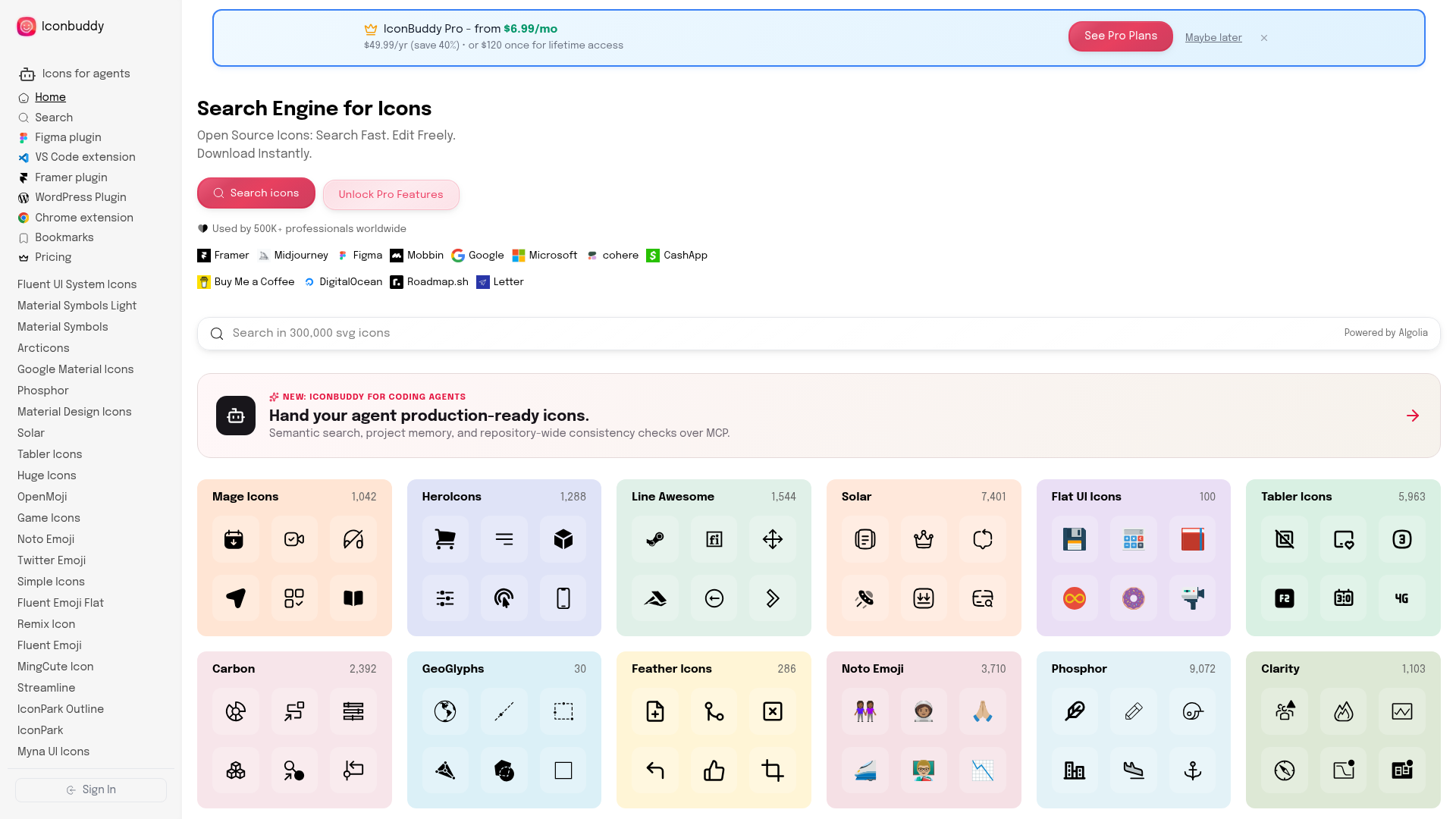
IconBuddy's answer is aggregation. The site lists over 150 icon sets, from the ubiquitous (Material Symbols, Font Awesome) to the niche (Siemens Industrial Experience Icons, WebHostingHub Glyphs). Each set gets its own page with a preview, count, and direct download links. This is not a new idea—icon aggregators have existed for years—but IconBuddy's scale is notable. The homepage claims 200K+ open-source SVG icons, and the sheer number of sets suggests a serious curation effort.
The aggregation model has a clear benefit: it turns a fragmented ecosystem into a single point of entry. Instead of learning the search quirks of each set, you learn one. Instead of bookmarking ten different sites, you bookmark one. For a designer or developer, that's a real time-saver.
How IconBuddy Built a Better Icon Search Engine
The search is the core of the product. The homepage features a prominent search bar, powered by Algolia, a hosted search service known for speed and typo tolerance. This is a smart choice: Algolia handles the fuzzy matching, the instant results, and the filtering, so IconBuddy can focus on the catalog.
The search results are grouped by icon set, showing which sets have a match, and you can filter by style (line, solid, color) and license. The interface is clean and fast, which matters when you're hunting for a specific icon in a library of 200K+. The site also offers a dedicated search page, and the overall experience feels more like a tool than a directory.
What's less clear is how the search handles semantic queries. The site's tagline is "Search Engine for Icons," but the evidence suggests it's primarily keyword-based. You search for "trash," and you get trash icons. You don't get "delete" or "remove" unless the set's metadata includes those terms. This is a limitation, but it's also an opportunity: the company's new agent tooling hints at a move toward semantic search.
From Search to Workflow: Plugins, Extensions, and the Design Pipeline
Finding an icon is only half the battle. The other half is getting it into your project. IconBuddy addresses this with a suite of integrations: a Figma plugin, a VS Code extension, a Framer plugin, a WordPress plugin, and a Chrome extension. The Figma plugin is particularly important because Figma is the de facto tool for UI design. With the plugin, you can search and insert icons directly into your design files without leaving the canvas. The VS Code extension serves developers who need icons in their code, and the Framer plugin targets the no-code website builder crowd.
The Chrome extension is a clever addition: it lets you search IconBuddy from any tab, so you can grab an icon without breaking your flow. This integration-first approach is what separates IconBuddy from a simple icon directory. It's not just a website; it's a tool that lives where the work happens.
The site also offers icon editing and customization features, though the details are sparse in the provided materials. The tagline "Edit Freely" suggests you can change colors, sizes, and formats before downloading, which is a common need. The Pro plan likely unlocks more advanced editing options, but the exact feature set is not disclosed.
The New Frontier: Icons for AI Agents
The most intriguing signal is the "Icons for agents" page. The site promotes "IconBuddy for coding agents" with a promise to "hand your agent production-ready icons." The pitch mentions semantic search, project memory, and repository-wide consistency checks over MCP (Model Context Protocol). This is a significant pivot: instead of just serving humans, IconBuddy wants to serve AI agents that generate code.
The idea is that when an AI coding agent needs an icon, it can query IconBuddy's API or MCP server to get the right SVG, rather than hallucinating a placeholder or using a generic icon. The "project memory" and "consistency checks" suggest the tool can learn a project's icon style and enforce it across the codebase. This is a smart move because AI agents are becoming a primary interface for software development, and they need reliable, consistent assets.
This is also a natural extension of IconBuddy's aggregation model. If you have 200K+ icons with metadata, you can train a semantic search model or expose an API that agents can use. The company is positioning itself as the icon source for the AI era, which is a bold and forward-looking bet.
What IconBuddy's Pricing Says About Its Ambition
The pricing page reveals a freemium model with a Pro tier at $6.99/month, $49.99/year (a 40% savings), or a $120 one-time lifetime access. The lifetime option is notable—it suggests the company is willing to trade recurring revenue for upfront cash, which can be a smart move for a tool with a passionate user base.
The Pro plan likely includes advanced features like unlimited downloads, vector editing, and API access, but the specifics are not detailed in the provided materials. The pricing is competitive with other icon services, and the lifetime option is a strong incentive for early adopters.
What's interesting is that the pricing page is a standard SaaS model, not a per-icon or per-set model. This suggests IconBuddy sees itself as a subscription tool, not a marketplace. The ambition is to be the default icon source for professionals, and the pricing is designed to make that an easy decision.
IconBuddy's bet is that aggregation and search are the winning strategy in a world of abundant icon sets. By building a fast, integrated, and now AI-ready platform, it's aiming to be the layer that sits between the fragmented open-source ecosystem and the people—and agents—who need icons. Whether that bet pays off depends on execution, but the direction is clear.